Red Flags at Martyr Leader’s Funeral Signal Resistance and Unavenged Blood
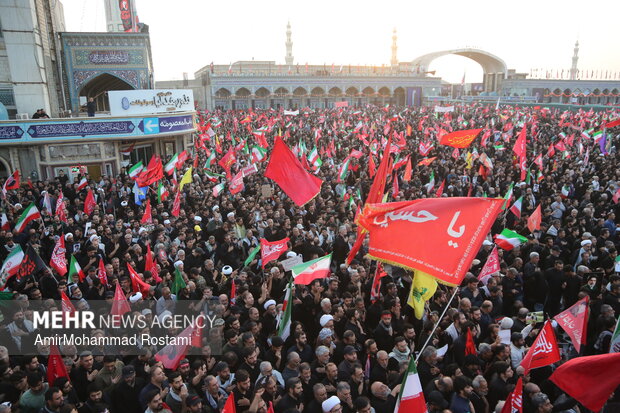
According to the International Desk of Webangah News Agency, Al Jazeera network’s website reported that the funeral procession for Iran‘s Martyr Leader, characterized by extensive public participation, is considered a well-calculated political and religious precursor. Friday was designated for official condolences and the reception of foreign delegations, Saturday for public farewell at the Imam Khomeini Grand Prayer Hall, and Sunday for the funeral prayer led by Ayatollah Jafar Sobhani.
Thus, the Martyr Leader’s funeral procession navigated through three crucial dimensions: the government and foreign relations, the public, and religious ceremonies.
The presence of official delegations was a prominent feature on the first day of the funeral. Foreign political and diplomatic delegations arrived in Tehran from Friday morning to pay their respects to the Martyr Leader’s body. This was not merely a ceremonial act; the commencement of the proceedings with foreign delegations imbued the funeral with political significance extending beyond Iran’s internal affairs, demonstrating the ruling establishment’s continued organizational and managerial capacity for large-scale official events even after the Martyr Leader’s passing.
Saturday’s ceremony, dubbed ‘The Public’s Last Farewell to the Martyr Leader’ by Iranian media, began at the Imam Khomeini Grand Prayer Hall in Tehran. It continued for two days with a massive turnout of citizens from across the country. During this event, symbols, banners, photographs, and slogans became increasingly prominent.
Within Iranian political culture, the Grand Prayer Hall is not solely a venue for mourning but also a space for religious and political activities, where Friday prayers, significant events, and official speeches converge. On the day of the public farewell, images held as much importance as texts and speeches. The caskets were placed in a central location, red flags were displayed, and slogans spoke of revenge.
The hoisting of red flags during the Martyr Leader’s funeral was noteworthy. These flags hold significance in the political and religious culture of Iranians that transcends mere mourning, often associated with the concept of blood that remains unavenged and the narrative of martyrdom and resistance against injustice. The funeral procession was not merely a silent farewell but appeared as a space for the reproduction of the discourse of resistance. Flags, slogans, and images of the caskets were interwoven to reproduce the narrative that the Martyr Leader’s martyrdom is not the end of an era but heralds its continuation.