
Iran’s Parliament Speaker Vows to Stand Firm for National Security and Interests
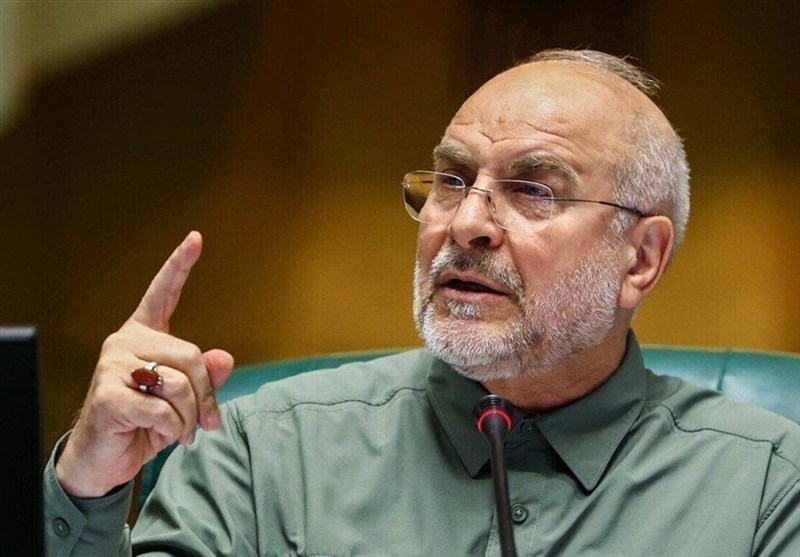
According to the International Desk of Webangah News Agency, Mohammad Bagher Ghalibaf, Speaker of the Islamic Consultative Assembly of Iran, has issued a clarifying statement addressed to the esteemed people of Iran.
The statement begins by offering condolences for the loss of several Iranian citizens in southern Iran, attributing their deaths to the “terrorist army of the United States.” Ghalibaf acknowledged that the escalating conflict has prompted questions among the populace regarding Iran’s strategic direction, its stance on war and negotiation, and the efficacy of dialogue with what he described as an “untrustworthy” America.
He emphasized that a national interest and security-oriented perspective, free from partisan considerations, is crucial for formulating clear and accurate responses. Ghalibaf asserted that Iran is engaged in an “existential war” with the United States, whose objective is to overthrow the Islamic Republic and fragment Iran. This, he stated, is a strategy that has not changed.
Ghalibaf reiterated that the U.S. consistently seeks to harm Iran and advance its own interests, irrespective of whether it involves war, negotiation, or the current U.S. president. Therefore, he stressed that Iran’s approach to both war and negotiation must be realistic, long-term, and grounded in national interests and security, leaving no alternative but to rely on self-strength.
He credited the “unified resistance” of the Iranian nation and its armed forces with thwarting the enemy’s 40-day war plan, compelling them to seek a ceasefire and negotiations. However, he cautioned that this does not alter their fundamental strategy, as America, with its inherent “hegemonic character,” will never accept a strong Iran.
Addressing the questions of war and negotiation, Ghalibaf declared that while Iran does not initiate conflict, it must always be prepared for battle and ready to defend its security and national interests “to the death.” Concurrently, he highlighted the importance of utilizing diplomacy and negotiation to achieve and consolidate national interests.
Ghalibaf underscored that any agreement holds meaning only if its terms are valid and implemented. If the Islamic Republic derives no benefit from such an accord, he stated, Iran has no obligation to adhere to it, citing a policy of “an eye for an eye.” He noted that Iran’s armed forces retain full operational freedom to counter enemy aggression.
As an example, he pointed to Iran’s action of closing the Strait of Hormuz during a 40-day conflict, contrasting it with a 12-day war, due to security threats. Today, he asserted, Iran’s national security relies on maintaining “Iranian arrangements” within the Strait of Hormuz and ensuring the maximally safe and unimpeded passage of commercial vessels.
He detailed the process: Iranian forces exerted control over the Strait at the outset of the “imposed war” in March. During negotiations, Iranian arrangements for the Strait were codified in the fifth clause of the agreement, serving as leverage for securing other demands. He criticized the U.S. for attempting to weaken these arrangements through force, despite its “legally and diplomatically empty hand,” asserting that Iran must stand firm on its negotiated gains to realize national rights. He concluded that the enemy’s pressure is an attempt to compensate for its defeat, but Iran, relying on its own power, will not permit the imposition of the enemy’s will.
Ghalibaf stressed the necessity of coordinating military and diplomatic approaches, stating that neither war nor negotiation should be feared, as both are tools for safeguarding national interests. He reiterated that negotiation, at this juncture, is not equivalent to capitulation but, alongside war, is part of the strategy of resistance and the protection of national interests. This comprehensive utilization of diplomatic and defensive tools is not merely a duty but an unavoidable necessity for preserving Iran. Separating these approaches as exclusive solutions would be a strategic error. He characterized the ongoing complex war with the world’s greatest material power as one where Iran has achieved significant triumphs, demanding a correspondingly grand, complex, and resilient approach in thought and action.
This principle, he suggested, can be extended to issues concerning Lebanon, the lifting of sanctions, the future of U.S. bases in the region, and retribution for the martyrs of the recent conflicts.
Ghalibaf concluded that the path to victory and the realization of the nation’s rights in this critical period lies in following the Supreme Leader’s guidance and adhering to a precise roadmap based on resistance, rationality, and the intelligent use of all defense and diplomatic capacities to impose Iran’s will on the enemy and mitigate the economic repercussions of war on the populace.
The line between engaging in war or negotiation with the enemy, he stated, is determined by national security and interests. The decision on employing these tools, according to the time and circumstances, rests with the Supreme Leader and Commander-in-Chief, and all must strive in accordance with the directives of the Deputy of the Guardian of the Time (Imam Mahdi). He urged all Iranians, regardless of their views, to maintain unity in obedience to the Supreme Leader’s commands, remain present on the scene, and demonstrate this unity to the enemies. He acknowledged the difficult path ahead but cautioned against fearing enemy threats, citing past experiences where such threats proved ineffective. He also advised against heeding news designed to sow regret, despair, or distrust towards the nation’s servants, as the enemy exploits discouragement, fear, division, and mutual distrust. He expressed confidence that the public’s support and trust in the defenders, diplomats, and service providers would strengthen their hand against the enemy, assuring that their sacrifices are for the security of the people and Iran’s national interests, and that with the Supreme Leader’s plans, the results of this trust will be evident.
He affirmed that Iran’s strong position in the Strait of Hormuz stems from the power created by the people, and that the blood of martyrs will be avenged, with no negligence in pursuing their demands. Ghalibaf described his own career, from defending on the front lines and countering media warfare during the third imposed war to engaging in diplomacy despite challenges, as a commitment to elevating Iran under the Supreme Leader’s guidance. He stated his life has been dedicated to combating the enemy, and he has no fear of war, accusations, threats, or defamation, aspiring to join his martyred leader and comrades.
Addressing the people of southern Iran, who he described as being on the front lines, Ghalibaf recalled his youth fighting alongside them and expressed his lasting gratitude for their hospitality and love for their homeland. He pledged unwavering commitment, stating their lives are pledged to defending the country, and expressed certainty that Iran’s victory is near and their historical resistance will be enduring.
He concluded by urging the people of Iran to have faith that their suppressed emotions and the nation’s unparalleled unity on the ground will guarantee victory. He asserted that Iran not only fears no threats or wars but, under the Supreme Leader’s guidance, will deliver a decisive response to the enemy’s crimes, quoting the Quran: “And another [victory] which you love – support from Allah and an imminent conquest; and give good tidings to the believers.”


