UN Envoy Urges UK to Implement ‘Radical Shift’ in Policy Towards Israel
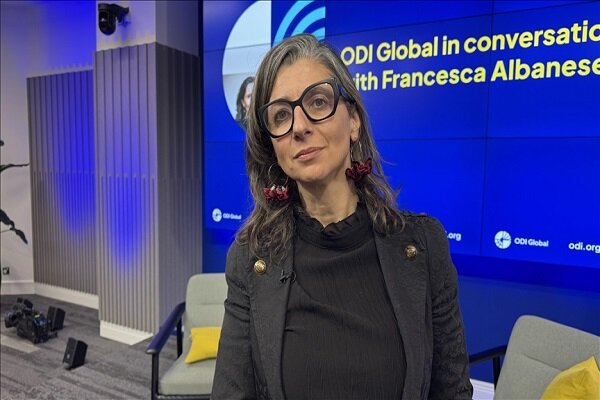
According to the International Desk of Webangah News Agency, Francesca Albanese, the UN Special Rapporteur on the situation of human rights in the Palestinian territories occupied since 1967, has urged the British government to implement a ‘radical and genuine transformation’ in its policy towards the Israeli regime. Speaking to The Guardian, Albanese described a proposed ban on trade with Israeli settlements as a significant step but emphasized that it would be insufficient if solely limited to preventing settlement goods from entering the UK market.
Albanese stated that the ban planned by the UK government, as articulated by Foreign Secretary Ed Miliband, ‘represents a change in the UK government’s position and is a very important step,’ but cautioned that its effectiveness should be evaluated based on its practical impact rather than its publicity value.
The British government is expected to reveal details of its new package of measures concerning Israel next Tuesday, which Miliband has termed a ‘comprehensive reset’ of Britain’s policy towards Tel Aviv. This move comes amid mounting pressure on the UK government to adopt more stringent measures against Israeli settlement expansion and in light of the ongoing restrictions on aid entering the Gaza Strip.
Albanese warned that a prohibition on certain imports from settlements, particularly agricultural products and cosmetics, would not be enough. She noted that these products constitute only a ‘tiny fraction’ of British support for the occupation system, and Tel Aviv could easily mitigate the impact of such sanctions.
She called for an expansion of measures to include services, alongside a gradual halt to British intelligence cooperation, the cessation of all arms export licenses, and a review of flights operating from the Royal Air Force base in Akrotiri, Cyprus.
The UN rapporteur cautioned that failure to adopt these measures, or their complete removal, would render the declared shift in UK policy merely a ‘press release’ over time. She pointed out that banning goods like dates from the settlement of Ma’ale Adumim in the West Bank, while continuing to issue permits for equipment used in constructing barriers and checkpoints around settlements, does not signify a change in the UK government’s relationship with the occupiers but rather a ‘reconfiguration of its communication strategy.’
Albanese specifically focused on the ‘E1’ settlement project in East Jerusalem, warning of its consequences for the possibility of forming a geographically contiguous Palestinian state.
She added that the British government must end any ambiguity surrounding tenders for this project, which, according to Palestinian and international warnings, separates East Jerusalem from large parts of the West Bank and fragments Palestinian territories.
The UN official described the E1 project as going beyond settlement expansion and being part of the process of annexing Palestinian land to the occupied territories. She urged the UK to threaten companies involved in the execution of this project with sanctions or similar actions.