
Israel Destroys 80% of Lebanon’s Bint Jbeil, Rendering it Uninhabitable
According to the International Desk of Webangah News Agency,
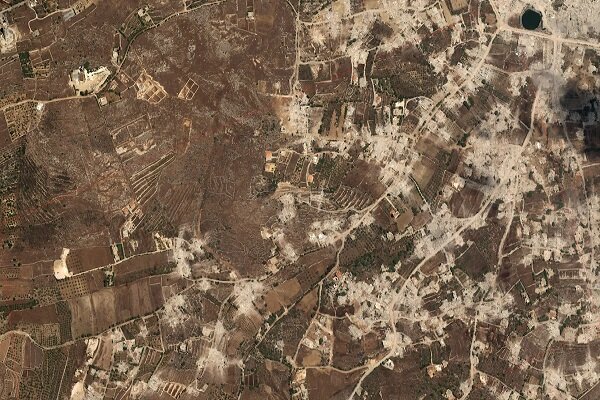
the Lebanese newspaper Al-Akhbar has reported that eight out of every ten homes in Bint Jbeil have been destroyed by Israeli occupation forces, with more than 80% of the city completely leveled. Over 2,000 buildings have been reduced to rubble, equating to at least 5,000 residential units.
The municipality of Bint Jbeil has documented the destruction of 11 educational centers, hospitals, and relief facilities. Water and electricity networks have also been demolished, hundreds of shops leveled, and agricultural lands and ancient trees uprooted. Consequently, the Israeli regime has transformed Bint Jbeil into a territory unfit for habitation.
This report, compiled by the Bint Jbeil municipality and substantiated by maps, aerial imagery, field surveys, municipal records, and testimonies from residents and affected business owners, details the damages from Israeli aggressions between 2023 and 2026. It alleges that the Israeli enemy has committed three acts of genocide in Bint Jbeil, encompassing the demolition of homes, erasure of historical memory, and the burning of agricultural lands.
The report indicates that the residents of Bint Jbeil have lost all their assets, with the number of displaced families now exceeding 1,500. Prior to the conflict, 81% of families owned their homes; this figure has plummeted to just 3%, while the percentage of families living as tenants has risen to 74.6%.
During what the report describes as the brutal crimes of the Israeli regime, two municipal power stations in the areas of “Saf-al-Hawa” and “Al-Baraka,” equipped with 13 generators, were destroyed. Internal electricity and water networks suffered complete damage. At the “Saf-al-Hawa” water station, a reservoir with a capacity of 900 cubic meters was completely obliterated, and another with a capacity of 2,000 cubic meters was damaged. The solar energy system powering the station, which supplies eight towns, was also almost entirely destroyed.
The Bint Jbeil municipality emphasizes that in the residential sector, the extent of the widespread damage is beyond description, with approximately 5,000 residential units destroyed. In the city center alone, over 500 buildings in the “Ain al-Saghirah,” “Hayy al-Jami,” and “Hayy al-Baraka” areas, along with the old square and “Harat al-Jama’ana,” were detonated. The city’s Grand Mosque, dating back over 400 years, was not spared from these explosions.
In the west, the neighborhoods of “Al-Awini,” “Al-Qalaa,” and the areas of “Tel Mas’oud,” “Shaliboun,” and “Saf-al-Hawa” were devastated. To the east, the neighborhoods of “Ain al-Kabirah” and “Al-Maslakh” were almost entirely annihilated. In the south, vast areas of “Al-Wadi,” “Al-Dura,” “Aqabet Salha,” and “Aqabet Maroun” were destroyed, along with the surrounding agricultural lands.
Despite the evacuation of the city’s hospitals, they too were not spared destruction. The report documents the targeting of “Salah Ghandour” Hospital, the demolition of sections of Bint Jbeil Public Hospital, as well as the destruction and detonation of relief centers, the targeting of ambulances and relief personnel, a pharmacy warehouse, and the destruction of most of the city’s pharmacies.
The municipality also recorded the complete destruction of over 500 commercial shops and the partial destruction of 200 others. A large part of the market, the “Ojeiro” building, the development services center, and the destruction of sports facilities, from the municipal stadium to basketball courts, futsal courts, and the swimming pool, were also documented.
The Israeli regime’s direct damages to the agricultural sector are estimated at over 70%, stemming from the destruction of lands and orchards, the uprooting of ancient trees, and damage to more than 70% of roadside trees.


