Iranian President Delivers Powerful Address at UN General Assembly
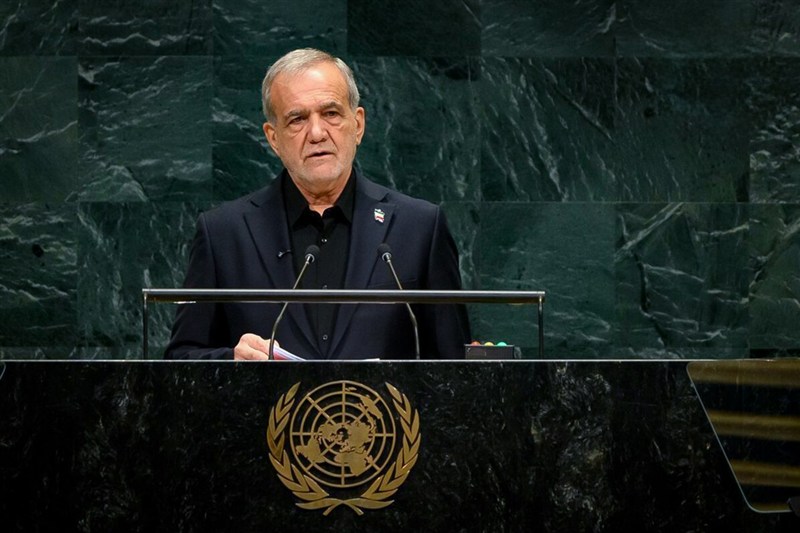
According to the International Desk of Webangah News Agency, Iranian President Masoud Pezeshkian delivered a significant address at the 81st United Nations General Assembly, opting for a message of national resilience and a challenge to prevailing international narratives. The speech was not merely a reiteration of official Iranian positions but was designed to confront the narrative constructed by the United States concerning Iran in recent times.
Pezeshkian’s address centered on critical points, including a direct statement on nuclear capabilities: “The atomic bomb is in Israel, and inspectors are in Iran.” He also prominently displayed images of a martyred leader and children from Minab, underscoring the human cost of conflict.
The Iranian President’s remarks followed a critical statement by the US President at the UN, which Pezeshkian countered not with a dry diplomatic statement, but by directly addressing the core of the dispute. He asserted, “We are not terrorists; we are victims of terrorism.”
A pivotal moment of the speech occurred early on when President Pezeshkian chose to respond to the US President’s accusations before delivering his prepared text. Instead of solely speaking about Iran’s martyrs, he presented their images at the UN podium. The photographs of the martyred leader and children who fell victim to American-Zionist attacks in Minab, Lamerd, and other parts of the country served as more than just documents or statistics; they were a powerful visual testament.
The President spoke of schools, sports halls, hospitals, universities, bridges, and infrastructure, highlighting the plight of innocent children who were killed without fault. The discussion transcended the immediate differences between Iran and the US or Iran and Israel. The “representative of the Iranian nation” sought to frame the issue as a simpler, more humane question: What is the responsibility of the international community when civilians and children are victims of attacks?
A key strength of the address was that the President did not equate victimhood with weakness. This was perhaps the most crucial political message of his speech. Pezeshkian discussed the attacks on Iran and the suffering of its people, but immediately followed by emphasizing Iran’s steadfastness. He noted that the US and Israel attacked with advanced military equipment and technology, yet Iran “did not bow.” Simultaneously, he stressed that Iran’s retaliatory actions did not target civilians and were defined within the framework of national defense.
This point marked a transition from mere defense to a clear message about deterrence. Iran, he conveyed, does not seek power for aggression but to ensure its security and existence are not threatened. Pezeshkian was explicit in this regard: “We do not seek permission from anyone to defend our country.” This message was accompanied by an equally significant one: Iran does not view war as the solution to all problems.
He presented neither an image of a submissive Iran nor one that shuns dialogue. His message was that it is possible to be powerful and engage in negotiations simultaneously; it is possible to be prepared for peace while rejecting the language of force.
Another segment of the speech directly addressed the United Nations. Pezeshkian questioned the audience about the implications of international law being applied only when it aligns with the interests of powerful nations. He asked how trust in the international order could be rebuilt if one country is immune from accountability due to its military might, while another faces sanctions for the same dispute.
This was perhaps one of the most serious parts of the speech, as the Iranian President not only defended his country but also challenged the very criteria of the international order. He argued that if justice exists, it must be for all; if international law exists, it should not be subject to power; and if the UN is to be a home for nations, the voices of weaker nations should not be lost amidst the clamor of powerful ones.
Finally, Pezeshkian concluded his speech with a message that could be considered a summary of his entire address: Iran extends a hand of cooperation to the world, but not from a position of weakness. He stated that Iran is ready for dialogue but will not accept the language of force.
The value of this speech likely lies in its delicate balance between two images: a grieving Iran and a resilient Iran; a victimized Iran and a defending Iran; an Iran ready for dialogue and an Iran that is unconquerable. President Pezeshkian sought to present an image of Iran at the UN that fits neither the propaganda of major powers nor an attitude of passivity. He showed the world images of martyred children, spoke of the martyred leader, and highlighted attacks on the country’s infrastructure, while simultaneously making it clear that Iran does not fear war and seeks no one’s permission for its defense.
In a world where the voices of the powerful often drown out those of victims, a crucial function of such a platform is to lift victims from being mere statistics, to transform them into human beings, and then to ask a world that claims justice: “Who should see this human being?”