Persian Literary Devices Enhance Iranian President’s UN Address
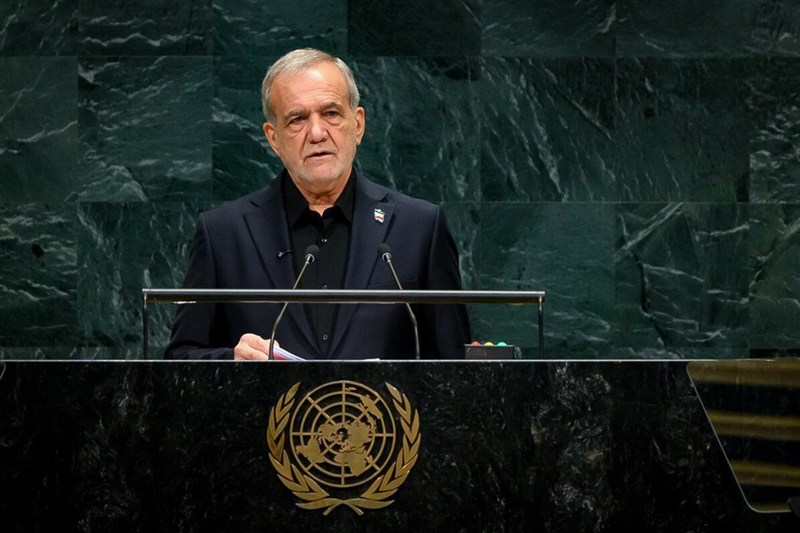
According to the International Desk of Webangah News Agency, a scholarly analysis of the Iranian President’s address at the United Nations highlights a significant cultural and literary dimension, demonstrating how historical memory and familiar elements of Iranian culture are being recontextualized for a global audience. The speech, delivered by President Donald Trump, is not solely a diplomatic maneuver but a carefully constructed text where word choice, sentence structure, repetition, and pronoun usage carry profound meaning.
Beyond its political implications, the address can be examined through the lens of literary analysis and discourse, not to reduce politics to literature, but to understand how a particular image of Iran is forged through language. In this discourse, Iran is presented not merely as a state or political actor, but as a historical, cultural, and ethical identity that defines itself against threats, humiliation, and force, while simultaneously seeking common ground with the global audience through shared human values.
A prominent feature of this political rhetoric is the use of antithesis, a long-standing tradition in Persian rhetoric. Phrases such as “Those who are terrorists and train terrorists tell us you are terrorists” create a dualistic structure, positioning “us” against “them.” This stylistic device, mirroring poetic techniques of juxtaposing opposing concepts, allows for rapid comprehension and sharpens the distinction between the speaker’s position and that of the “other.” Concepts like resistance versus aggression, justice versus tyranny, and dignity versus humiliation are strategically employed to construct a clear image of self and other.
Repetition, another ancient tool of persuasion, is evident in phrases like “We will never bow down. We will never kneel.” The emphatic repetition of “never” elevates the message from a simple political statement about steadfastness to a memorable declaration of resilience. This echoes traditional Persian oratory and poetry, where rhythm and repetition are as crucial to message retention as logical argument, transforming a word into a symbol of endurance and a part of the audience’s memory.
The speech also draws upon diverse religious and ethical traditions, referencing figures like Jesus Christ and Prophet Muhammad, as well as other moral traditions. These allusions are not mere historical mentions but attempts to find common ground across different cultures and religions, a practice familiar in classical Persian literature where poets like Rumi and Hafez incorporated various religious and cultural narratives to explore universal themes. In the political sphere, these references aim to build a shared language and foster connection.
The narrative of Iran presented is not confined to its status as a nation but aligns it with universal ethical and human values that resonate globally. This approach is vital for political communication, as messages linked to broader principles like justice, dignity, peace, and self-defense are more likely to attract a wider audience than those solely framed by national interests.
The pronoun “we” is particularly noteworthy for its flexible reference. It can signify the Iranian nation, the Muslim community, or more broadly, any people resisting oppression. This fluidity in reference is crucial for discourse analysis, as identity is constructed and redefined throughout the speech. “We” can shift from a national to a transnational or human identity, reflecting a tradition in Persian literature where the boundaries between individual, collective, and human identity are often fluid. Iranian identity, in this context, is built not just on history or geography but on a constellation of values, memories, sufferings, and resistances.
The narrative shifts from victimhood to agency by addressing attacks on civilians and civilian infrastructure, positioning Iran as a victim. However, this victimhood is immediately linked to defense and resistance, transforming the narrative from one of passivity to active engagement. This transformation is key to identity construction: suffering, when coupled with resilience, becomes integral to a resistant identity, conveying the message “We stand despite harm.”
Collectively, these elements—antithesis, repetition, citation, shifting pronoun references, and the movement from suffering to resistance—are powerful tools in crafting an identity narrative. These devices, deeply rooted in the traditions of Persian rhetoric, poetry, and prose, have been adapted from their historical roles in conveying emotion, thought, and identity to the modern political and diplomatic arena. The setting has changed from a pulpit to the UN General Assembly, and poetry now manifests as political prose and diplomatic discourse, demonstrating the enduring power of Persian literary elements in contemporary political discourse.
Persian literature, far from being static, has evolved its form of presence. It emerges from the pages of books to stand on political platforms, its language shifting from poets to politicians. Even a simple word like “we” can be elevated to a profound concept, highlighting that in today’s world, identity is constructed as much through language as through history and geography. The New York address is thus a case study in presenting “Iran” as a historical, cultural, and ethical identity to a global audience, showcasing the enduring power of language to shape perception, foster empathy, and embed a narrative in collective memory.