
US Election Interference in Brazil Sparks National Sovereignty Debate
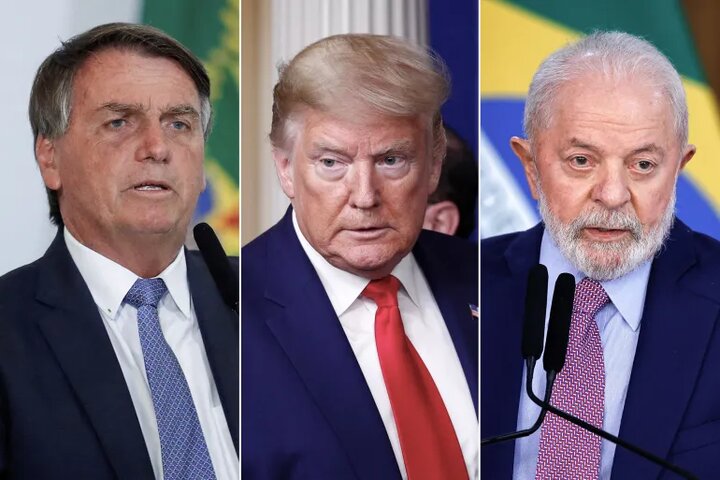
According to the International Desk of Webangah News Agency, the presidential elections in Brazil, held on Sunday, are more than just a democratic exercise to decide the country’s economic, security, and public service future. The United States has historically, and particularly during the presidency of Donald Trump, demonstrated a growing tendency to interfere in Brazil’s electoral landscape.
Current Brazilian President Lula da Silva has voiced concerns over any external influence, specifically highlighting the ideological and political connections between the campaign of his rival, Flavio Bolsonaro, and the Donald Trump movement. This has elevated the issue of national sovereignty and Brazil’s relationship with Washington to the forefront of the electoral contest. The dynamic between Brazil and the United States has been characterized by Washington’s persistent interventions and Brazil’s pursuit of political independence in an increasingly multipolar world.
History of US Election Interference in Brazil
Renato Cesar Ferreira, a political science researcher at the University of Campinas, told Al Jazeera Net that while Washington has been Brazil’s primary political and economic partner and has a long history of “open interference” in its elections, this relationship has undergone significant changes in recent years.
Ferreira posits that Brazilian politics is divided between two distinct perspectives on the country’s role in the international system:
First, the far-right current, represented by Flavio Bolsonaro, views Brazil as fundamentally Western and believes that strategic relations with the United States should be maintained, even at a political or economic cost.
Second, the current administration of Lula is based on the principle that Brazil should diversify its international partnerships and engage with Washington as an equal partner, respecting national sovereignty. This approach seeks a more balanced and independent relationship rather than a complete severance of ties.
Renato Jose da Costa, a professor of international relations at the Federal University of Pampa, stated that US intervention in Brazilian elections is not a new phenomenon, noting that even the 1964 military coup in Brazil occurred with US participation, approval, and coordination.
However, Costa believes that what has changed is how this role is promoted and marketed to certain segments of the population, particularly “far-right groups within the country.” He explained that the presence of the US or Donald Trump is presented as a savior, a defender of Western values, and an opponent of communism. This narrative is deployed despite communism not being a significant force in Brazil for decades, nor has a regime with such characteristics ever been implemented there.
Despite concerns voiced by some regarding their country’s dependence on Washington, Costa contends that the primary driver for voters remains personal support for figures like Bolsonaro or Lula, and the personalization of electoral choices, rather than a critical and realistic assessment of foreign policy.
The relationship between Bolsonaro and Trump has transcended bilateral politics, evolving into a global phenomenon that redefines the “far-right” and connects its prominent figures across continents.
Far-Right or Neo-Fascism in Brazil
Ferreira emphasized that the “far-right” is a global phenomenon. Some political scientists describe this new movement as a form of “neo-fascism,” embodied by leaders such as Trump, Bolsonaro, Javier Milei (President of Argentina), and other political actors worldwide.
Ferreira added, “In this sense, while these movements have distinct national characteristics, they share common theoretical foundations, strategies, agendas, and forums. Therefore, understanding the rise of the Bolsonarist current in Brazil is impossible without considering this international dimension.”
He further stated that former President Jair Bolsonaro defended American interests and values, even at the expense of Brazil’s own. This admiration for Trump’s persona and policies by Jair was cultivated and promoted among the bases of the right-wing and far-right movements in Brazil, serving as a campaign slogan.
A deeper struggle over Brazil’s place in a changing world is evident between those who view Washington as a strategic ally and those who perceive it as a symbol of hegemony. As tensions rise between the principle of national sovereignty and the appeal of the American model, the ballot boxes in Brazil appear to reflect not only domestic choices but also an international contest for influence and the nation’s future outlook.


