French Student Protests Escalate Amidst Economic Woes and Pre-2027 Election Climate
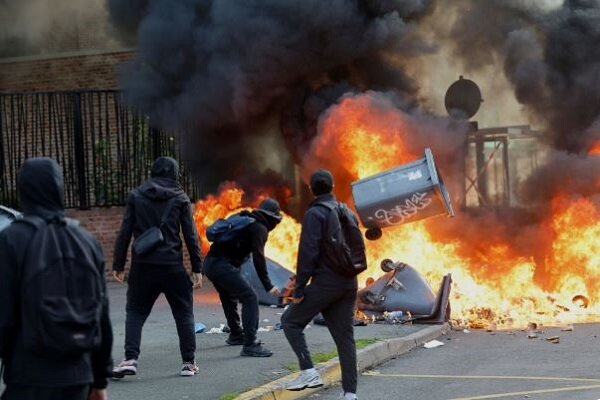
According to the International Desk of Webangah News Agency, student protests that began approximately ten days ago in the suburbs of Paris, focusing on improving educational conditions, teacher shortages, and overcrowded classrooms, have rapidly transformed into a nationwide wave. This movement has now gained new dimensions with the closure of hundreds of schools, the involvement of university students and teachers, and violent confrontations with police.
Several critical questions arise from this escalating situation: What factors propelled an educational protest to such rapid and widespread growth? Are the roots of these protests solely tied to the state of schools and budgetary constraints, or do broader economic and social pressures play a role? Crucially, what impact will the continuation of these protests have on the French government as it approaches the 2027 elections?
[//media.mehrnews.com/d/2026/10/03/0/6202522.png?ts=1791056679775]The student protests in France cannot be solely attributed to issues within schools. These demands are unfolding against a backdrop of economic pressure, declining purchasing power, budgetary limitations, and anxieties about the future, transforming schools into focal points for the accumulated dissatisfaction of the younger generation. The wave that began less than two weeks ago in the Paris region has now reached over a thousand high schools, with hundreds experiencing closures or significant disruptions.
[//media.mehrnews.com/d/2026/10/03/0/6202525.png?ts=1791056680511]Directly, students are criticizing class sizes of 32 to 35 pupils, a shortage of teachers and educational staff, the absence of replacements for absent educators, long school hours, and the poor condition of school buildings. According to figures from the French Ministry of Education, during the 2024-2025 academic year, nearly 10 percent of teaching hours in public secondary schools were effectively not delivered, with a portion of these lost due to the inability to secure substitute teachers. Consequently, the protests are not merely the product of political incitement or a sudden street movement; they are underpinned by a series of accumulated problems within the educational system.
[//media.mehrnews.com/d/2026/10/03/0/6202527.png?ts=1791056682031]However, the educational crisis is itself part of a larger strain facing France’s economy and budget. While the government plans to increase national education funding to 65.5 billion euros by 2027, it is simultaneously seeking approximately 43 billion euros in savings to curb the budget deficit. This is occurring at a time when the cost of financing debt has risen, and the government faces increasing demands for defense and security expenditures. Thus, even the increase in education funding is situated within a broader fiscal squeeze.
In addition to domestic pressures, external crises have directly impacted the French economy and daily life. The war in Ukraine, now entering its fifth year, continues to impose security and economic costs on Europe. Furthermore, the Middle East crisis and disruptions to energy transit through the Strait of Hormuz have added new pressure on fuel and energy prices, with President Macron linking rising energy costs to the consequences of these crises.
Under these circumstances, student protests have emerged at the nexus of educational issues, livelihood pressures, budgetary constraints, and the repercussions of external crises. This convergence has limited the government’s capacity to simultaneously pursue domestic reforms and manage international crises.
The most significant question following the expansion of these protests is whether the current wave will remain confined to high schools or spread to other social groups. In response, the involvement of universities, teachers, and some labor unions in the protest movement, alongside new calls for continued demonstrations, indicates a potential for connecting educational demands with livelihood and social concerns. Nevertheless, the distinction between sporadic protests and the formation of a widespread social movement remains substantial, with factors such as sustained participation, organizational networks, and the linkage of different groups’ demands playing a crucial role in determining its trajectory.
[//media.mehrnews.com/d/2026/10/03/0/6202524.png?ts=1791056680512]In this context, the government’s reaction can influence the continuation or containment of the protests. A security and police response to student gatherings, particularly when minors become involved in clashes with police, could broaden the scope of demands from educational issues to topics such as freedom of protest and the government’s approach to social discontent. Conversely, a purely budgetary response may not suffice for protesters who view their problems as part of a larger crisis. Consequently, the government faces difficult choices between social concessions, financial limitations, and security control.
Moreover, if the protests connect with teachers, public service employees, parents, and labor groups, the pressure on the government will multiply. In such a scenario, the issue would extend beyond school closures or disruptions to affect the daily functioning of the country. France has prior experience with widespread social protests and general strikes, and therefore, the linkage of new demands with existing grievances could increase the cost of governance. Under these conditions, the government would be compelled to allocate a portion of its political capacity to managing protests, even while simultaneously needing to manage the budget, economy, and international crises.
However, the spread of protests cannot be considered definitive. Student demonstrations can evolve into a sustained social wave if connections are forged between the demands of different groups and the protests move beyond purely educational matters. Otherwise, their scope might be limited by the reopening of schools, the offering of certain concessions, or a reduction in the intensity of crackdowns.
Therefore, the decisive factor in the coming days will not solely be the number of protesting schools but rather the extent to which these protests can foster a social coalition around common demands.
The current protests are occurring at a time when France has effectively entered a pre-election phase. The 2027 presidential elections are scheduled for April 18 and May 2, 2027, and President Macron is ineligible for re-election. Consequently, the issue is not merely the current government’s response to the protests; any social crisis can become a topic for defining the political legacy of Macron’s administration and shaping the agenda of the next president.
A novel aspect of this situation is that student protests can intertwine France’s domestic and foreign policy equations. Increased energy costs, the crisis in the Strait of Hormuz, and the ongoing war in Ukraine are no longer purely diplomatic matters; they are directly linked to the cost of living, public finances, and government priorities. President Macron himself highlighted the direct impact of international developments on the lives of French citizens during a recent meeting with political parties, tasking the government with ensuring energy supply and mitigating the pressure from rising prices. Therefore, in the upcoming elections, discussions about how much France allocates to defense, foreign commitments, and the management of international crises could be placed alongside issues such as education and livelihoods.
[//media.mehrnews.com/d/2026/10/03/0/6202526.png?ts=1791056680603]Furthermore, the protests have already entered the political arena, potentially intensifying electoral polarization. The government has accused the radical left of instigating the protests, a charge the left has denied; conversely, left-wing figures are seeking to portray themselves as defenders of the younger generation’s demands. Simultaneously, a poll published on September 28 indicated that the future presidential race is already shaping up between the right and the radical left. While this situation does not guarantee a definitive election outcome, it demonstrates how social protests can be rapidly redefined within the framework of political competition.
Ultimately, the significance of the student protests for the 2027 elections lies less in their direct impact on teenage voters and more in their potential to alter the agenda for voters and political parties. Some protesters are not yet of voting age, but their demands concerning education and public services can influence families, teachers, and other social groups. According to observers, if the crisis persists, politicians will be compelled to take clearer positions on the balance between external costs, energy, defense, debt, and public services. Thus, student protests could evolve from a professional grievance into a symbol of a larger question about France’s priorities in the coming years—a question whose answer will influence both domestic politics and the foreign orientation of the next government.