
Russian Philosopher Alexander Dugin Eulogizes Ayatollah Khamenei, Citing Martyrdom’s Enduring Impact
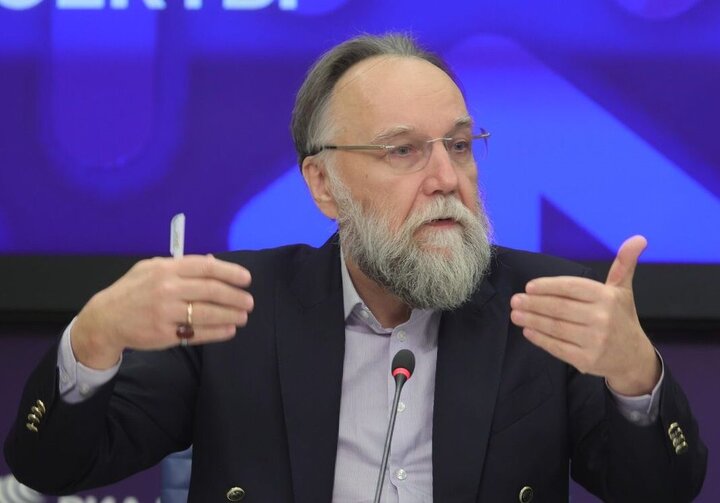
According to the International Desk of Webangah News Agency, prominent Russian philosopher Alexander Dugin has articulated his profound reflections on the late Ayatollah Khamenei, emphasizing the enduring impact of his martyrdom. Dugin extended his deepest sympathies to the Iranian nation for what he described as a monumental loss in their military, religious, and political leadership, regretting his inability to attend the funeral ceremonies due to various constraints.
Dugin, an Orthodox Christian himself, highlighted a significant shared connection between Iranian culture and Shiite tradition: the ‘culture of martyrs.’ He explained that the Greek term ‘Martyros’ for martyr signifies not only suffering but also bearing witness to truth. Dugin expressed his deep sorrow and anger towards those responsible for the “horrific crime” against the “martyred leader of the Islamic Revolution,” asserting that the suffering of such great individuals is ultimately constructive. He posited that their martyrdom represents life itself and carries even greater significance than their time in leadership, embodying the ‘dignity of death for the truth’ which shapes the future era.
Addressing the concept of leadership within the Velayat-e Faqih system, Dugin described the leader’s presence as a fundamental ‘act of being’ that transcends mere political management. He lauded the Iranian political system for being headed by a spiritual figure, characterizing Ayatollah Khamenei as an ‘ayah’ (sign of God) accountable only to the divine. Dugin stated that Ayatollah Khamenei fulfilled this role flawlessly, with his martyrdom serving as the crowning achievement of his mission, opening a path to eternity for both himself and the Iranian people. He described the late leader as a ‘gateway’ to another realm, now open.
Dugin asserted that Iran’s courageous resistance against the entire West is not coincidental and expressed more sorrow for the Iranian people than for Ayatollah Khamenei, stating that his life was great, and his martyrdom potentially more impactful than his life. He affirmed that the late leader’s presence continues to endure.
The philosopher framed the confrontation with the West not as a geopolitical conflict but as an ontological and religious war, referencing concepts like ‘Baal civilization’ and ‘Dajjal’ (Antichrist). He argued that modern Western civilization is not merely one among many but represents the ‘civilization of Satan’ and ‘Dajjal,’ characterized by the indiscriminate targeting of innocents. Dugin criticized the actions as lacking any political or economic logic beyond sacrificing innocent children for this ‘Baal civilization.’ He cited Iran’s symbolic act of challenging the world by seemingly burning a statue of Baal as an expose of the true nature of the “American-Zionist regime,” labeling them as ‘Dajjal’ who target the most defenseless and best individuals.
Consequently, Dugin declared the war against the West to be truly global, with Iran and Russia actively combating this civilization as allies in a shared struggle against a common enemy: the “American-Zionist Baal.” He urged the nations of the Islamic world, Asia, Africa, India, and Latin America to recognize this as a fight against the “enemy of humanity,” not just individual conflicts of Russia or Iran. Dugin acknowledged the material impossibility of defeating this civilization due to its technological and military dominance, but affirmed that in the realm of truth, those on God’s side will ultimately prevail.
He predicted that the long sufferings of Shiites and their countless martyrs, along with the hardships of Russian and Orthodox martyrs, will eventually be compensated. Dugin encouraged the Iranian people to remain steadfast, warning against trusting the deceitful West and stating that “dealing with Satan is sealed with blood.” He advised them to stand firm rather than fight, as victory belongs to them. Dugin emphasized that unwavering unity guarantees victory, viewing martyrs, victims, and spiritual leaders as affirmations of their triumph. He stated their fight is for an “eternal cause,” ensuring their victory by being on the side of eternity.
Regarding the national cohesion of Iranians amidst recent threats, Dugin interpreted it as a spiritual and civilizational awakening and a message to the Islamic world. He noted that while the world previously doubted Iran’s political cohesion, it is now evident that the Iranian nation is united. This unity, he observed, spans religious adherents, ordinary citizens, and even formerly Western-leaning youth, all of whom have now grasped the true nature of the West.
Dugin asserted that the Iranian people have demonstrated the meaning of true faith and that many Muslims worldwide support Iran, with all “true Muslims” now standing with Iran against Israel and the United States. He contrasted this “great spiritual mobilization” of Iranians with the “contemptible and humiliating” behavior of other Islamic governments, questioning their faith and loyalty to Allah. Dugin urged Muslims to cease justifying their inaction and instead join the “only rightful jihad: jihad against Dajjal,” supporting Iran, which he said has raised the “black flag of Khorasan,” believing the advent of Imam Mahdi is near.


