
Iran Attacks Devastate Israel’s Largest Oil Complex in Haifa
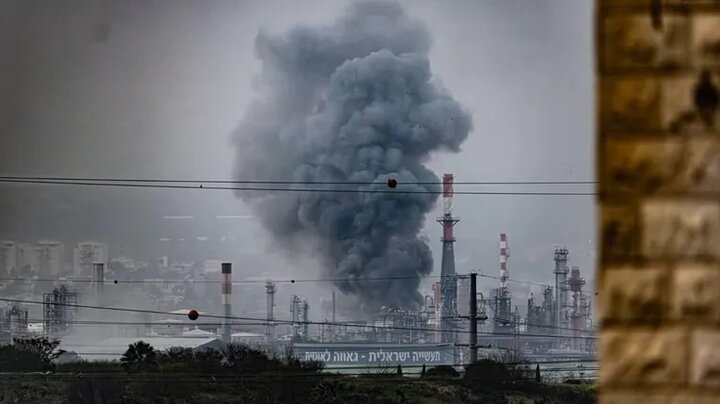
According to the International Desk of Webangah News Agency, newly declassified documents obtained by Israel‘s Channel 12 indicate a severe industrial catastrophe at the largest oil refining complex in occupied territories, stemming from Iranian missile strikes during recent conflicts. The documents reveal that damage to the Bazan petrochemical complex in the Haifa Bay is significantly greater than publicly acknowledged, with complete reconstruction projected to extend beyond 2028.
The Bazan complex is a cornerstone of Israel’s energy infrastructure, serving as the primary facility for refining crude oil into various fuels and derivatives, including gasoline, diesel, kerosene, cooking gas, asphalt, and industrial chemicals.
The complex was subjected to two Iranian missile attacks: the first during the June 2025 conflict and the second in February of the current year. The June 2025 strike, described as more devastating, resulted in the deaths of three employees and critically damaged the main power station, leading to a complete shutdown of all refining operations. Bazan estimated the losses from this attack to be between $150 million and $200 million, highlighting the facility’s importance to the local energy market.
The second attack involved two stages, with shrapnel from an interceptor missile followed by a direct hit on a derivative storage tank. While Bazan initially claimed minimal damage and continued production, and Energy Minister Eli Cohen stated the attack would not significantly impact fuel supply, new documentation from the Israeli Ministry of Interior paints a starkly different picture. The draft planning and reconstruction directive indicates damage extended beyond gas turbines to include boilers, electrical rooms, and supporting operational systems. The targeted tank, with a capacity of 12,700 cubic meters, was completely destroyed and deemed irreparable, necessitating the construction of a new facility from scratch. The document also shows that the required construction area for repairs is nearly double that approved after the first attack, underscoring the true scale of the devastation.
The damage to the oil tank directly impacts the facility’s ability to produce gasoline meeting market standards and affects supply to consumers. This information starkly contradicts official Israeli government statements.
The revelation that full reconstruction will not be completed before 2028 has triggered widespread criticism within Israeli circles, particularly from local officials and environmental groups. They question the logic of investing heavily in a facility slated for eventual decommissioning. Haifa Mayor Yona Yahav stated that the extent of damage from Iranian missiles should serve as a wake-up call for all stakeholders, emphasizing the petrochemical complex’s strategic risk to hundreds of thousands of residents in and around Haifa. He further noted that recent conflicts have demonstrated how the concentration of petrochemical industries in residential areas makes them prime targets in any military confrontation.


