Ayatollah Fallahati Highlights Martyr Leader’s Popularity, Criticizes US Policies
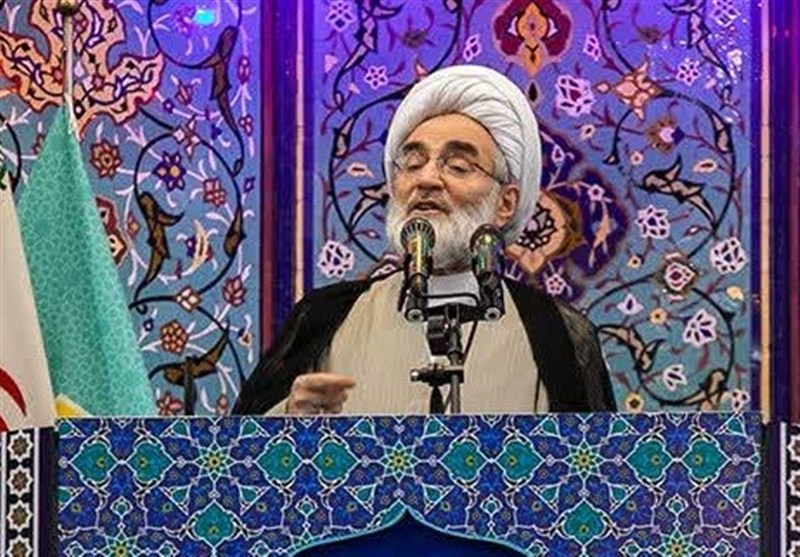
According to the International Desk of Webangah News Agency, Ayatollah Rasoul Fallahati, the Friday Prayer Imam of Rasht, delivered a significant address during the congregational prayers, describing the funeral procession of the martyr leader as a momentous and unparalleled event. He stated that since the dawn of humanity, even during the funerals of divine prophets and infallible imams, such a vast gathering has not been witnessed.
Ayatollah Fallahati referenced a statement from a Shiite Arabic media outlet that referred to the martyr leader as “shy before his grandfather Hussein (AS),” alluding to the deceased’s humility in the presence of Imam Hussein (AS) and the martyrs of Karbala.
He further elaborated that over 50 million people in Iran and Iraq participated in the ceremonies, with approximately 45 million in Iran alone, suggesting that a majority of the Iranian nation was present at this extraordinary event, deeming it not just rare but unprecedented.
According to Fallahati, if the martyr leader’s body had been taken to any other country, free peoples worldwide, followers of various religions and faiths, and all who believe in freedom and human dignity would have come to welcome and pay their respects.
The Imam of Rasht’s Friday Prayer noted the funeral ceremonies held in Iran, Iraq, Najaf, Karbala, and Mashhad, emphasizing that Iraq had never witnessed such public participation. He highlighted the profound unity between the nations of Iran and Iraq, former adversaries in an eight-year war, who now bid farewell to the martyr leader with affection, respect, and a massive turnout of scholars, clerics, and the general populace.
Ayatollah Fallahati also drew a comparison to the funerals of revered marja’s and religious scholars, such as Grand Ayatollah Fayadh and Grand Ayatollah Boroujerdi, observing that despite their esteemed positions, the recent ceremony’s scale and public attendance were incomparable to previous ones.
Reasons for the Martyr Leader’s Popularity Among Nations
Fallahati explained the reasons behind the martyr leader’s immense popularity. Firstly, he was not solely concerned with the freedom of Muslims but championed the liberty, identity, dignity, and freedom of all humanity. Global populations recognized the martyr leader’s dedication to human honor and dignity, viewing him as a beacon of hope for the oppressed and a powerful wave against oppression, oppressors, and the global dominance system.
He pointed to the current global landscape, stating that many individuals worldwide have lost hope and the will to live under the pressure of corrupt leaders, tyrannical powers, international Zionism, and certain subservient rulers. In such a tumultuous world, the martyr leader had become a symbol of hope and resistance for oppressed nations. The diverse attendance reflected the people’s belief that this divine figure cared for human dignity, national pride, and the support of all the world’s downtrodden, refusing to remain silent in the face of injustice.
The Imam of Rasht expressed gratitude to the Iranian nation, noting that for years, both domestic and foreign enemies had sought to portray Iranians as indifferent to their martyr leader. However, the millions-strong participation demonstrated the contrary reality.
Fallahati asserted that the Iranian nation, through this massive turnout, reaffirmed its loyalty to the Islamic Revolution, its ideals, and the path of the martyr leader. He added that those who believed the Iranian people’s concerns were limited to economic issues, food, and basic necessities now understood that the nation stands firm in defending the Revolution and its independence.
Comparing the impact of the martyr leader’s martyrdom to that of figures like Martyr Morteza Motahhari, Fallahati suggested that the demise of any true servant of the people has historically sparked a new wave within society and the Revolution. He predicted that the effects of the martyr leader’s martyrdom would resonate for years, at least a decade, across various societal strata, guiding many back to the revolutionary path.
According to the Imam of Rasht’s Friday Prayer, people gathered to express gratitude for an individual who dedicated his youth, life, capabilities, and very being to Islam and the Islamic Ummah. The martyr leader had been on a path of struggle against oppression, transgression, infidelity, and arrogance since his youth, ultimately sacrificing his life for religion, the Quran, and his people, much like his ancestor.
Simple Living and Opposition to Extravagance
Fallahati identified the martyr leader’s simple lifestyle as another key factor in his popularity. He stated that the leader eschewed a comfortable, luxurious, or aristocratic life. According to his devoted wife, even his home furnishings and furniture were second-hand, reflecting a deliberate choice for the simplest form of living.
He found it incredible that the leader of the Islamic world lived with second-hand items and modest, inexpensive clothing, contrasting this with individuals who, after the Revolution, embraced expensive cars, lavish homes, and ostentatious lifestyles, engaging in excessive spending. The martyr leader opposed such behaviors, personally shouldering responsibilities and refraining from granting special privileges to his children or close associates. People witnessed and believed in this way of life and his sincerity.
Regarding the motivation behind the public’s participation in the funeral, the Imam of Rasht stated that people came to thank someone who preserved the independence of the Iranian nation, championed its honor, and consistently worked for its glory. They believed the martyr leader accepted them and had faith in their capabilities, thus coming to express appreciation for someone who, in turn, believed in them.
Fallahati further added that the nation also gathered to honor a personality dedicated to the honor of Islam, the triumph of Muslim nations, the support of the oppressed, and the confrontation of hegemonic powers. He acknowledged that some attendees came to seek absolution, particularly those who, influenced by enemy propaganda in recent years, especially in 1404, had chanted slogans like “Death to the Dictator” or leveled accusations against the martyr leader and his family.
According to him, the martyr leader distinguished between the main instigators of unrest, those ensnared by circumstances, and misled youth, treating the latter with paternal affection. Many of these individuals, after his martyrdom, realized the magnitude of their loss and attended the ceremony to seek forgiveness.
People Remained with the Martyr’s Body Until the Last Moment
The Imam of Rasht noted the continued presence of the public along the funeral route, stating that in various cities, from Karbala and Najaf to Mashhad, people accompanied the martyr leader’s body until the very end, unwilling to part from him. Even when the plane arrived to transport his sacred remains to the holy shrine, people remained at the site. A magnificent prayer was led by his beloved son over his father’s body.
Fallahati extended his greetings to the Iranian nation, expressing appreciation to all Iranians, mourners, and especially the people of Rasht for their extensive and magnificent participation. He emphasized the need for this street and popular presence to continue, as it instills fear in the enemy and showcases the nation’s unity.
Unity of Nation and Officials is a Great Blessing
He stated that Iran is a country where the government, nation, officials, armed forces, and leadership stand together. This unity, he asserted, is a great blessing bestowed upon the Iranian nation in these times.
The Imam of Rasht thanked the Supreme National Security Council and the government for their decisions, efforts, and actions taken for the people and the country during this period. He also expressed gratitude to all political and executive officials who have labored in service to the people. The leadership, he stressed, is a red line for the Iranian nation, and his remarks to political officials are made from the perspective of Islam, the Revolution, and a civilization based on Wilayat al-Faqih.
United States Has Caused War and Destruction Worldwide
Fallahati highlighted the historical track record of the United States, stating that since its inception, it has initiated numerous wars globally, bringing death and destruction wherever it has intervened through aircraft, missiles, bullets, and troop deployments.
He cited Nicaragua, Afghanistan, Pakistan, Iraq, Iran, Syria, Lebanon, Russia, Eastern Europe, and Ukraine as examples of U.S. interventions and warmongering. He described American leaders as behaving like wild creatures towards nations, perpetrating killings in various parts of the world.
The Imam of Rasht asserted that American untrustworthiness has become a proverb among the world’s nations. Throughout history, the U.S. has reneged on every commitment and agreement it has signed at various junctures. He recalled Ayatollah Khomeini’s designation of the U.S. as “Great Satan” and “Greater Satan,” noting that many world nations now fully grasp this description. The current Supreme Leader has continued this path, elucidating and managing this truth for the world’s nations.
Fallahati pointed out that even European countries, seemingly allied with the U.S., fear it. Russia and former Soviet Union countries also have a history of confrontation with the U.S. However, the Iranian nation is among the few that has not feared the U.S. and has not bowed in submission. He added that the martyr leader trained the Iranian nation to be courageous, fearless, and resilient, which was a heavy and unbearable burden for the Americans.
US Disagreement with Iran is About National Independence
He argued that the issues of clergy, nuclear matters, military capabilities, assets, and other pretexts raised by the Americans are not the core problem. The fundamental issue for the U.S. is that the Iranian nation refuses to be subservient and insists on independence. He stated that the U.S. cannot tolerate an independent nation that resists its directives, and all its claims and concerns are pretexts for pressuring the Iranian people.
The Imam of Rasht questioned the possibility of dialogue and negotiation with those who possess such a dark and tainted history, asking whether they understand the principles of discussion or only comprehend the language of power, missiles, and decisive responses.
Fallahati recalled his repeated declarations from this pulpit in recent weeks and sessions that Americans lie, will attack, and will tear up their commitments and agreements. He noted that the Iranian nation has witnessed their actions against the country over the past 47 years, including the martyrdom of its people, scientists, and scholars.
Why Are Some Still Hopeful About Negotiating with the U.S.?
He criticized certain political viewpoints, posing the question of why some politicians still believe that a new dialogue with the U.S. is possible. He questioned this mindset, asking how one can negotiate when the other party fundamentally does not understand the language of dialogue.
The Imam of Rasht deemed memorandums of understanding and written agreements lacking enforcement guarantees to be ineffective, stating that merely writing a letter or a memorandum of understanding does not guarantee U.S. adherence.
Addressing the congregants, elites, seminary students, university scholars, teachers, and writers present, Fallahati stated that negotiation occurs when war and conflict have ceased. He questioned the meaning of discussing negotiation when two parties are at war and the enemy continues to attack.
He asked why Iran should once again be the first party to concede, why it should declare readiness to open routes and straits without receiving anything in return for the hardships, suffering, and losses incurred. He posed rhetorical questions: Have Americans released Iran’s assets? Have they retreated from their positions? Have they vacated their military bases? Have they reduced their military equipment? The answer to all these questions is negative.
U.S. Increases Military Equipment While Talking About Negotiations
The Imam of Rasht stated that concurrently with discussions of negotiation, Americans have deployed thousands of drones and military equipment in neighboring countries and the Persian Gulf region, increasing their forces, officers, and soldiers in Arab countries. He added that they have martyred some Iranians and injured about 50 others. In such circumstances, where war and aggression continue, discussing negotiation is illogical, and a proportionate and deterrent response must be given to the enemy.
Fallahati pointed to the increased attacks, reinforced military equipment, and the deployment of thousands of American military personnel and officers in Arab countries as indicators of the insincerity of negotiation claims. He reiterated that negotiation with the U.S. is a mistake because Americans do not understand the language of dialogue and only comprehend the language of force and power.
Expel US Forces from the Region
He stated that the Iranian nation will not abandon the field and urged the armed forces to take measures to ensure the Americans flee the region and never again consider returning. The nation’s demand, he asserted, is for the complete cessation of U.S. military presence in the region and the withdrawal of its forces, bases, and equipment from countries surrounding Iran.
The Imam of Rasht criticized certain Arab rulers and kings, stating that they fear the U.S. more than anyone and lack the courage to stand against it. He suggested they are willing to grant their bases to the U.S. and resort to any action to remain in power for a few more days. He concluded that 47 years of experience have shown the Iranian nation that America only understands the language of power and increases its aggression in the face of weakness, demands for concessions, and transgressions.
The Iranian Nation Will Not Rest Until Revenge is Taken
Fallahati emphasized the necessity of avenging the blood of the martyr leader, stating that the criminal leaders of the U.S. and Netanyahu should know that they will not have a peaceful and secure life henceforth, and the Iranian nation will not forget the blood of its leader.
He noted the dissemination of these remarks through enemy media, stating that they should be aware that Muslims and freedom-seekers worldwide are prepared to sacrifice their lives to confront and punish criminals.
According to the Imam of Rasht’s Friday Prayer, the free, Muslim, heroic, and courageous Iranian nation wore black during the funeral procession while also holding red flags. These flags conveyed the message that the martyr leader’s blood must be avenged and that this retribution will be exacted.
He addressed the free youth of the world, Muslims, free Jews, and Christians, urging them not to spare these two criminals, as the free nations of the world will not let them go either, and Iranians will not rest until they have avenged the blood of their martyr leader.