
Turkish Parliament Members Denounce ‘Makkah Defense Pact’ as Illegal and Detrimental
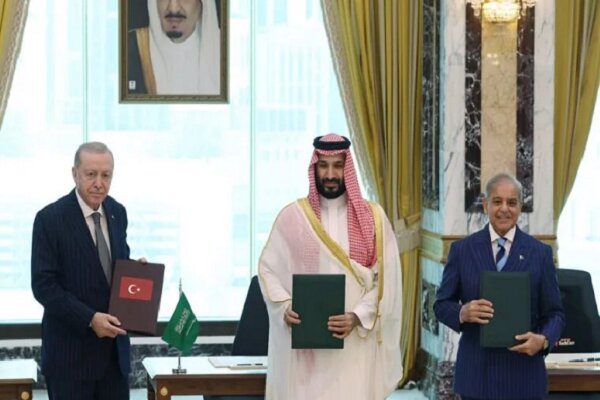
According to the International Desk of Webangah News Agency, Turkish parliamentarians have voiced sharp criticism against a mutual defense agreement inked by Turkey, Saudi Arabia, and Pakistan. These representatives asserted that the treaty is illegal and requires ratification by the Turkish Parliament.
The lawmakers contend that signing this accord transforms Turkey into a mercenary state subservient to Saudi Arabia. Tuerhan Csomos, head of the “Good Party” parliamentary group, stated that the “Makkah Joint Defense Agreement,” signed by President Recep Tayyip Erdoğan, stipulates that an attack on any of the three signatory nations will be considered an assault on all and necessitate a joint defense response.
Questioning Erdoğan’s authority to sign such an agreement, Csomos emphasized that it must be presented to the Parliament for approval according to Article 90 of the constitution, allowing for thorough deliberation of its details. He raised concerns about the current nature of threats facing Turkey and its potential involvement in wider conflicts.
Csomos highlighted the precarious situation regarding Saudi Arabia amidst the Iran-US tensions, suggesting Iran might retaliate against U.S. attacks on Saudi soil in exercise of its right to self-defense. He questioned Turkey’s position in such a scenario, asking if it would engage in conflict against Iran, describing it as a highly perilous development.
Murat Emir, Deputy Chairman of the “New Party” parliamentary group, observed that efforts are underway to portray the agreement, signed by the President, as a “strategic brilliance.” However, he views it as a collapse of structural rationality.
Emir pointed out Pakistan’s nuclear capabilities and its ongoing dispute with India over Kashmir, alongside potential conflict with Afghanistan. He also noted Saudi Arabia’s role as a shield for Israel in its conflict with Iran, its intertwined interests with Israel and the U.S., and its protracted war with the Ansar Allah movement.
Given these clear regional dynamics, Emir stated that they cannot accept an agreement that draws Turkey into such regional disputes. He described the pact as offering no benefit beyond financial gain from Saudi Arabia, regrettably turning Turkey into a mercenary custodian for these nations. The parliamentarian also observed that despite the ruling party’s public stance against Israel and in support of Palestine, Turkey is now a key player in a blockade seemingly aimed at Iran.
He concluded that there is no justification for undertaking such regional risks, and no one has the right to drag the country into such adventures based on individual diplomacy. He stressed that they and the esteemed Parliament await the agreement and demand a clear explanation for the reasons compelling the Republic of Turkey to bear these risks. Retired Turkish Ambassador Mithat Rendi commented that this is a defensive agreement sought by the U.S. and indicates Saudi Arabia is also experiencing a security vacuum.


