Makkah Defense Pact Faces Scrutiny Amid Tripartite Interest Divergences
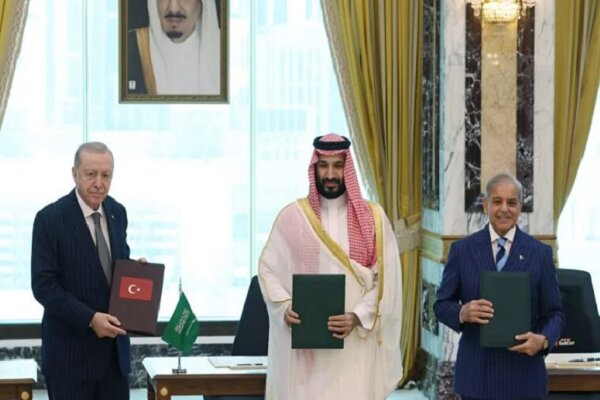
According to the International Desk of Webangah News Agency, the recent signing of the “Makkah Joint Defense Pact” between Saudi Arabia, Turkey, and Pakistan, intended to serve as a framework for collective deterrence, has once again reshaped the regional alliance landscape. However, divergent national interests and conflicting calculations among the three signatory nations are casting doubt on the pact’s ability to fulfill its commitments, especially in relation to Iran.
Analysis and speculation surrounding the agreement highlight significant contradictions that international affairs experts believe may significantly impede its implementation. Al-Akhbar has identified eight key points of concern:
Firstly, the defense pact is inherently military in nature and, within the framework of security cooperation, necessitates the defense of any signatory party facing an attack. Turkish Foreign Minister Hakan Fidan stated that the operational mechanism of the “Makkah Pact” aligns with NATO in all aspects. Nevertheless, it appears that the regional conditions may not be conducive to the signatory countries upholding their commitments under this pact.
Secondly, all three signatory nations are dependent on the United States. This dependency brings the U.S. role in this move into focus. Some speculate that the agreement may serve as an American message to Iran, aimed at pressuring Tehran into making concessions.
Thirdly, the Sunni identity of the three signatory countries fuels concerns among some observers about sectarian incitement. This may be a reason why Egypt has so far refrained from joining the pact, as it seeks to position itself as a player beyond religious disputes, aiming for a larger role in foreign policy.
Fourthly, the Makkah agreement conflicts with the Ataturk principle of Turkish neutrality among nations. Some political observers view this pact as a revival of the “Baghdad Pact,” established by Britain in 1955, which Turkey joined under Adnan Menderes’s government.
Fifthly, the announcement of the new coalition comes a month after the NATO summit held in Turkey, suggesting a degree of alignment with NATO’s resolutions. Consequently, some believe that the three countries involved in the “Makkah Pact” are seeking to act as representatives of the West in the region, aiming to alleviate some of the burden of American setbacks.
Sixthly, Turkish circles supportive of President Erdoğan justify joining the new coalition by asserting that it provides a new deterrent against the expansionist ambitions of the Zionist regime toward Turkey. However, it appears that the signing of this agreement also serves the interests of the Zionist regime. Furthermore, Erdoğan’s pursuit of this agreement seems to be motivated by a desire to garner new votes in the 2028 presidential election, amidst declining popularity for the Justice and Development Party.
Seventhly, assessing the needs of the countries involved in the Makkah Pact reveals complex equations. Turkey has its own domestic and regional calculations, which do not necessitate Saudi Arabian support, and Saudi Arabia arguably lacks the capacity for such robust backing. Pakistan, geographically distant from any potential confrontation between Turkey and the Zionist regime or Greece, does not feel the need for this pact to counter India, given its nuclear arsenal. Moreover, Turkey cannot risk openly supporting Islamabad against New Delhi. Therefore, the country most in need of this agreement appears to be Saudi Arabia. Riyadh is suffering from a perceived decline in deterrence against Iran or the Houthi Ansarullah movement in Yemen and is attempting to create a theoretical opportunity to bolster its deterrence through this new coalition, although the success of this endeavor remains uncertain.
Eighthly, the new coalition has been formed despite widespread disagreements among its signatories. The ideological differences between Ottoman Islam and Wahhabi Islam, which have been in contention for over two centuries, are just one of these deep-seated disparities. These contradictions will place Turkey in a difficult test. For example, if Iran were to attack American positions in Saudi Arabia, and Riyadh invoked the agreement for Turkish intervention, the question arises whether Turkey would engage and go to war with Iran in defense of Saudi Arabia.
Al-Akhbar concludes that there is little room for optimism regarding this coalition. According to prominent Turkish writer Fehmi Koru, the pact, reminiscent of the “Baghdad Pact” era, is likely to foster considerable rivalries and chaos.