Saudi Arabia, Turkey, Pakistan Sign Joint Defense Pact Amid Regional Tensions
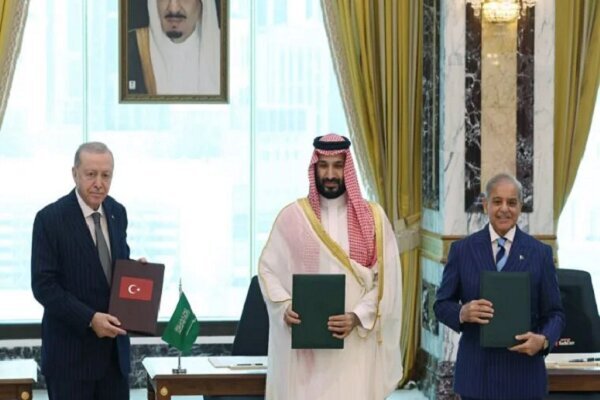
According to the International Desk of Webangah News Agency, the signing of the “Makkah Agreement for Joint Defense” among Saudi Arabia, Turkey, and Pakistan is being recognized as one of the most significant recent security developments in the Islamic world. This agreement has been forged in a period of unprecedented regional tensions and growing uncertainties about the dependability of the U.S. security umbrella. The importance of this accord extends beyond the military cooperation of these three nations; it may signal an effort by regional powers to decrease their dependence on external security frameworks and establish new mechanisms for deterrence.
The agreement, signed on August 7, 2026, stipulates that an armed attack against any one of the three countries will be considered an attack against all. The signatories have committed to strengthening collective deterrence and expanding defense cooperation. This pact arrives at a critical juncture, with the U.S.-Israel conflict against Iran posing new security pressures on regional states, coupled with rising tensions over vital energy and shipping routes. The timing of the agreement, therefore, is as significant as its content, suggesting that regional security arrangements are entering a new phase.
In this evolving environment, regional security is no longer solely dependent on national defense capabilities. Missile and drone attacks, threats from armed groups, insecurity of energy transmission lines, and potential disruptions to shipping routes have demonstrated that traditional national security boundaries have largely dissolved. A nation may possess formidable military strength, but if threats emanate from multiple fronts and involve both state and non-state actors, relying solely on domestic capabilities may not suffice to meet all security needs. The Makkah Agreement should be assessed within this context.
The strategic composition of the signatory countries itself carries a significant message. Saudi Arabia holds a unique religious and economic standing, and due to its pivotal role in the global energy market, security developments around it have repercussions extending beyond its borders. Turkey boasts substantial military and industrial capacities, operational experience, and an active presence in multiple security environments, while also being a NATO member. Pakistan, as the only nuclear power in the Islamic world, gains considerable strategic weight in any regional defense arrangement.
Geopolitically, these three nations are situated in distinct spheres of the Islamic world’s security geography: Saudi Arabia at the heart of the Persian Gulf and the Arabian Peninsula, Turkey at the nexus of the Middle East, the Caucasus, and the Black Sea, and Pakistan in South Asia. Consequently, their agreement has the potential to create an extensive communication network, transforming security from a purely regional issue into one with trans-regional dimensions. This characteristic leads some observers to view the Makkah Agreement not as a temporary measure, but as an initial step toward forming a broader network of security cooperation within the Islamic world.
The core principle of the agreement lies in the declaration that an attack on one country constitutes an attack on all three. The strategic value of this principle is not primarily in its application during wartime, but in its impact on the calculations of potential adversaries before a conflict erupts. When a country understands that attacking one member could draw two other major powers into the dispute, the potential cost of military action increases, possibly leading them to abandon the decision to attack altogether. In essence, successful deterrence is that which prevents war before it begins.
However, a gap exists between the declaration of a security commitment and its practical implementation. Deterrence is credible only when the adversary not only recognizes the pact but also believes that its members will genuinely bear the costs of fulfilling their obligations if necessary. For Saudi Arabia, Turkey, and Pakistan, their significant military, economic, and political capabilities can reinforce this message. Nevertheless, the ultimate credibility of the agreement in practice will depend on the establishment of mechanisms for coordination, command, intelligence sharing, and joint decision-making.
A crucial factor driving the formation of this agreement is the growing doubt surrounding the traditional role of the United States in regional security. For decades, a significant portion of Arab states in the Persian Gulf linked their security to the U.S. military presence, bases, and defense arrangements with Washington. Recent developments, however, have reignited questions about whether the United States is capable or willing to fully guarantee the security of its regional partners during a major crisis. This uncertainty could prompt regional countries to diversify their security partners and develop more independent options.
From this perspective, the Makkah Agreement can be seen as part of a broader trend where regional nations are striving to transform “security” from an imported commodity into a regional responsibility. This does not imply the exclusion of the United States from security equations but rather an expansion of options for regional countries, ensuring that if Washington’s approach changes, they do not find their entire defense capacity dependent on a single foreign partner.
A significant issue that could influence the future of this agreement is the precise definition of “armed attack.” Modern security threats are not exclusively posed by official state armies; armed groups and non-state actors can also launch extensive and organized attacks. Therefore, if the agreement’s mechanism only covers direct state-to-state attacks, a portion of the region’s actual threats might fall outside its purview.
Consequently, clarifying the scope of commitments, defining the conditions for activating joint defense, and establishing decision-making processes for each crisis will be vital for the agreement’s credibility. The clearer these rules are, the better third parties will be able to calculate the likely reaction of the three countries, thereby enhancing the agreement’s deterrent effect.
While it is premature to give a definitive answer to whether this marks the beginning of a new security order, indications suggest the region is experiencing a form of security diversification. Reports indicate that discussions about this agreement commenced long before the current circumstances, with consultations for security cooperation among the three countries extending beyond a reactive response to recent crises. Furthermore, the discussion of expanding this framework to include other regional nations raises the possibility that the Makkah Agreement could evolve into the nucleus of a more extensive security structure in the future.
The non-participation of Egypt is noteworthy but should not necessarily be interpreted as Cairo’s opposition to this trend. Egypt has always maintained its own specific considerations regarding regional security arrangements and has a distinct perspective on Arab national security. Therefore, Egypt’s decision may stem from independent calculations about its position within the region’s security architecture, rather than an outright rejection of security cooperation among regional nations.
In conclusion, the Makkah Agreement should be viewed not merely as a defense pact among three countries, but as an indicator of a gradual shift in how regional nations perceive security. Increased threats, diminished confidence in external guarantees, and the necessity for multi-layered deterrence have propelled countries toward new forms of cooperation. The ultimate value of this agreement will be determined not by the signing ceremony, but by the members’ ability to translate political commitments into tangible mechanisms for defense cooperation and deterrence.
If this trend persists, the Makkah Agreement could be one of the first signs of a new security architecture emerging, where regional countries take greater responsibility for their own security. This architecture would involve reduced reliance on foreign powers, with regional alliances gradually assuming a more prominent role in the security equations of the Middle East.