Mecca Defense Pact Faces Scrutiny Over Cohesion and Effectiveness
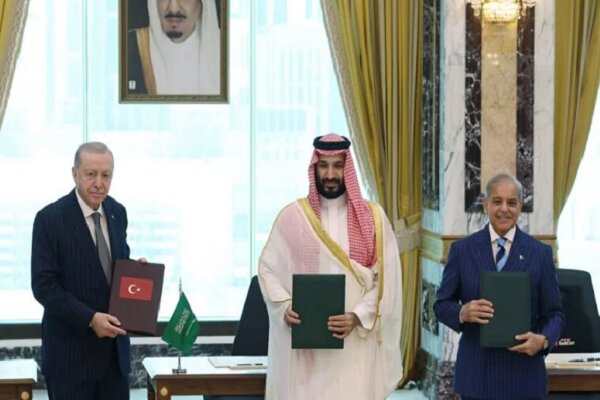
According to the International Desk of Webangah News Agency, the Mecca Common Defense Agreement, signed by Saudi Arabia, Turkey, and Pakistan, could initially appear to signal the formation of a new regional security arrangement. Under this agreement, an attack on any one member is considered an attack on all. However, beyond its symbolic and political value, significant questions arise concerning its efficacy, internal cohesion, and feasibility of execution. Divergent national interests among the three countries, ambiguity in the scope of defense commitments, and the risk of this mechanism morphing into a regional bloc represent the most prominent challenges that could impact its future.
The primary challenge stems from the differing security threats faced by the three members. Saudi Arabia perceives significant security concerns related to Iran, Yemen’s Ansarullah movement, and Tehran-aligned armed groups. In contrast, Pakistan’s primary focus is on India, the security of its eastern borders, and the Kashmir dispute. Turkey, meanwhile, has distinct security priorities, dedicating substantial military and political resources to developments in Syria, Iraq, the Eastern Mediterranean, and border security issues. Consequently, the commitment of ‘an attack on one is an attack on all’ faces uncertainty regarding its applicability across all these diverse crises.
This divergence in perceived threats can become problematic if one member becomes embroiled in a conflict that the other two do not consider directly relevant to their national security. In such scenarios, the political commitment enshrined on paper might diverge from governments’ actual calculations, potentially reducing a collective response to a limited, symbolic, or purely political reaction.
A second significant challenge concerns the core of the agreement: under what circumstances does an attack trigger collective defense? In the current regional landscape, threats are not exclusively confined to direct military assaults by one state on another. Attacks by armed groups, missile and drone operations, cyberattacks, and indirect actions constitute a substantial portion of regional conflicts. If the agreement strictly covers direct state-on-state aggression, a significant array of real-world threats would fall outside its purview. Conversely, if the involvement of any armed group automatically activates the common defense obligation, the signatory members could inadvertently find themselves entangled in a web of regional conflicts that do not necessarily align with all their interests. Thus, the absence of a clear definition for activating defense commitments stands as a major weakness of the accord.
A defense pact’s deterrent power relies on the adversary’s belief that its members are prepared to uphold their commitments in real-world scenarios. However, a considerable gap exists between signing an agreement and establishing a tangible defense structure. Sustained deterrence necessitates concrete mechanisms for intelligence sharing, operational coordination, command and control, joint planning, and crisis decision-making. Without such mechanisms, the Mecca agreement risks becoming more of a political pledge than a genuine military alliance. The mere presence of powerful militaries does not automatically translate into the capacity for joint warfare. Disparities in equipment, military doctrines, command structures, and strategic priorities can also complicate trilateral coordination.
One of the unstated but important objectives of such arrangements is to reduce regional states’ reliance on the American security umbrella. However, this presents a fundamental paradox. Turkey is a NATO member, Pakistan has a long history of military cooperation with the United States, and Saudi Arabia continues to depend on American equipment, training, and defense collaboration. Therefore, the Mecca agreement cannot yet be interpreted as a withdrawal of the region from the U.S.-led security system. At best, this agreement could serve to diversify the security resources of its member states. However, if this structure is to operate without a genuine reduction in military and political dependence on the West, its security autonomy will be constrained. The fundamental question is whether the member states are truly constructing an independent security architecture or merely adding a new layer alongside the existing American security framework.
Defense agreements are typically easy to sign during times of peace; their true test begins when one member is engaged in conflict. If Saudi Arabia faces a large-scale attack in the future, will Turkey and Pakistan be willing to commit their forces? If Turkey becomes involved in a crisis along its borders, will Saudi Arabia and Pakistan be inclined to intervene directly? And if Pakistan confronts a major crisis with India, will the other two members be prepared to enter a costly confrontation to uphold the agreement’s commitments? The answers to these questions remain uncertain, and this ambiguity could be the most significant test of the Mecca agreement’s credibility. If members exhibit differing reactions during a genuine crisis, the pact’s deterrent effect will be severely diminished, as a defense treaty is only deterrent when a potential adversary is assured of a collective response’s certainty, or at least high probability.
The Mecca agreement holds the potential to initiate a significant regional security development, but its capacity to evolve into an effective alliance remains unproven. Its greatest challenge lies not in a lack of military power but in the divergence of member interests, threats, and strategic calculations. Ambiguity in defining ‘attack,’ a lack of clear details regarding common defense mechanisms, continued significant reliance on the United States, and the risk of the agreement devolving into a sectarian alignment are all factors that could limit its effectiveness. From this perspective, the Mecca agreement should be viewed as the beginning of a difficult test rather than the end of an era and the dawn of a new security order. If the three nations can translate their political commitments into concrete defense mechanisms, military coordination, and joint decision-making, this agreement could evolve into a significant regional structure. Otherwise, there is a risk that the Mecca agreement will become a political pact louder than its operational capacity, potentially becoming a component of new power competition in the Middle East rather than reducing insecurity.