Trump Scales Back US-South Korea Drills Amid Shifting Geopolitical Landscape
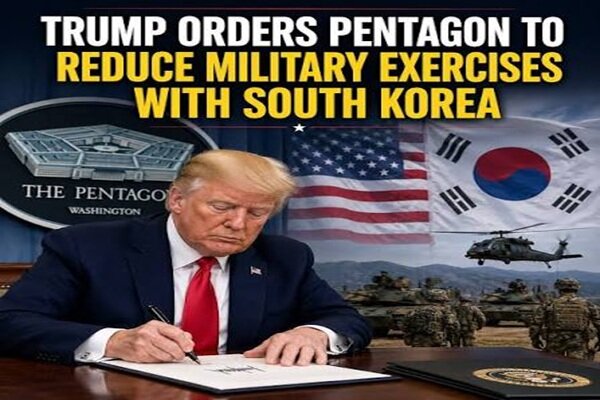
According to the International Desk of Webangah News Agency, U.S. President Donald Trump has directed the Pentagon to scale back joint military drills with South Korea. Trump indicated that while it is too late to cancel the exercises entirely, he has instructed Secretary of Defense Pete Hegseth to significantly reduce their scope. He cited his strong relationship with North Korean leader Kim Jong Un and dissatisfaction with Seoul’s lack of support for the United States in the conflict against Iran as reasons for this decision.
President Trump’s decision comes at a time when Washington is grappling with the consequences of the war against Iran, increasing competition with China, and expanding cooperation between Russia and North Korea. This move transcends a mere adjustment in U.S. military planning and could have significant implications for the future of Washington’s alliances. The importance of this decision is amplified by Trump’s explicit mention of South Korea’s non-cooperation in the war against Iran, indicating that the conflict has become a factor in U.S. relations with its East Asian allies.
Why Did Trump Reduce the Drills?
The “Ulchi Freedom Shield” exercise is one of the most critical annual drills between the U.S. and South Korea, held since 1976. Its primary objective is to prepare the forces of both nations to counter potential threats from North Korea. This year’s exercise was scheduled to last for 11 days, with approximately 18,000 South Korean troops and 28,500 U.S. personnel stationed in the region participating. Trump’s decision to substantially reduce these drills directly impacts one of America’s key deterrence tools on the Korean Peninsula. North Korea has consistently labeled these exercises as provocative, often responding with missile tests or increased threats during their staging.
Trump had previously expressed opposition to U.S.-South Korea drills. Following his meeting with Kim Jong Un in Singapore in 2018, he described these exercises as costly and provocative. He is now reiterating his personal relationship with the North Korean leader as a reason for the reduction. From this perspective, Trump appears to be using reduced military pressure as a diplomatic tool. He may believe that scaling back the drills could pave the way for a return to dialogue with Pyongyang, allowing him to once again present himself as a president capable of direct negotiation with Kim.
However, the current circumstances differ significantly from 2018. North Korea has advanced its missile and nuclear capabilities in the interim, and its relations with Russia and China have strengthened. Consequently, Kim Jong Un is in a different strategic position and may not be in a hurry to return to negotiations with the United States.
The War Against Iran: A Variable Reshaping U.S. Calculations
The most significant aspect of Trump’s recent decision is his direct reference to the war against Iran. Trump stated his dissatisfaction with South Korea’s lack of cooperation in efforts to counter Iran’s nuclear program, noting that Seoul rejected Washington’s request for participation. This indicates that the repercussions of the unsuccessful war against Iran have extended beyond West Asia, influencing U.S. relations with its allies in other parts of the world.
South Korea is considered one of America’s closest military allies, and the presence of U.S. forces there forms a crucial part of East Asia’s security architecture. Nevertheless, Seoul has declined to participate directly in the war against Iran. This decision can be analyzed within a cost-benefit framework. For South Korea, direct involvement in a war with Iran could entail considerable security, economic, and political costs, especially given the existing threat from North Korea.
Seoul’s non-participation suggests that even close U.S. allies are now calculating their national interests and security independently of Washington’s demands, particularly in the wake of the costly defeat against Iran. Therefore, the war against Iran has delivered a crucial message to the U.S. alliance system: America’s power is most effective when its allies are willing to share the costs of employing that power.
In this context, Iran’s influence emerges. A country’s influence gains greater significance when its power can affect the calculations of other states. If an ally like South Korea concludes that engaging in conflict with Iran poses more risks than benefits, it is natural for them to refrain from participation.
Who Is Filling the U.S. Power Vacuum?
Trump’s decision has not occurred in a geopolitical vacuum. East Asia is currently a major arena for great power competition, with China rapidly expanding its military capabilities. Beijing has enhanced its missile, naval, and nuclear forces in recent years and has intensified military and political pressure on Taiwan. Washington and its allies are concerned that China might exploit any reduction in U.S. focus to increase pressure on Taiwan or bolster its position in the Western Pacific.
Meanwhile, North Korea is no longer an isolated actor. Pyongyang’s relationship with Moscow has significantly strengthened, leading to increased military cooperation. North Korea has also maintained its ties with China and is leveraging the competition between the U.S., China, and Russia to enhance its bargaining power.
Under these circumstances, a reduction in U.S.-South Korea drills could lead to two different interpretations. On one hand, Pyongyang might perceive it as a positive sign for de-escalation and the commencement of negotiations. On the other hand, China and Russia might view it as an indication of increased pressure on U.S. resources and capabilities.
The costs incurred by the United States following the war against Iran have limited its capacity to manage all crises at the same level of intensity. The war against Iran, competition with China, the conflict in Ukraine, and security commitments in Europe and Asia are all on the U.S. agenda simultaneously. Consequently, any decision to reduce military activity in one region can have implications for another.
Do Allies Still Trust America?
Perhaps the most significant consequence of Trump’s decision is not for North Korea, but for America’s own allies. The U.S.-South Korea alliance has been built for decades on the principle that Washington would defend Seoul against North Korean threats. Joint exercises are a part of this security guarantee. Therefore, any reduction in these drills could raise questions about the future stability of U.S. commitments. This concern is not limited to South Korea. The U.S. maintains an extensive network of allies in Europe and Asia, and the credibility of this network largely depends on the belief that Washington possesses both the capability and the will to defend them during crises.
The war against Iran has intensified this question. If allies observe that the U.S. is compelled to redeploy its resources from other regions to manage a major conflict, they may gradually seek to enhance their independent defense capabilities or cultivate more diverse relationships with other powers. The Philippines offers a notable example in this regard. The escalating tensions between Manila and Beijing indicate that Asian countries require U.S. support while also seeking to avoid sole reliance on one power for their security. In South Korea’s case, proposals for dialogue with North Korea to formally end the Korean War suggest that Seoul may be exploring complementary paths to ensure its security.
Conclusion
The reduction in U.S.-South Korea drills occurs at the confluence of several significant developments: the war against Iran, strain on U.S. military resources, escalating competition with China, closer ties between Russia and North Korea, and growing allied doubts about Washington’s commitment. From this perspective, the war against Iran is a crucial variable in this equation.
South Korea’s non-cooperation in the war against Iran demonstrates that even Washington’s close allies assess the costs and benefits of confronting Tehran independently of U.S. demands. Conversely, Trump has shown that he considers the level of allied cooperation in his security decisions. However, the most significant implication of this decision may be its impact on the credibility of U.S. deterrence. If Washington’s allies conclude that the U.S. is forced to reduce its commitments on one front due to involvement on another, their confidence in America’s ability and capacity to manage multiple crises simultaneously will diminish.
Ultimately, the issue extends beyond North Korea; this decision highlights serious limitations in America’s ability to simultaneously uphold security commitments across multiple fronts. The war against Iran has imposed substantial military and political costs on Washington, compelling the U.S., alongside competition with China and Russia, to recalibrate its priorities. Consequently, allies’ confidence in Washington’s capability and willingness to defend them concurrently is weakening, a trend that represents one of the most significant geopolitical consequences of the war against Iran for the U.S.-led security order.