
Popular Mobilization Forces Chief: Iran Resisted Global War, Iraq Will Not See Conflict Over Arms Monopoly
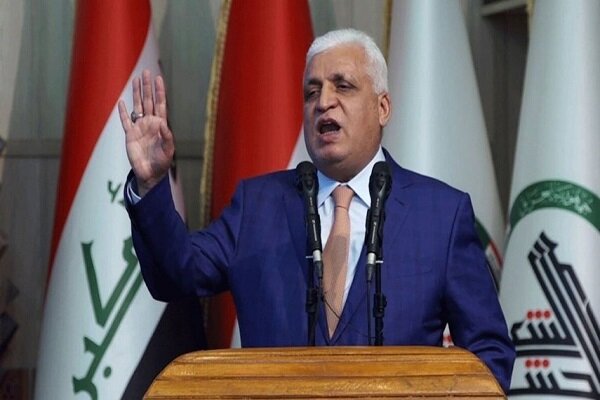
According to the International Desk of Webangah News Agency, Faleh al-Fayyad, head of the Popular Mobilization Forces (PMF), said in an interview with Al-Sharqiya TV that Iran confronted an almost global war and managed to stand firm against its challenges.
Al-Fayyad also expressed that he relinquished all other positions, considering his duty within the PMF a greater honor than any other.
Addressing the issue of state monopoly on weapons, al-Fayyad commented that imposing such a monopoly through force would lead to confrontation and stated this would not occur.
The head of Iraq’s Popular Mobilization Forces further dismissed the possibility of Iraq witnessing internal conflict among Iraqis after the expiration of the arms monopoly deadline for armed groups at the end of September.
He asserted that no armed clashes would take place after the arms monopoly deadline concludes, describing this date as a new Eid and a fresh start for Iraq. He emphasized that they would not accept the presence of any overt weapons after October 1st.
Al-Fayyad stressed that despite the overlap between the PMF and armed groups in Iraq, the Popular Mobilization Forces are not responsible for these groups.
He added that the situation in Iraq is complex and that the PMF is an entirely Iraqi experience, not a copy of Iran’s Islamic Revolutionary Guard Corps.
Al-Fayyad noted that the PMF has not fired a single bullet in the current regional conflict between the United States and Iran, and its headquarters have been targeted approximately 100 times.
Al-Fayyad further explained that the organization is a military force affiliated with the Commander-in-Chief of the Iraqi Armed Forces and does not possess the authority to decide on warfare in Iraq.
He continued by stating that the current regional conflict has imposed an undesirable reality on Iraq, which is already experiencing instability.
Al-Fayyad concluded by emphasizing that the legitimacy of weapons was tied to the presence of American occupying forces, and that all parties must contribute to creating a new environment and initiating the drawing of a new power equation based on correct frameworks following the U.S. withdrawal from Iraq.


