Iran Warns Against ‘Fake Zangezur Corridor’ Threatening National Security
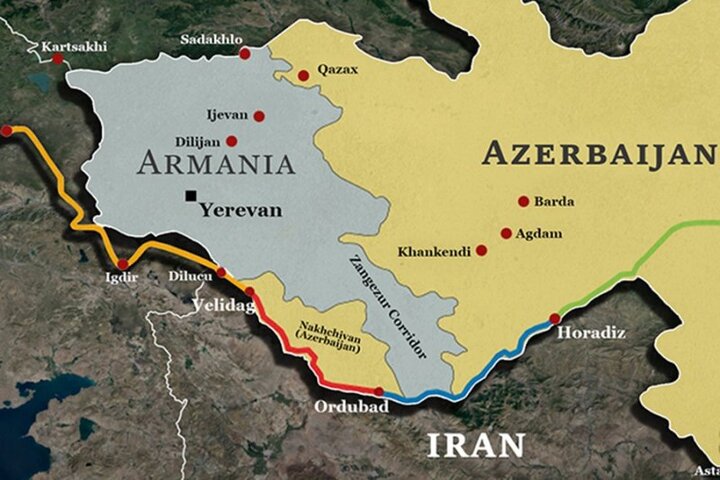
According to the International Desk of Webangah News Agency, Iran is facing a new wave of geopolitical pressure, this time from its northwest, as the “fake Zangezur corridor” project gains momentum. This development is seen as a strategic threat to Iran’s economic and cultural lifelines, prompting urgent calls for a decisive response.
The concept of “siege” has been a recurring theme throughout the history of the Islamic Republic of Iran, from the Iran-Iraq War and tensions in the Strait of Hormuz to the maximum pressure campaign and oil sanctions of the 1990s. However, recent developments in the South Caucasus indicate a new form of encirclement targeting Iran’s geoeconomic and geocultural throat from its northwest.
While Tehran engaged in costly negotiations with the Trump administration to break a naval blockade in the Persian Gulf and maintain control over the Strait of Hormuz, the article argues for an even more assertive approach to prevent the consolidation of the “fake Zangezur corridor,” also referred to as the “Trump route.” This is presented not as a choice, but a vital necessity for preserving Iran’s territorial integrity, national security, and civilizational identity in the Caucasus and Central Asia.
A core tenet of a new defense and security doctrine is understanding that threats against Iran have become fluid and networked, with adversaries exploiting geopolitical vacuums and historical passages. Therefore, Iran must prioritize neutralizing the “fake Zangezur corridor” and its continuation into Armenia, known as the “Trump route,” in future negotiations with the United States.
Concerns are amplified by the active pursuit of this corridor’s completion by Baku and Turkey. Recent reports indicate discussions between Ilham Aliyev, President of Azerbaijan, and Abraham Hamadeh, a U.S. Congressman, in Baku regarding the TRIPP route and its potential for increased regional connectivity. Both sides reportedly emphasized Donald Trump’s role in advancing Armenia-Azerbaijan rapprochement for this project, highlighting its potential to foster regional stability and new trade opportunities. Turkish state-aligned media has also repeatedly presented the Zangezur corridor as an alternative to the Strait of Hormuz, aiming to market it to Western audiences.
The article dissects the “Zangezur corridor” as a tool for geopolitical suffocation. It describes the project, allegedly driven by Turkey and Azerbaijan with U.S. and Israeli guidance, as a corridor through southern Armenia (Syunik province) designed to directly connect Azerbaijan to Nakhchivan and then to Turkey, along Iran’s border. While presented as a transit and economic route, it is viewed as a ticking time bomb threatening Iran’s national interests and security. The designation “fake corridor” stems from its purported imposition, illegality under international law, and disregard for Armenia’s national sovereignty and Iran’s vital interests.
The consolidation of this corridor is described as a “security tsunami” with several interconnected threats:
- Spillover of Hostile Forces: The most immediate threat is the potential transformation of Iran’s northwestern border into a gray zone vulnerable to hostile forces. The corridor is seen as an ideal logistical highway for NATO forces under the guise of peacekeeping or technical advisors, remaining Takfiri and Salafist elements seeking new battlefields, and pan-Turkist separatist groups aiming to annex Iran’s Azerbaijani-populated provinces. Such a presence at the tri-border area of Iran, Armenia, and Azerbaijan could serve as an advanced operational base for psychological operations, infiltration, sabotage, and destabilization of Iran’s East Azerbaijan, West Azerbaijan, Ardabil, and Zanjan provinces, leading to the “geopolitical suffocation” of northwestern Iran.
- Control of Iran’s Transit Routes: A key strategic goal for Iran is to become a transit hub for goods and energy. The North-South corridor, connecting Russia to the Persian Gulf and India via Iran, is central to this strategy. The Zangezur corridor is viewed as a direct competitor, offering an alternative route controlled by Turkey and Azerbaijan. More critically, it threatens to sever Iran’s physical and geopolitical connection to Europe and the Caucasus via Armenia and Georgia, making all land-based Iranian trade routes in the north and west dependent on those controlled by Turkey and Azerbaijan. This scenario could empower Baku and Ankara to impose tariff, bureaucratic, and security bottlenecks, rendering Iran a passive player in regional transit dynamics and undermining its ambition to become a global transit hub.
- Facilitation of Turkic World and NATO Influence: The “Turkic World” concept is described as encompassing hard and soft power tools, including Turkey’s MIT intelligence agency, TÜRKSOY, Yunus Emre Institute, TIKA, and extensive media and educational networks. The Zangezur corridor would provide a physical and logistical platform for the seamless operation of these entities along Iran’s borders. This influence is not merely security-related but is seen as a precursor to a long-term project of “identity, civilizational, and historical manipulation” in Iran’s Azerbaijani regions. Linking these regions to a Sunni-Akhwani world and a fabricated pan-Turkist historical narrative, which seeks to co-opt figures, culture, and history from Iran’s Azerbaijani areas, would become easier and more dangerous with a physical corridor connecting them to the Turkic world. This soft project aims to gradually sever the identity of people in these regions from their Iranian identity and link them to a trans-border identity led by Turkey, with the Zangezur corridor serving as the vital artery for this identity-erasing and civilization-destroying project.
- Paving the Way for Northwest Iran’s Secession: The cumulative threats—from hostile force deployment and intelligence-cultural infiltration to transit route control and severed connections to Iran’s rear—are viewed as components of a larger puzzle aimed at “paving the way for the secession of northwestern Iran.” This is not considered a far-fetched scenario, as contemporary history shows great powers creating ethnic and separatist crises to weaken rivals. The Zangezur corridor, by geographically separating Iran from Armenia (a natural barrier against extreme pan-Turkism) and enabling direct connection between pan-Turkists in Baku, Turkey, and their infiltrators within Iran, could become a powder keg for future secessionist adventures. Providing artificial respiration to this secessionist body is seen as a significant service to Iran’s enemies.
The article criticizes appeasement viewpoints that suggest cooperating with the Zangezur corridor, arguing they are dangerously simplistic and naive. Such perspectives are characterized by: believing in the benevolence of rivals, underestimating security and identity threats, and promoting geopolitical passivity. Accepting the corridor is seen as a formal admission of strategic defeat and a signal of Iran’s absolute weakness to regional actors, potentially provoking further demands.
The piece highlights a shared threat to Iran, Russia, and China, emphasizing the necessity of alliance-building. For Russia, the Zangezur corridor threatens its historical role as a bridge between Europe and the East, its transit routes, and its traditional influence in the South Caucasus, potentially bypassing and neutralizing Moscow’s influence in Armenia. For China, the “Belt and Road” initiative relies on stability and diversified transit routes. An exclusive and insecure corridor controlled by the Turkey-NATO axis directly contradicts Beijing’s interests. The Zangezur corridor’s geopolitical disruptions could overshadow the Silk Road Economic Belt’s route through Iran. China requires a stable and powerful Iran as an anchor for its plan, not one besieged by ethnic and security crises.
Consequently, the article advocates for a coordinated, multi-faceted strategy with Russia and China to counter the perceived plot orchestrated by the U.S. and Israel, executed by Turkey and Azerbaijan:
- Political and Diplomatic Axis: Iran should proactively organize trilateral or multilateral meetings with Russia and China, including Armenia, to condemn forced border changes, denounce imposed corridors, support Armenia’s territorial integrity, and warn of the project’s security repercussions.
- Economic and Transit Alliance: Alternative and robust transit projects involving Russia and China should be defined and accelerated. Initiatives like the Aras corridor (connecting Baku to Nakhchivan), the North-South corridor via Iran, and alternative routes from Iran and Armenia to Georgia and the Black Sea, with joint Chinese and Russian investment, should be developed to rival the Zangezur corridor and undermine its economic justification.
- Security and Intelligence Cooperation: Intelligence sharing with Russia and China regarding terrorist, Takfiri, and separatist group movements, monitoring NATO and Turkish intelligence activities, and designing joint security exercises in border areas can enhance the deterrent capacity of this three-part resistance axis.
- Strategic Support for Armenia: Iran, alongside Russia, should unequivocally support Armenia’s security and sovereignty, particularly in Syunik province, through defense, economic, and energy cooperation. An independent and strong Armenia is seen as the primary obstacle to the completion of the “fake corridor.”
In conclusion, the article states that Iran’s negotiation in the Strait of Hormuz was based on “collective security versus absolute instability,” a logic that should extend to the South Caucasus. Confronting the Zangezur corridor is framed as defending another geopolitical strait, one through which Iran’s identity, history, security, and future pass. It is presented as a civilizational and identity battle. Just as Iran has prevented its “breathing” from being cut off by maritime blockade in the Persian Gulf, it must not and will not allow “aggressive hands” to constrict Iran’s civilizational throat on its northwestern borders.
A strategic alliance with China and Russia is deemed an urgent imperative to break this encirclement before its completion. Tehran must decisively demonstrate that regional security cannot be stable or feasible without considering Iran’s interests. The perceived “sinister plan” by the U.S. and Israel for a new geopolitical suffocation is destined to fail against the vigilance, seriousness, and unity of the resistance front and its Eastern partners. This critical issue must be a priority in future negotiations with the U.S., leveraging the capacities of China and Russia to enhance Iran’s bargaining power and pressure the American side to achieve favorable outcomes.