
Top US General in Europe, Africa Steps Down Amid Pentagon Shake-up
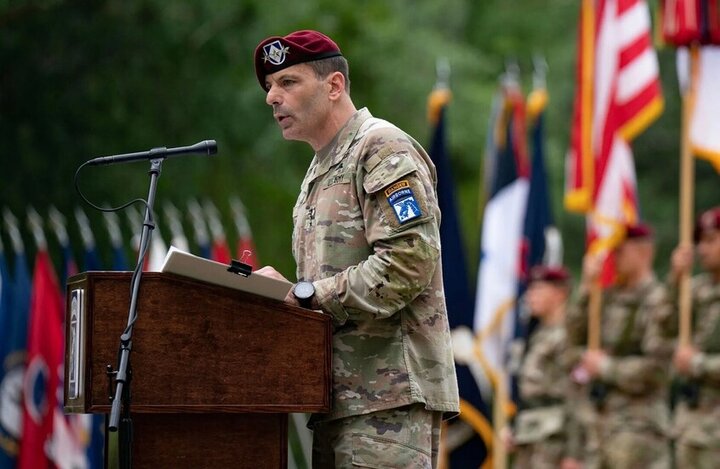
According to the International Desk of Webangah News Agency, U.S. Army General Christopher Donahue, who led American forces in Europe and Africa, concluded his tenure at a ceremony held at Clay Kaserne in Wiesbaden, Germany, on Thursday. He officially handed over command to his successor, Lieutenant General Alexis Grynkewich, who will now serve as the commander of U.S. forces in Europe and the supreme allied commander in Europe for NATO.
General Donahue, whose extensive career includes commanding the elite Army Delta Force and the 82nd Airborne Division at Fort Bragg, served in his European command for approximately 18 months. This duration is notably shorter than the typical assignment for this position. His departure comes at a time when U.S. Secretary of War Pete Hegseth has publicly indicated plans for significant personnel changes and a review of leadership within the Department of the Army, reportedly aiming to sideline officers who do not comply with his directives.
This resignation follows a series of high-profile departures from key military positions. Earlier, the Department of the Army had announced the resignation of John Filan, head of the Navy’s personnel administration. More recently, Fox News reported on the resignation of the U.S. Border Patrol chief.
The confirmation of General Donahue’s resignation last week has fueled conjecture regarding political undertones behind his decision. However, a Pentagon official, speaking on condition of anonymity, asserted that the resignation was a personal choice and that Donahue was not pressured to step down.
While the Pentagon has declined to comment on the specific resignation, the development is seen by some analysts as aligning with Secretary Hegseth’s stated objectives to reduce the number of generals appointed during the Biden administration and to streamline the Army’s command structure. Reports from German news agency DPA indicate a move towards downsizing leadership roles.
Concurrently, General Grynkewich announced that the command of U.S. Army Europe and Africa will be reduced from a four-star to a three-star general position. This adjustment could potentially impact the new commander’s scope of authority and interactions with NATO commanders, as well as alter the U.S. military’s structural framework.
These ongoing transformations have raised concerns among some retired U.S. military officials and European allies regarding a potential gradual reduction in the American military presence on the continent. Such apprehensions are amplified by recent directives, such as Secretary Hegseth’s order to withdraw approximately 5,000 U.S. troops from Germany. This action was contextualized by former President Donald Trump’s criticisms of NATO members for perceived over-reliance on U.S. military capabilities and insufficient support for Washington’s policy objectives.
As of mid-April, U.S. Army statistics indicate that approximately 86,000 American military personnel are stationed across Europe, with nearly 39,000 of them based in Germany.


