
Iranian Cleric Declares Massive Funeral Rallies a ‘Referendum’ on Islamic Republic
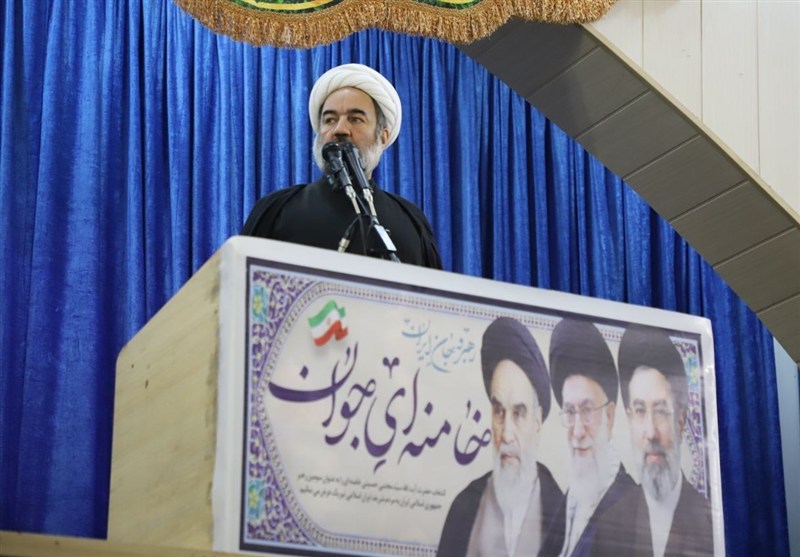
According to the International Desk of Webangah News Agency, Ayatollah Mostafa Mohamadi, the Friday prayer leader in Zahedan, asserted that the unprecedented public attendance at the funeral of a prominent leader was a definitive expression of the nation’s will, functioning as a referendum on the Islamic Republic itself. He delivered these remarks during his Friday sermon in Zahedan, also commemorating the martyrdom of Imam Sajjad (AS) and the anniversary of the Goharshad Mosque uprising.
Mohamadi drew parallels between the current mourning for a “martyred leader” and the historical significance of the events of Karbala and the martyrdom of Imam Sajjad (AS). He emphasized that the Iranian nation, like Imam Sajjad (AS) and Hazrat Zeinab (SA) after the tragedy of Ashura, must not retreat from its divine mission but instead invigorate its commitment to the culture of Ashura and the ideals of the Islamic Revolution.
The cleric described the slain leader as a “great personality of the Islamic nation,” a “comprehensive, complete, and unparalleled individual” who served as a prime example of a believer in pure Muhammadan Islam. He noted that the “veil of contemporaneity” currently obscures the full understanding of this leader’s stature and contributions, which will become more apparent over time.
Mohamadi highlighted that the massive turnout at the funeral ceremonies in Tehran, Qom, and Mashhad, as well as in Najaf and Karbala in Iraq, demonstrated the loyalty of the Iranian people and the wider Islamic community to the revolution’s values. He observed the participation of diverse segments of society, including the elderly and those with disabilities, braving hardships and heat, showcasing extraordinary love, loyalty, and sacrifice.
He articulated six key messages conveyed by the widespread public participation. The first message was a renewal of allegiance to the leadership and the ideals of the revolution. The second message underscored the unity and cohesion of the resistance front, signaling a determination to continue the path of the martyred leader with greater resolve. The third message was a demand for retribution and vengeance for the leader’s assassination, urging officials and military forces to pursue justice against those responsible.
Mohamadi criticized the perceived lack of security for those who claim responsibility for assassinations, pointing to the assassinations of prominent figures like General Qassem Soleimani, Sayyid Hassan Nasrallah, Ismail Haniyeh, Yahya Sinwar, and the “martyred leader.” He questioned why these individuals do not feel insecure despite openly admitting involvement.
The cleric also identified a continued enmity towards the United States government as a fourth message. He traced this animosity back through decades of American interference, coups, support for the Pahlavi regime, and hostile actions against Iran. He stated that beyond historical grievances, there is now a profound personal animosity due to the assassination of the “father of the nation” and leader.
He addressed the chant of “Death to America,” clarifying that it is directed at the U.S. government and its hegemonic system, not its people. Mohamadi also criticized remarks suggesting the purchase of American goods if quality and price are favorable, emphasizing that national and Islamic honor should preclude such transactions given the perceived betrayal.
In his fifth point, Mohamadi interpreted the massive funeral attendance as a clear response to suggestions for holding a referendum on the Islamic Republic system. He argued that the extensive public participation, particularly from the younger generation, served as a powerful endorsement of the revolution and its leadership.
The sixth message was directed at officials and military personnel, urging them to act with authority, revolutionary spirit, and decisiveness in fulfilling the demands of the Supreme Leader. He refuted any notion that the people are weary or incapable of resistance, asserting their readiness to defend the Islamic Revolution.
Mohamadi countered the idea that withdrawal and negotiation from a position of weakness are solutions, stating that those who propose such approaches misunderstand the revolutionary, proud, and insightful Iranian people. He concluded by emphasizing that the cost of resistance is far less than the cost of surrender, drawing a parallel between the martyred leader’s stance and that of Imam Hussein (AS) in the face of overwhelming adversity.


