
Ayatollah Ameli Links Leader’s Funeral to Regional Influence and Condemns U.S. Provocations
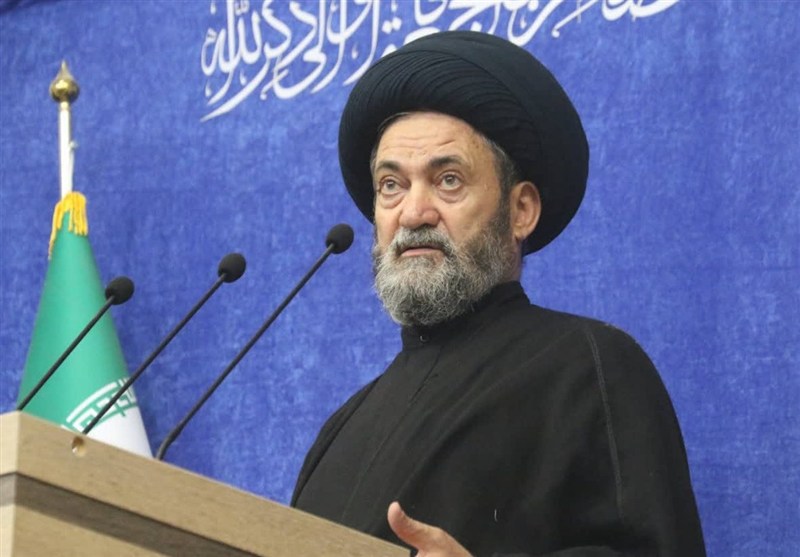
According to the International Desk of Webangah News Agency, Ayatollah Seyyed Hassan Ameli, the Friday prayer leader of Ardabil, stated in his sermon that the recent funeral procession for the “martyred leader of the Revolution” was a historic and prideful event for Iran. He noted that the ceremonies held in Tehran, Qom, Najaf, Karbala, and Mashhad were exceptional in terms of crowd size, national cohesion, public insight, loyalty, and the dispiriting effect on enemies, while also provoking anger and hostile language from them. This, he asserted, demonstrated the influence of the Islamic Revolution across the region.
Ameli highlighted that the unprecedented scale of the funeral, with an estimated over 45 million participants across Iran and Iraq, broke attendance records. He cited a foreign correspondent who expressed disbelief at the sheer magnitude of the crowds. The Ayatollah expressed certainty that the perpetrators of the assassination, identified as the United States and Israel, deeply regretted the act upon witnessing the impact on unity and resistance in Iran and Iraq.
The cleric further condemned what he termed “utter shamelessness” by President Trump, who he said mocked the Iranian people’s “sacred tears” as artificial. Ameli characterized Trump’s statements, including a reported threat to assassinate Iranian officials, as the “peak of transgression” that will ultimately lead to the downfall of tyrants.
He elaborated that Trump’s public disgrace was evident, fueled by anger over his miscalculation that the Iranian leader lacked popular support. Instead of regret, Trump resorted to severe insults against the Iranian nation, revealing his extreme agitation. Ameli posited that an angry leader’s decisions inevitably lead to regret, as true statesmanship lies in self-restraint, a quality he believes Trump lacks, leading to global criticism of his rhetoric.
The Friday prayer leader suggested that Trump’s anger stems from the enhanced national cohesion in Iran following the leader’s martyrdom, which thwarts his “sinister ambitions.” He also pointed to the global embarrassment caused by the massive funeral turnout, prompting questions within the United States about the assassination of a widely beloved figure.
Ameli accused the U.S. of desperation, citing the alleged bombing of the Tehran-Mashhad railway to disrupt funeral attendance. He also criticized the rhetoric of exiled opposition groups, who he claimed falsely attributed the large gatherings to bribery or hired individuals, thereby exhibiting “utter shamelessness” and deep betrayal.
Regarding the funeral in Iraq, Ameli emphasized its significant message, highlighting the deep affection for the leader in a foreign land. He suggested that similar turnouts would have occurred in Pakistan, Turkey, and Azerbaijan if the ceremonies had been held there. This, he explained, indicates that the slogans of the Islamic Revolution resonate with all nations and that the leader’s approach was inclusive, addressing the suffering of the entire Ummah and reviving the sacred pride of the Islamic community.
Ameli asserted that while the leader’s physical body was interred in Mashhad, his thought, ideology, and impact remain alive, marking the beginning of a new, blessed, and long-lasting life. He countered the notion that the funeral was the leader’s final blow to tyranny, arguing that the true impact began after his martyrdom, akin to the enduring legacy of Imam Hussein (AS).
The cleric drew a parallel between the leader’s assassination and that of Imam Hussein, stating that the enemy, by killing him, made him immortal. He referenced a quote suggesting that the Umayyads inadvertently immortalized Hussein, a sentiment he applied to the current leader’s fate.
Ameli then shifted focus to the strategic importance of the Strait of Hormuz, noting it as a central point of contention between Iran and the U.S. He argued that U.S. promises regarding sanctions relief were temporary and that their strategy relies on intensifying sanctions to weaken Iran. The cleric stated that Iran’s control over the Strait of Hormuz is the sole factor nullifying this plan, serving as both leverage and a significant revenue source. He warned that Iran’s dominance would spell the end for Israel, making its prevention a priority for the U.S. and Israel.
He underscored Iran’s awareness of the Strait’s importance and its refusal to allow alternative routes like the Omani passage. Ameli noted that the agreement implicitly grants Iran authority over passage arrangements, a detail the U.S. is now reportedly trying to undermine. He attributed the U.S. concessions to the potential global economic fallout of a temporary Strait closure, estimated at two trillion dollars, and a severe fuel crisis.
Ameli reiterated Iran’s right to prevent new routes and ship traffic, calling U.S. aggression contrary to the agreement. He asserted that the U.S. lacks the power to prevent Iran’s actions, leading to actions like bombing bridges, which he deemed a sign of disgrace. He also criticized the U.S. Secretary of War’s suggestion to assassinate Iranian leaders during the funeral, calling it a sign of battlefield defeat and desperation.
The Friday prayer leader expressed widespread Iranian support for the Strait of Hormuz’s protection and the government’s actions, emphasizing national unity. He stated that U.S. attacks would not disable Iran’s missile capabilities, which can be operated from anywhere in the vast country. He warned that any further U.S. missteps, like closing the Strait, would force Trump back to negotiations under more stringent conditions for Iran.
Ameli characterized Trump’s policy as an attempt to exhaust the enemy, comparing it to the prolonged “Ramadan War.” He invoked the historical example of Shah Ismail I, who encouraged his soldiers with the motto “If you are tired, say Ali,” implying that those driven by love for Imam Ali would not tire.
He stressed that U.S. aggression should not become routine, advocating for reciprocal action that deters future attacks. Ameli identified the closure of the Strait of Hormuz as the U.S. main vulnerability and suggested Iran announce its complete closure should hostilities continue. He concluded by emphasizing the need for retribution for the leader’s blood, while acknowledging that no amount of retaliation could equate to his martyrdom. He prayed for divine intervention to remove “Trumpism” from the world and separate good from evil.


