
Herzliya Security Conference Highlights Existential Threats Facing Israel
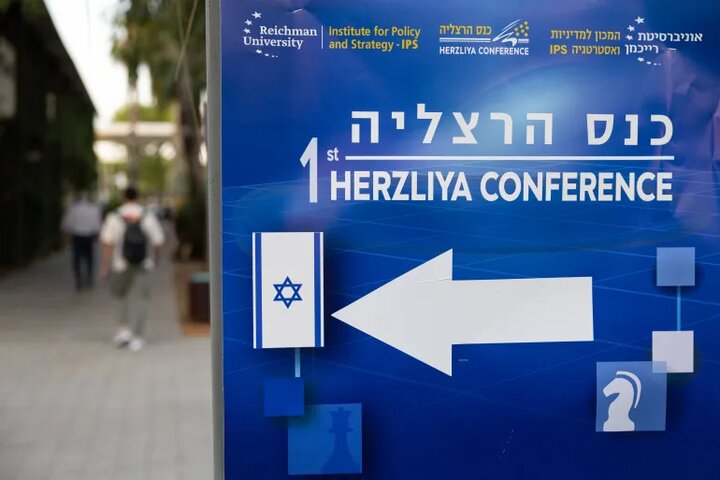
According to the International Desk of Webangah News Agency, the annual Herzliya Security Conference, a prominent security forum for the Israeli regime, was held over two days this year, focusing on the existential crises confronting the entity and the potential for its collapse. The conference brought together high-ranking political, security, and academic figures to explore solutions to these pressing issues.
Al Jazeera, in a report on the conference’s agenda and discussions, noted that the first day was dedicated to outlining the conceptual framework of Israel’s challenges. The second day saw deliberations on operational matters, including Iran, Lebanon, the United States, foreign relations, conscription, and military budgets.
Major General (Res.) Amos Gilead, head of the Institute of Policy and Strategy at Reichman University, stated in his opening address that a lack of strategic vision prevents military achievements from translating into political outcomes. He warned that persistent social immunity crises could lead to a situation where Iran merely needs to wait for Israel’s downfall.
Disjointed Foundations
Meanwhile, Israeli President Isaac Herzog spoke of a “fateful moment” in the regime’s history, extending beyond cabinet changes to the very destiny of the entity. He cautioned that a society where each faction feels like a “persecuted minority” cannot maintain the rules of the game for long.
This sentiment was echoed by Matanyahu Engelman, the Israeli State Comptroller. He announced that his office had published 50 reports related to war matters and deemed the establishment of an investigative body into the October 7th events an “unavoidable necessity.”
The Iran File and Its Borders
Professor Boaz Ganor, President of Reichman University, offered sharp criticism of the Israeli cabinet’s claims of “military victory” against Iran. Ganor argued that while Israel and the United States might have achieved tactical success in the recent campaign against Iran, they had strategically failed. He pointed out that the Iranian regime did not collapse, its nuclear program was not dismantled, enriched uranium was not destroyed, and its missile systems were rapidly rebuilt.
Former Prime Minister Naftali Bennett, concurring with Ganor’s assessment, stated that military strikes alone are insufficient. Bennett remarked that a thousand days have passed since October 7th, yet Hamas remains armed in the south, Hezbollah grows stronger, and Tehran’s sovereignty remains intact. He proposed adding a fifth element, “initiative,” to the regime’s security doctrine, alongside deterrence, warning, decisiveness, and defense.
Criticizing Netanyahu, Bennett presented sensitive statistics, noting that Iran has exceeded enrichment levels of 3, 20, and 60 percent. He asserted that between 2018 and 2021, Israel lacked the sufficient capability or an alternative plan to counter Iran crossing the nuclear threshold. He emphasized the absence of a plan in Tel Aviv to confront Iran, even as security experts believe military might cannot compensate for a lack of planning.
Power Without Policy
Gadi Eizenkot, former Chief of Staff of the Israeli military, addressed the themes of the Herzliya Security Conference, stating that Tel Aviv is failing to politically capitalize on military achievements and that the cabinet’s “strategic class” is damaged.
Avigdor Lieberman, former Minister of Defense and a right-wing opponent of the Netanyahu cabinet, added another dimension to the criticism, declaring that Israel’s strategic situation “could not be worse.”
Yair Lapid, the opposition leader, placed foreign relations at the heart of the security equation, asserting that Israel’s foreign relations have “never been this bad.” He described the current situation as a “disaster” stemming from amateurism, arrogance, and a flawed understanding of reality.
He further stated that the Netanyahu cabinet had replaced 13 officials in the Foreign Ministry over the past three years, left the domestic propaganda apparatus without a director for two and a half years, and appointed individuals close to him to sensitive positions.
These concerns deepened in discussions regarding the United States. One speaker on the second day highlighted a decline in support for Israel among young Republicans (aged 35-50) to around 50 percent. Concurrently, support for Palestinians is reportedly increasing in public polls, a trend that is beginning to exert pressure on Congress concerning military aid.
The Cost of Security
Major General (Res.) Amir Baram, Director-General of the Israeli Ministry of Defense, shifted the discussion to the costs of rebuilding military capabilities. He described the current phase as an “operational pause” rather than the end of hostilities and warned that international agreements could funnel hundreds of billions of dollars to Iran, accelerating its power reconstruction. Baram called for the implementation of a military strengthening plan valued at 350 billion shekels (approximately 94.6 billion dollars), which includes interceptor systems, offensive munitions, intelligence resources, and the restoration of readiness for systems depleted in ground and air combat.
Conclusion
Al Jazeera concluded that the Herzliya Conference demonstrated that the Israeli regime lacks cohesion not only on the international stage but also in confronting its internal conditions, with a diminished capacity for strategic planning by the cabinet. Most politicians attending the Herzliya Security Conference agreed that military power loses part of its meaning when detached from law, domestic immunity, and international legitimacy.
Consequently, the fundamental question of the conference was not “how will Israel win future wars?” but rather “how can long-term security defeat be prevented?”


