
Israel-Backed Alliance in Horn of Africa Fuels Regional Tensions
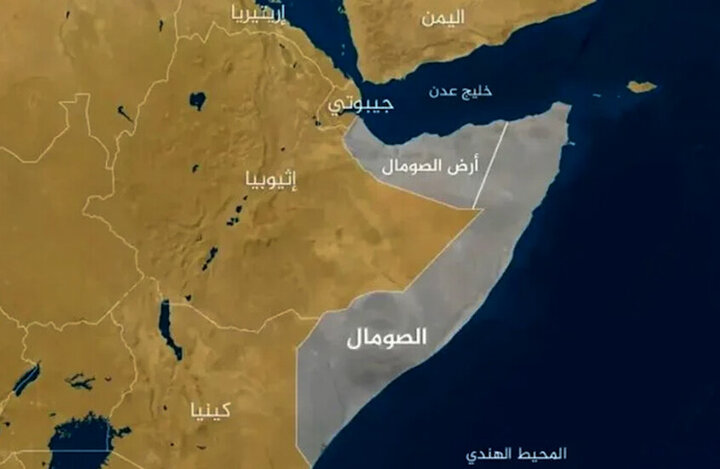
According to the International Desk of Webangah News Agency, the escalating tensions in the Red Sea are contributing to a complex political landscape in the Horn of Africa, as reported by Lebanon’s Al-Akhbar newspaper. The region is reportedly moving towards comprehensive conflict amid rising concerns over a potential complete closure of the Bab al-Mandab Strait and increasing Israeli influence in the breakaway territory of Somaliland.
The Ansar Allah movement in Yemen’s declaration of a naval blockade against Saudi Arabia, which could lead to the complete closure of the Bab al-Mandab Strait to international shipping in the Red Sea, has amplified worries for Horn of Africa nations. These countries are already grappling with severe economic consequences from what they describe as the war-mongering actions of the United States and the Israeli regime against Iran. These impacts have manifested as rising inflation, increased import costs, devaluation of local currencies, and disruptions to essential supply chains.
In recent months, there has been a noticeable deepening of the Israeli military presence in the self-declared state of Somaliland, reportedly with overt support from the UAE and implicit oversight from the US. The French newspaper Le Monde has reported on the development of extensive military facilities in the southern part of Hargeisa, the capital of the breakaway region, near its airport.
Addis Ababa Relies on Israel
Al-Akhbar further reports that against this backdrop of escalating US-Iran conflict, Ethiopia is positioning itself as a key ally of Israel and the United States in the region. Ethiopia’s primary objective through these endeavors is to strengthen its strategic and security ties with Somalia, Djibouti, and Eritrea. Ethiopia expresses concern over an Arab-Turkish convergence with its neighbors, which it characterizes as a breeding ground for ‘support of radical Islam.’ The nation claims to be striving for a political and military role to prevent the region from falling under the influence of Islamist groups. This approach, reportedly backed by regional partners including Tel Aviv and the UAE, and implicitly accepted by the administration of President Donald Trump, has led Prime Minister Abiy Ahmed to prioritize his country’s access to the Red Sea.
During the opening of the ‘Ethiopian National Dialogue’ conference, Abiy Ahmed stated that the loss of its Red Sea coastline by his country serves as a ‘historical lesson on the consequences of internal division,’ and that periods of internal strife have had negative repercussions affecting Ethiopia’s destiny.
Somaliland: A Gateway to Regional War
The sustained convergence between the Israeli regime and Somaliland has sparked growing unease among numerous regional actors. This concern was recently voiced during a meeting in Cairo between Egypt’s Foreign Minister Sameh Shoukry and his Eritrean counterpart, Osman Saleh Mohammed. Shoukry described the opening of a Somaliland embassy in occupied Jerusalem as a serious and direct threat to Somalia’s sovereignty and territorial integrity, deeming it a unilateral action by Israel that targets ‘Egypt’s national security’ deep in the Red Sea.
During their meeting, Egypt and Eritrea emphasized the necessity of activating a ‘trilateral mechanism’ involving Egypt, Eritrea, and Somalia to counter accelerating security challenges. They affirmed that security and sovereignty over the Red Sea are ‘inherent and exclusive to its coastal states.’ This stance is seen as a response to the deepening military cooperation between the Israeli regime and Somaliland, as well as Ethiopia’s persistent efforts to secure a sea outlet with sovereign rights.
Tel Aviv Fishing in Troubled Horn of Africa Waters
Meanwhile, certain Israeli research and intelligence institutions, such as the Jerusalem Center for Foreign Affairs (JCFA), have characterized these movements as a step towards ‘rebuilding a strategic alliance for stability and prosperity’ in the Horn of Africa. These reports claim that Tel Aviv has the opportunity to ‘manage a comprehensive security framework in the Red Sea,’ a framework that would not only counter the expansion of Iranian influence and its allies but also reshape international trade security to Israel’s benefit. This strategy clearly points to Ethiopia and Somaliland, which maintain close strategic and military ties with the Israeli regime.
It appears Tel Aviv intends to leverage its relationships with Somaliland and Ethiopia as a strategic base to construct an alliance in the Horn of Africa. This initiative is reportedly inspired by normalization agreements with the Israeli regime, aiming to contain Iran’s policies in supporting regional resistance through preemptive strategies and continuous military operations.
This pattern, which capitalizes on the conflicting interests of regional powers, could exacerbate the precarious conditions in the Horn of Africa and obstruct any genuine regional de-escalation efforts. It also risks creating a geopolitical reality where the traditional roles of states are diminished in favor of international and private commercial and security cartels. Despite ongoing efforts by some regional countries and their partners in the Red Sea, including Turkey, to halt this accelerated plan, conflicting interests have thus far rendered these endeavors ineffective, unless they translate into tangible actions on the ground capable of safeguarding the collective security of the Horn of Africa.


