
US Forces Accused of Deadly Wedding Attack in Sirik, Iran, Raising Questions on Weaponry
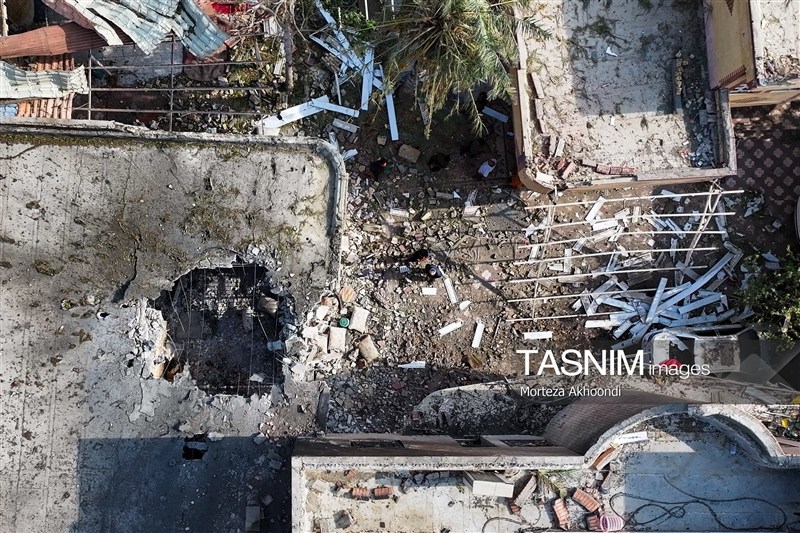
According to the International Desk of Webangah News Agency, a residential building in the port city of Sirik, Hormozgan province, where a wedding ceremony was underway, was targeted in an attack by American terrorist forces on the night of September 1, 2026. The incident tragically resulted in the death of four Iranian citizens, including a four-year-old child, and left approximately 68 others injured.
Initial investigations into evidence gathered from the scene suggest the possible use of three types of weapon systems in the attack. One of the primary targets identified was a telecommunications antenna in Sirik. However, geolocation of the hit building, where the wedding reception was taking place, indicates a distance of approximately 150 to 200 meters between the building and the antenna’s location. Analysis of the recovered weaponry fragments has so far ruled out any significant deviation in accuracy for engagement at this range.
The first potential weapon system under consideration is the SLAM ER air-launched cruise missile, manufactured by Boeing. This missile is designed for ground attack missions and is typically carried and deployed by F/A-18 Super Hornet fighter jets in the U.S. Navy. The SLAM ER is an evolution of the Harpoon anti-ship cruise missile. It features a 360-kilogram warhead, a speed of Mach 0.7, and a three-part guidance system combining inertial navigation with GPS, complemented by an infrared imaging seeker for terminal guidance. The SLAM ER has been exported to Saudi Arabia, Turkey, South Korea, the United Arab Emirates, and Taiwan.
A second possibility is the JSOW (Joint Standoff Weapon) series of air-launched glide bombs, designed by Raytheon. Experts examining the debris suggest that these tactical air-launched weapons, a key asset for the U.S. Navy, might have been employed. The JSOW family has three main variants, with two designed for submunitions against personnel and armor, and the third developed for penetrating and high-explosive payloads. Given the nature of the damage, it is believed that the Series C variant, designed for heavier payloads, might have been used. These bombs can achieve a range of approximately 120 kilometers when released from high altitudes, utilizing a combined GPS and inertial navigation system, along with an infrared imaging seeker for final targeting. The warhead weighs approximately 225 kilograms. Images released by U.S. forces themselves from previous operations have shown at least one JSOW beneath the wing of an F/A-18 Super Hornet prior to flight from the aircraft carrier USS George Bush.
The third option being considered involves American ‘Lucas’ series suicide drones. Analysis of some images and acoustic signatures has raised the possibility of these unmanned aerial vehicles being used. These drones are reportedly an American response to Iran’s Shahed 136 series. The building that was targeted and the entry point of the projectile from the roof suggest that the SLAM ER or JSOW, with their substantial explosive force, would likely have completely destroyed the structure upon impact. This leads to the hypothesis that one of the former two weapon systems might have been used against the telecommunications tower, while the attack on the house could have been carried out by Lucas drones.
The analysis of the Lucas drones reveals they are equipped with an optical system at the front and utilize a specialized military service of Starlink satellite internet called Starshield for their communication. The combination of these systems is said to eliminate the possibility of targeting errors. While the U.S. primary objective was reportedly the telecommunications tower, the current evidence does not indicate a potential deviation of 150 to 200 meters for these weapons. Furthermore, the targeted house was the only one in the vicinity where a large gathering was present for a celebration, a fact that raises further questions.
Iranian officials are asking if this incident represents a clear and explicit crime against civilians who have resisted against the U.S., given the circumstances and the potential weaponry involved.


