
Lavrov: Iran Nuclear Site Attacks Damaged IAEA Credibility, Calls for Gulf Security
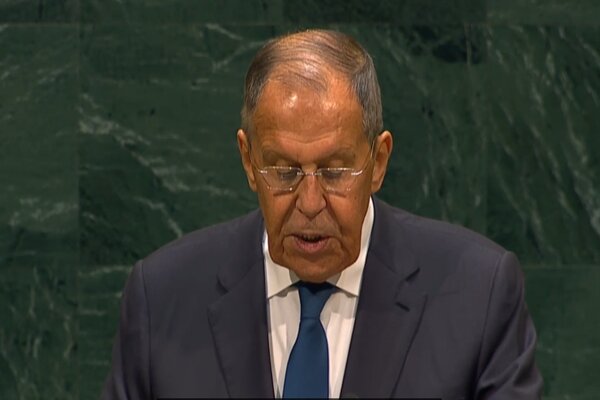
According to the International Desk of Webangah News Agency, Russian Foreign Minister Sergey Lavrov stated on Saturday during the 81st session of the United Nations General Assembly that the confrontations in the Persian Gulf and the Strait of Hormuz must cease. He announced an initiative to establish peace in the Persian Gulf region and resolve the crisis in the Strait of Hormuz. Lavrov emphasized that targeting Iran’s nuclear facilities had inflicted irreparable damage on the credibility of the International Atomic Energy Agency (IAEA).
Lavrov further elaborated that repeated armed conflicts in the Persian Gulf and the Strait of Hormuz continue to harm global shipping and trade. He asserted that resolving this crisis requires confidence-building measures among the Persian Gulf nations, Arab states, and Iran. Russia, in line with other countries, is prepared to play a constructive role in stabilizing the strategic Middle East (West Asia) region.
The Russian Foreign Minister also called for the immediate release of the President of Venezuela and his wife, stressing that such violations should not be repeated. Additionally, he urged Washington to lift trade restrictions imposed on Cuba and remove the country from the list of state sponsors of terrorism.
He added that the time has come to ensure the establishment of a Palestinian state based on United Nations resolutions. Lavrov recalled that the Security Council approved a peace plan for the Gaza Strip nearly a year ago, but peace has not yet been achieved. He noted that the situation in the West Bank is worsening due to intensified Israeli settlement activities, and without the establishment of a Palestinian state, Israel’s security will remain under constant threat.
The Russian official pointed out that the United States has dismantled the European security structure and installed an anti-Russian regime in Ukraine. He stated that Europe is attempting to obstruct the path of peace negotiations, which the U.S. government has prioritized.


