
Lebanese Newspaper Editor Details Israeli Pager Attack, Calls for Strategic Retaliation
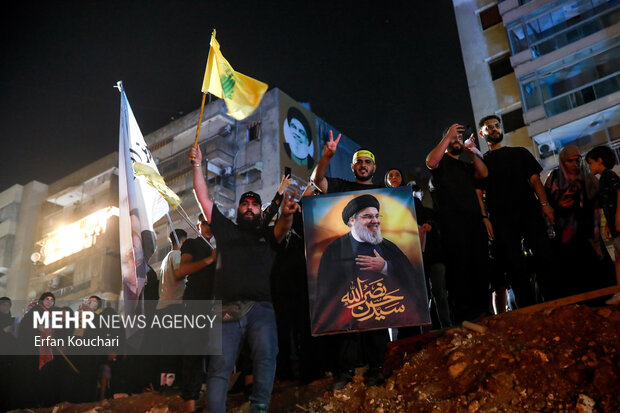
According to the International Desk of Webangah News Agency, Ebrahim Al-Amin, editor-in-chief of Lebanon’s Al-Akhbar newspaper, has shed new light on the recent Israeli operation involving the detonation of pagers, which resulted in the martyrdom and injury of a significant number of Lebanese citizens and Hezbollah elements. Al-Amin detailed in an article that a wafer-thin chip, no thicker than ordinary paper, was sufficient to equip the handheld pagers with an effect akin to a real bomb. This chip was embedded within the battery components of the wireless devices.
The Lebanese analyst asserted that the material used in this terrorist act was not manufactured in Israel but rather in a military facility belonging to the United States Army, located at one of its bases within the United States. He explained that the numerous tests initially conducted were not for the pager process itself, but for other matters that had previously been tested in various parts of the world, including Palestine, citing the assassination of Yahya Ayyash.
Al-Akhbar noted that such deception is not an unusual directive for intelligence services globally; it is an inherent, structural, and fundamental characteristic. However, concerning Israel, this deceit knows no bounds.
The Zionist “Master Key” in Executing the Pager Operation
Ebrahim Al-Amin elaborated on the pager operation, stating that Yossi Cohen, who later became the head of Mossad, began his new duties alongside Meir Dagan, whom he described as the most criminal leader of Mossad, responsible for numerous plots against Hezbollah. Dagan initiated a special program after the 2000 liberation, as the circumstances following the September 11, 2001, attacks opened all doors for him. At that time, the entire world became a hub for security activities spearheaded by the United States in retaliation for its victims.
Some time later, Dagan dispatched Yossi Cohen to Lebanon. Cohen reportedly entered Lebanon multiple times. Al-Amin emphasized that regardless of how Cohen entered Lebanon, where he resided, or whom he met, it is crucial to understand that he was the individual previously active in managing the “human infiltration plan” within Hezbollah. His primary mission was to gain access to senior resistance commanders. Cohen’s target list, in addition to Hezbollah, included all members of the party’s Jihad Council, both those known to the public and those operating in the shadows. He was equipped with all the intelligence Israel had gathered on individuals involved in developing the resistance’s capabilities.
Why Nasrallah Was the Zionist Enemy’s Top Target
The Zionist enemy managed its battle against the resistance in Lebanon with this mindset. Within this cycle, Seyed Hassan Nasrallah was recognized as a figure who posed a severe threat to the Israeli regime. From the enemy’s perspective, he was not merely a secretary-general with extensive powers but had become a comprehensive umbrella providing broad cover for a world of resistance activities against Israel across the globe. The enemy’s most significant objective was to understand the path of the martyred leader and, once identified, proceed to the execution phase.
How Can the Martyr’s Revenge Be Taken?
In the concluding section of his article, Ebrahim Al-Amin wrote that two years have passed since the martyrdom of Seyed Hassan Nasrallah, and people will not easily overcome this shock. However, the issue goes beyond weariness from the feeling of loss; resistance supporters are accustomed to loss and hold motivations in their minds and hearts that transform absence into a blessing. This, he noted, is an advantage believers possess.
Al-Akhbar added that if the goal of an all-out war on all fronts is to prevent the opposing side from resting and contemplating the future, then the Israeli regime well understands that the war is not and will not be over. The lessons learned after “Al-Aqsa Storm” clearly indicate that we are facing an enemy with whom coexistence is impossible, and this enemy, whether as a regime, an institution, or even at the population level, should not remain in the region.
The most crucial understanding is that the idea of revenge is not a tribal, angry operation but a complete mission driven by faith in justice and insistence on achieving the best results. However, it requires intelligence far exceeding Zionist cunning. More importantly, this idea necessitates steadfastness, which will find its way through a “new generation and a storm.”.
It is now clear that confronting the enemy takes many forms. However, what the resistance in Lebanon and Palestine needs is an operation of a different nature—one that involves imitation and insidious simulation of the enemy’s most malicious and painful actions. For this reason, the enemy must be understood thoroughly, in the depths of its society and in all its dimensions.
Ebrahim Al-Amin concluded by stating that it is imperative to understand how the Zionist enemy navigates within its “paper house” rooms. We must infiltrate its mind. In doing so, we will possess an instrument of revenge that is not merely the thickness of a sheet of paper, but the thickness of all history books.
Only then can we stand before the shrine of Seyed Hassan Nasrallah, not to recite prayers or shed tears, but to pay true tribute to someone who remains a testament to the legitimacy of resistance and its capacity to achieve victory.


