
US State Department Releases Full Text of Beirut-Tel Aviv Framework Agreement
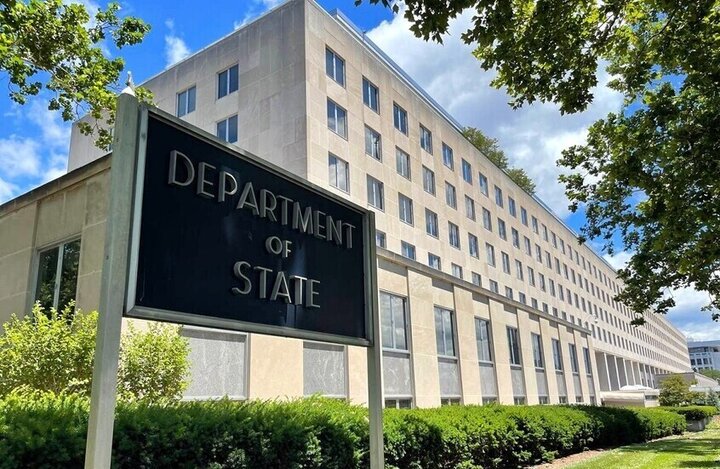
According to the International Desk of Webangah News Agency, the U.S. Department of State on Saturday published the full text of the framework agreement between Lebanon and the Israeli regime. The document, released following extensive negotiations with U.S. mediation, details a mutual commitment to ending conflict and addressing its root causes.
Key provisions of the agreement include the affirmation of both Israel and Lebanon’s right to live in peace as independent neighboring states. The framework emphasizes a shared desire for security and signals a resolve to achieve a comprehensive resolution of all outstanding issues through direct bilateral negotiations, supported by the United States. It also outlines a phased process whereby the Lebanese army would extend its sovereignty over all Lebanese territory through the disarmament of non-state armed groups.
As part of this process, detailed in an annex prepared with U.S. backing, Israeli forces would gradually withdraw from Lebanese territory. The Lebanese army is set to assume full security responsibility in designated pilot areas, serving as a mechanism for Israeli redeployment and the phased stationing of Lebanese troops. These pilot areas will transition to exclusive Lebanese government control after non-state armed groups are disarmed and their infrastructure dismantled. International support is expected to facilitate reconstruction efforts, allowing Lebanese civilians to return to these areas.
The Lebanese government has reiterated its firm commitment to exercising full sovereignty over its territory, focusing on the disarmament of all non-state armed groups to ensure they hold no military or security role. Lebanon is seeking support from international partners, particularly Arab nations led by the U.S., to achieve this objective.
Israel, in turn, asserts that its military operations in Lebanon are a direct response to threats and hostile actions by non-state armed groups, notably Hezbollah. Tel Aviv maintains that ending these threats through disarmament and the dismantling of these groups across Lebanon, coupled with agreed-upon security measures, will eliminate the need for future Israeli military action or presence. Israel explicitly states it harbors no territorial ambitions towards Lebanon.
The Lebanese government, in line with the UN Charter, affirms that its security forces bear the exclusive responsibility for the nation’s security and defense, and that the government holds the sole sovereign right to declare war and peace. Lebanon rejects any claims by any country or party to use force on its behalf without explicit authorization, deeming any such claims to play a military or security role illegal and contrary to national interests.
Both parties emphasize that the agreement does not preclude the inherent right of self-defense, recognized under the UN Charter and applicable international law, and that no third party can exercise this right on their behalf. A joint military coordination group, supported by the U.S., will be established to ensure the full implementation of the agreement.
The agreement highlights the shared goal of a secure and stable Lebanon under full government sovereignty, free from threats posed by non-state armed groups. The parties acknowledge that restoring security in southern Lebanon through the deployment of the Lebanese army and the safe return of civilians, alongside ensuring the security of northern Israeli areas, is crucial for long-term stability and peace.
The Lebanese government is committed to a decisive plan for its army to expand full military and security sovereignty within Lebanon, disarming all non-state armed groups. Lebanon welcomes U.S. support for these efforts, with new assistance contingent on tangible results and ongoing monitoring. This initiative is expected to enhance regional stability and security.
In a parallel effort, the United States will engage international partners to support Lebanon’s reconstruction, infrastructure development, economic recovery, and the creation of welfare opportunities. This includes humanitarian aid, economic improvement programs, and investment initiatives aimed at helping Lebanon overcome years of conflict.
Lebanon and the U.S. pledge to prevent the allocation of funds to entities associated with non-state armed groups and to take all legal measures to prohibit their activities. The Lebanese government specifically commits to preventing reconstruction funds from reaching these groups and their affiliates.
Following the signing, the parties will form working groups to draft a comprehensive peace and security agreement and will immediately establish complementary channels for direct and continuous communication with U.S. support. Both sides commit to proceeding in good faith until a comprehensive and lasting peace is achieved.
In pursuit of peaceful and stable relations, Israel and Lebanon commit to good-faith actions, including halting all hostile measures in international political or legal forums, and will endeavor to locate and return remains and secure the release of detainees.
The parties acknowledge and express deep appreciation for the role of the United States in supporting their efforts to end decades of conflict and establish lasting stability and comprehensive peace between them, noting the support of Donald Trump.


