Strait of Hormuz Erosion of Old Order, Persian Gulf Seeks New Security Framework
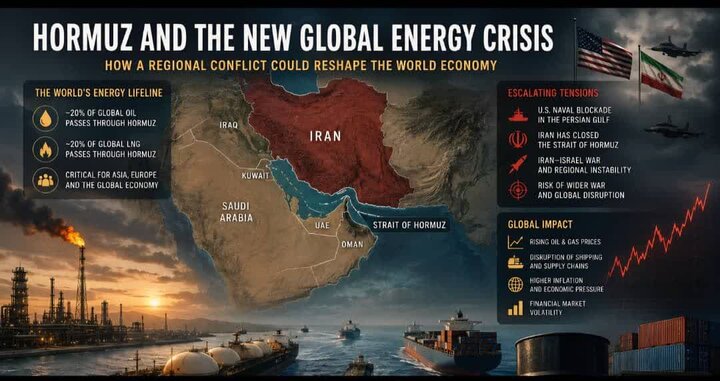
According to the International Desk of Webangah News Agency, the ongoing crisis around the Strait of Hormuz is more than a typical security confrontation in the Middle East; it represents the slow decay of a regional security paradigm that has governed the area for decades. Increased regional rivalries, the growing presence of external powers, escalating vulnerability of vital infrastructure, threats to maritime transport, and mounting concerns over energy security all point to a critical realization: the traditional security framework of the Persian Gulf is no longer adequate for the intricate demands of the 21st century.
The Strait of Hormuz has evolved beyond its role as a crucial maritime chokepoint, becoming a nexus of regional competition, global energy security, international trade, and great power rivalry. The central question is no longer whether instability in the Persian Gulf impacts the world, but rather the extent of these consequences should current tensions intensify. The answer holds significance not only for the Persian Gulf states but also for governments, corporations, and communities across the international system.
Hormuz: The Confluence of Geopolitics and Geoeconomics
The Strait of Hormuz is far more than a narrow waterway connecting the Persian Gulf to international waters; it is one of the world’s most vital strategic economic arteries. Its importance is not solely measured by the volume of oil and natural gas transiting through it. Equally crucial is its role in maintaining global market confidence and predictability. Modern economic systems depend on stability and foresight, in addition to access to resources. In an era of highly interconnected supply chains, even the perception of insecurity in a strategic maritime passage can trigger repercussions extending far beyond its geographical vicinity. Increased shipping costs, rising insurance premiums for vessels, market volatility, and disruptions to global trade routes are often the initial indicators of such instability. Consequently, Hormuz is no longer merely a Persian Gulf issue but has become a matter of global economic security.
The Demise of an Old Security Pattern
For decades, security in the Persian Gulf was predicated on a relatively straightforward logic: military deterrence. Regional states sought to secure themselves through arms acquisition, military modernization, strategic alliances, and leveraging the balance of foreign power. While this model helped avert certain types of conflict, recent developments have starkly illuminated its increasing limitations. Today, the threats facing the region extend far beyond conventional military encounters. Attacks on critical infrastructure, cyber operations, drone warfare, proxy conflicts, economic pressures, and disruptions to maritime security have fundamentally transformed the nature of strategic competition. In this context, increased military capability does not necessarily translate to enhanced security. In some instances, the accumulation of arms and intensified security competition can even foster mistrust and heighten the risk of miscalculation. The current crisis demonstrates that the Persian Gulf’s problem is not a lack of military power but a deficit in mechanisms capable of managing risks and preventing escalation.
From Energy Security to Global Economic Security
One of the most significant lessons of recent years is the increasingly blurred line between security and economics. Historically, disruptions to energy flows were primarily viewed through an economic lens. However, energy security has now become an intrinsic component of national security and international stability. Energy price shocks do not solely affect consumers; they impact inflation rates, industrial production, transportation costs, financial markets, and economic growth across various global regions. The ramifications of these developments typically extend far beyond the nations directly involved in a crisis. Therefore, instability in the Strait of Hormuz is no longer just a challenge for energy producers and consumers but poses a threat to the resilience of the global economy. The growing interdependence of modern economies means that local disruptions can rapidly create international consequences.
Great Power Competition and the Internationalization of the Crisis
The strategic importance of the Persian Gulf has also been amplified by its role within the framework of great power competition. For the United States, freedom of navigation and maritime security remain fundamental strategic interests. For China, secure access to energy resources and trade routes is vital for long-term economic stability. Europe, in turn, relies on stable energy markets and predictable trade networks. This overlap of interests has increasingly globalized regional crises. The primary risk is not necessarily direct confrontation between great powers, but rather the entanglement of local crises with broader geopolitical rivalries, making their management and containment more difficult. History has repeatedly shown that many conflicts escalate not due to a conscious decision to intensify a crisis, but because of differing interpretations of a single event by various actors. The greater the number of stakeholders in a crisis, the higher the probability of misperception, miscalculation, and unintended escalation.
Why the Persian Gulf Needs a New Security Architecture
The most crucial lesson derived from the current crisis is that enduring security in the Persian Gulf can no longer rely solely on military deterrence or traditional power-balancing arrangements. The region requires a new, multilayered security architecture capable of addressing the diverse challenges of contemporary international politics. Such an architecture must be built on several pillars: First, regional actors must establish permanent crisis management and emergency communication mechanisms to mitigate the risk of miscalculation and unintended escalation. Second, maritime security arrangements must be strengthened to ensure the continuous flow of trade and energy through vital waterways. Third, greater cooperation is needed to protect critical infrastructure, including energy facilities, ports, transportation networks, and digital systems—the foundations of regional and global prosperity. Fourth, regional security dialogues should be institutionalized to enhance transparency, reduce mutual suspicion, and manage strategic competition more effectively. Finally, energy security must be recognized as a shared regional and international interest, not a tool for geopolitical leverage. Without such measures, the region will remain trapped in recurring cycles of crisis and confrontation.
From Deterrence to Strategic Risk Management
Perhaps the most significant conceptual shift required today is the transition from a security model based solely on deterrence to one centered on strategic risk management. Deterrence remains essential, but in an environment characterized by intertwined military, economic, technological, cyber, and maritime risks, deterrence alone cannot guarantee lasting stability. The objective should not be the complete elimination of competition between states, as such a goal is unrealistic in any international system. Rather, the aim must be to prevent competition from devolving into confrontation, and confrontation into conflict. Achieving this requires a more comprehensive approach that integrates military capabilities with economic resilience, technological security, active diplomacy, and institutionalized crisis management mechanisms. In an increasingly interdependent world, risk management has become as important as deterrence.
Conclusion
The crisis surrounding the Strait of Hormuz is not merely a dispute over a strategic waterway but a reflection of deeper transformations in the regional and international security landscape. The principal challenge facing the Persian Gulf in the 21st century is not a lack of military power but an absence of effective mechanisms for managing competition, reducing mistrust, and preventing crises from escalating into broader conflicts. If the current crisis offers a significant lesson, it is that future stability will depend less on the accumulation of power and more on the creation of institutions and frameworks capable of balancing deterrence, cooperation, economic resilience, and strategic risk management. The future of the Persian Gulf—and to a large extent, the stability of global energy markets, international trade, and the world economy—will hinge on the ability of regional and international actors to forge such a framework. Therefore, the Strait of Hormuz is not just a point of regional tension but a test of whether the international community can adapt its security thinking to the interconnected and uncertain realities of today.