Iran Emphasizes Resistance and Rejects US Interference in Strait of Hormuz
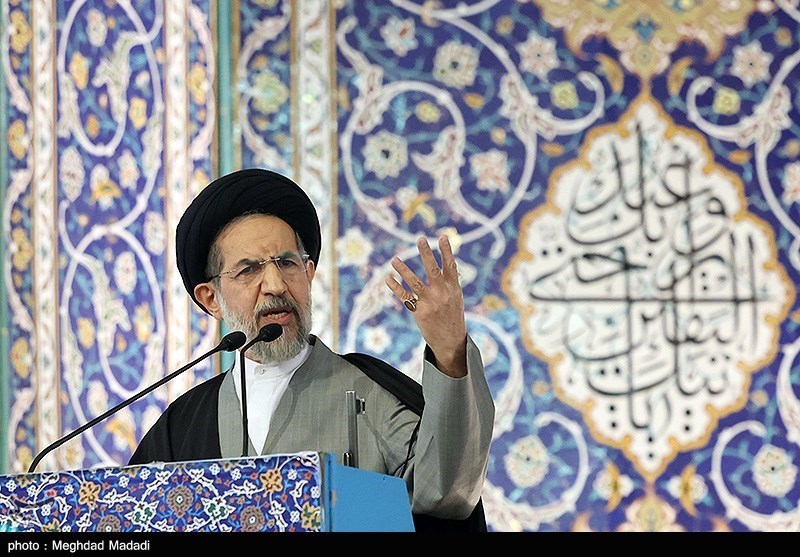
According to the International Desk of Webangah News Agency, Hojjatoleslam Seyyed Mohammad Hassan Abutorabi-Fard, the interim Friday prayer leader of Tehran, stated during this week’s prayers that unity and collective action are crucial for generating power. He highlighted the significant strength of the Islamic world today compared to the past, attributing this to collective patience, especially in confronting adversaries.
Abutorabi-Fard emphasized that the United States has historically colonized regional countries, urging the public to exercise patience exceeding that of the enemy to overcome this domination. He asserted that steadfastness against adversaries leads to victory, citing the 12-day Sacred Defense and the Ramadan War of Power as clear manifestations of this resistance, where the forces of the Sepah and the Army stood united alongside the Iranian nation.
He further underscored that military officers and the Iranian people jointly defended the country’s geographical borders and the strategically important Strait of Hormuz. “We must all maintain the highest level of connection and cohesion,” he urged, calling for collective efforts to protect rights, geographical boundaries, and intellectual and ideological frontiers.
Abutorabi-Fard described the martyred leader as a symbol of piety in personal, familial, political, economic, social, and cultural spheres. He characterized the Imam of the Ummah and the martyred leader as students of the school of imamate, standing against the arrogant world powers. He conveyed the Iranian people’s expectation that the nation’s diplomatic apparatus, trusted by the Islamic system, would engage with reckless enemies using powerful rhetoric. He urged the foreign minister to ensure that the martyred leader’s counsel on promoting the theory of resistance against formidable enemies is inscribed in negotiation rooms, as this theory is credited with generating current power and unifying Iran, Iraq, Lebanon, Yemen, Pakistan, and the entire Islamic world against oppression.
Referring to the United States’ violation of the memorandum of understanding structure between the US and Iran, Abutorabi-Fard condemned the actions of the “criminal ruling entity of the US” as unilateral and aggressive, constituting gross war crimes. He noted that the memorandum was not based on trust in the US, as the understanding mechanism is based on commitment for commitment. He affirmed Iran’s unwavering resolve in defending its national interests and the rights of its regional allies.
He expressed gratitude to the country’s armed forces, the Army and the Sepah, for exercising sovereignty over the strategic Strait of Hormuz, ensuring its security for the benefit of user nations, and for their decisive response to the provocations of the “terrorist American army.”
The interim Friday prayer leader unequivocally stated that under no circumstances would the US be permitted to interfere in the Strait of Hormuz. He recounted that during a 120-day period of intense conflict, the “terrorist American army” utilized its full capacity to wrest control of the Strait of Hormuz from the Iranian armed forces but experienced bitter defeats and incurred heavy losses. He asserted that what could not be achieved on the battlefield would never be attained by violating agreements, declaring that initiative now rests with Iran and the Axis of Resistance.
Abutorabi-Fard described the ceremonies for the martyred leader as an unparalleled, historical, and power-generating epic, created by the Islamic Ummah and the free spirits of the world, particularly the Iranian and Iraqi nations. He highlighted that millions of devoted followers in both vast and powerful countries created wonders, showcasing a new world order for Islam centered on the anti-hegemonic thought of Khomeini and Khamenei.
He further stated that the grand ceremony mourning the martyred leader demonstrated the unbreakable unity and cohesion of Islamic nations and the commander’s stunning power in the renewal of the Islamic world’s life and order. He noted that the 12-day defense, the Ramadan War, the martyrdom of oppressed students in Minab, and the ascension of a leader who lived grandly heralded the collapse of American hegemony. The stable security of American bases in the region was shattered, and the power equation shifted in favor of the Iranian nation and the Axis of Resistance, marking the beginning of Iran’s and the resistance’s era of offensive deterrence.
Abutorabi-Fard explained that the region is currently witnessing an order inspired by the faith and steadfast will of the people, the fierce fire of the battlefield, and the astonishing presence of Iranians at the funeral procession of the martyred leader. This new order is founded on contemplation, intellect, resistance, sacrifice, and adherence to principles articulated by the martyred leader and presented by the Supreme Leader of the Revolution. He stressed the importance of preserving this sacred union and strengthening the bond between the nation and the government.
He quoted the martyred Imam, who warned that one of the enemy’s tactics is to make people pessimistic about officials. While acknowledging that differences of opinion are natural in sensitive and pivotal times, he cautioned that exceeding the normal scope can hinder understanding, empathy, and cohesion in Islamic society, thereby posing a threat to national unity. He identified national unity as the cornerstone of standing against the enemy and assigned a decisive role to elites, media, and public speakers in fostering understanding and improving mutual comprehension within society. He urged avoiding any offensive words or actions and advocating for critique based on Quranic principles and knowledge, within the framework of ethical and religious guidelines, employing polite language.
Abutorabi concluded by declaring that the arrogant world and all satanic powers should understand that the slogan of revenge is not mere rhetoric but a statement born of faith and conviction. He identified those whose hands are stained with the blood of the Ummah’s leader as criminals whose guilt will never be forgiven. He asserted that the Islamic Ummah, encompassing all Islamic nations and freedom-seekers worldwide, demands retribution from these professional criminals.