
Resistance Axis Bolsters Readiness for New Conflict Wave, Emphasizing Unified Front Strategy
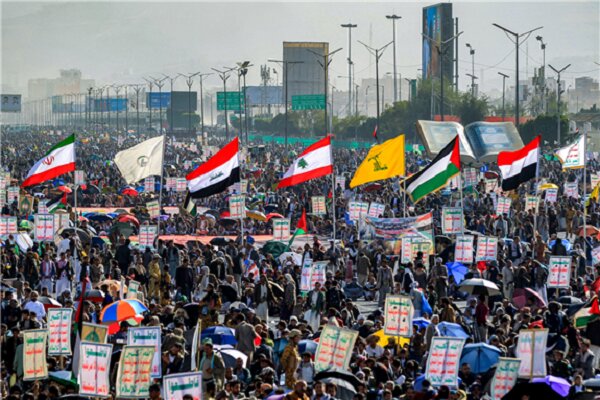
According to the International Desk of Webangah News Agency, the concept of the Resistance Axis is not a recent development but rather one with origins deeply embedded in the region’s societal fabric, culture, identity, religion, and history of anti-imperialist and anti-Zionist activism. Throughout history, regional nations have endured oppression and occupation, only to rise again from the same lands.
Since the 1979 Islamic Revolution in Iran demonstrated the power of popular will to dismantle the most formidable pillars of imperialism, to the summer of 2006 when Hezbollah in Lebanon forced the “invincible” Israeli army into a retreat, this axis has secured its victories not at negotiation tables but on the battlefield.
In 2014, the Popular Mobilization Forces (PMF) in Iraq confronted ISIS as the official government and army teetered on the brink of collapse, with Najaf and Karbala mere tens of kilometers from occupation. The Houthi movement in Yemen, despite enduring seven years of aerial, naval, and land blockade—one of the world’s worst humanitarian crises—not only refused to surrender but also entered the regional deterrence equation with missiles and drones.
Today, this axis represents not merely a tactical coalition but an identity project fueled by the experience of resistance, the blood of martyrs, and a shared collective memory that no external pressure can erase. Against this backdrop, this report will examine the role of the Resistance Axis in Yemen, Lebanon, and Iraq amidst the complex current Middle Eastern landscape.
Yemeni Dagger in the Heart of Bab el-Mandeb
The Ansarallah movement in Yemen, having withstood years of the most severe blockades and bombardments, has now entered the arena with a distinctly different language—one of negotiation and active deterrence. Not long ago, an attack on Abha Airport in southern Saudi Arabia served as Yemen’s clearest operational message for this stage, concretely translating the doctrine of “airport for airport.”
This was a direct response to Riyadh’s strike on Sana’a Airport following a disregard for previous agreement commitments, effectively transferring the cost to the aggressor’s territory. Alongside these operations, a “warning mobilization” demonstration in Saada was not merely a political show but an announcement of human resource readiness for subsequent phases. Meanwhile, the Bab el-Mandeb Strait, a chokepoint for 18 percent of global maritime trade, remains a lever that, according to Ansarallah leaders, has yet to be fully engaged, sending a clear message to the global economy.
Beyond this, the capability to target oil facilities in Saudi Arabia and the United Arab Emirates with missiles reaching up to two thousand kilometers has transformed this threat into a strategic reality. The most audacious announcement of this period was the explicit designation of Al Udeid Air Base in Qatar and Ali Al Salem Air Base in Kuwait as legitimate targets. This marks a new boundary in Ansarallah’s deterrence logic, stripping the host countries of their shield of neutrality. In this complex regional chess game, Yemen has transformed from a “shadow” role to an “active player,” demonstrating that the Yemenis have well understood that controlling this gateway and the cost they can impose on adversaries holds the key to any negotiation.
Hezbollah Lives On
Hezbollah in Lebanon, despite unprecedented pressures from multiple fronts simultaneously, continues to define resistance as the sole legitimate and unavoidable option for defending its territory and the independence and territorial integrity of Lebanon. The government of President Joseph Aoun, by signing the “Framework Agreement” with the Israeli entity on June 26, 2026, attempted to achieve through negotiation what the battlefield had denied the enemy—an agreement that Hezbollah labels a “surrender agreement” and has explicitly stated will never be implemented.
President Joseph Aoun failed to uphold his initial commitments to halt Israeli aggressions, facilitate the return of refugees, and release prisoners. Instead, the Baabda Palace became a platform for positions against the resistance. Nevertheless, senior Hezbollah representatives have clearly stated that neither governmental pressure, nor externally dictated agreements, nor attempts to criminalize resistance can divert this movement from its path. The weapons of resistance will not be handed over, as these weapons have arisen from the blood of martyrs, and the Lebanon of the future will be neither American nor Zionist.
Complex Battle in the Iraqi Arena
Despite increasing pressure from the Trump administration during a meeting with the new Iraqi Prime Minister Ali Al-Zaidi to disarm resistance groups, and efforts by some domestic factions to integrate these forces into the official government structure, the Iraqi resistance remains a stable backbone of the regional Resistance Axis. The experience of 2014 and the decisive role of the PMF in halting ISIS’s advance clearly demonstrated that the official army alone is incapable of safeguarding Iraq’s territorial integrity.
This ground reality serves as the most significant defensive bulwark for resistance groups against disarmament projects. In this context, the spokesperson for the Kata’ib Sayyid al-Shuhada and Sheikh Kadhim al-Fartousi explicitly declared that handing over weapons in exchange for government posts is a betrayal of the nation and the country. Kata’ib Hezbollah in Iraq, extending beyond domestic borders, reaffirmed its commitment to support Iran should a war resume, viewing this decision as stemming from conviction and faith, rather than political calculation.
What distinguishes the Resistance Axis from other regional coalitions is not merely its military capacity or geographical depth, but its soft power that springs from a vibrant and dynamic culture. A culture that views martyrdom not as an end but as a beginning, and resistance against oppression not as a political choice but as a religious and humanitarian duty.
When the people of Saada weep for their brothers in Gaza, when the combatants of Karbala prepare to defend Tehran, and when the people of southern Lebanon stand against tanks with bare hands, a shared narrative lies behind these scenes. A narrative that neither the United States can buy, nor Israel can bomb, nor any dictated agreement can neutralize. Today, the Resistance Axis, based on the strategy of unified fields, is more prepared than ever for a new wave of conflicts to defend its existence against aggressions once again.


