
Tens of Thousands of Moroccan Migrants Surge into Spanish Enclave of Ceuta, Sparking European Border Crisis
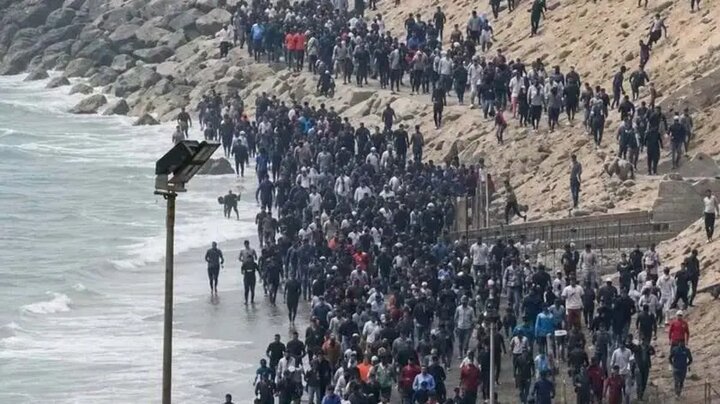
According to the International Desk of Webangah News Agency, tens of thousands of migrants from Morocco have poured into the Spanish city of Ceuta, creating one of Europe’s most significant border crises in recent years. Beyond the humanitarian dimensions, the situation has re-centered attention on historical disputes between Morocco and Spain, the European Union’s security challenges, and the ineffectiveness of its immigration policies.
Ceuta, located on Morocco’s northern coast and separated from mainland Spain by the Strait of Gibraltar, has long been a focal point for migrants seeking to reach Europe. In recent days, the city, a Spanish territory in North Africa, witnessed a massive arrival of migrants who reached the area from Moroccan shores via sea or land routes. Spanish and Moroccan sources have described this event as the largest wave of migration to Ceuta since the 2021 crisis, during which thousands also entered the territory in a short period.
While initial reports indicated the arrival of around 1,500 people, thousands more joined this wave within a single day. Local authorities eventually announced that the number of individuals who entered Ceuta over several days had reached approximately 60,000, a figure representing more than half of the territory’s population. This has created an unprecedented demographic and security situation for the Spanish government.
Humanitarian Crisis Amidst Migration Surge
The sudden increase in the number of migrants has also led to a widespread humanitarian crisis. Spanish authorities reported that at least 57 bodies have been recovered from the waters around Ceuta. These victims reportedly died from drowning or while attempting to cross border barriers. The death toll is expected to rise, with reports of several other migrants missing.
Simultaneously, migrant accommodation centers in Ceuta were overwhelmed within hours, experiencing severe capacity shortages. Local officials stated that all reception centers were full, making it impossible to accommodate new arrivals. This compelled the Spanish central government to mobilize emergency resources.
Military Deployment: Madrid’s Response to the Crisis
As the crisis intensified, the Spanish government deployed the army to assist border guards and police in Ceuta. The Ministry of the Interior announced the deployment of military forces to maintain security and control the borders.
On the other side, Moroccan security forces deployed water cannons and crowd control equipment around the city of Fnideq and the routes leading to the border to prevent new groups from moving toward Ceuta. Despite these measures, Ceuta’s geographical proximity to the Moroccan coast makes complete border control difficult. The distance between Fnideq beach and the nearest border point of Ceuta is only two to three kilometers, a distance many migrants attempted to cross by swimming.
Echoes of the 2021 Crisis
This is not the first time Ceuta has faced a massive migration wave. In 2021, concurrent with diplomatic tensions between Madrid and Rabat, over 10,000 migrants entered the area within two days. Many analysts now believe the current situation could be a repetition of that crisis, albeit on a much larger scale. Local Ceuta officials have described the current situation as a “humanitarian and social emergency,” warning that the continuation of the current trend could dismantle the public services infrastructure of the region.
Migrant Repatriation: Cautious Cooperation Between Madrid and Rabat
While controlling the borders, the Spanish government has also initiated the process of repatriating migrants. The Ministry of the Interior announced that Madrid and Rabat have reached an agreement to expedite the return of individuals who entered Ceuta illegally. Under this agreement, security forces from both countries will increase cooperation to prevent new arrivals and repatriate migrants.
Published statistics indicate that a significant portion of the migrants have already returned to Morocco in recent hours. Local officials reported the departure of tens of thousands of people from Ceuta, although thousands still remain in the territory.
Migration Crisis Exposes European Divisions
The repercussions of this crisis have extended beyond Spain’s borders. Disagreements within Europe regarding migration management have once again surfaced. Italy was among the first to react strongly, with officials calling for the suspension of Spain’s membership in the Schengen Area, arguing that Madrid had failed to protect the European Union’s external borders. Italian Prime Minister Giorgia Meloni announced her country’s readiness to take extraordinary measures, and the Italian Foreign Minister called for the closure of Schengen borders to Spain.
In response, the Spanish government labeled these positions as irresponsible. Spanish Foreign Minister José Manuel Albares emphasized that Madrid expects solidarity from its European partners rather than political statements. France, in reaction to these developments, intensified controls on its borders with Spain, and Finland supported Italy’s stance, indicating that divisions over immigration policy within the EU have entered a new phase.
Ceuta: A Nexus of Geography and Politics
The significance of Ceuta extends beyond the migration crisis. This small territory, spanning approximately 19 square kilometers, has been under Spanish control for centuries, yet Morocco considers it part of its own land and consistently emphasizes its claim for its return. This situation makes Ceuta one of North Africa’s most sensitive geopolitical points. Any security or humanitarian development in this region, beyond its border implications, can also affect the political relations between Madrid and Rabat.
Why Does This Crisis Recur?
An examination of the roots of this migration wave reveals that economic factors play a decisive role. Morocco’s unemployment rate has reached about 13 percent, with hundreds of thousands of young people outside the labor market. Many migrants hope to find a way to mainland Europe by reaching Ceuta.
Alongside economic problems, the spread of rumors about open borders has also significantly contributed to the formation of this wave. Local witnesses report that the dissemination of unofficial news on social media drew thousands of young people towards Ceuta’s borders in a short period.
A New Test for Europe
The Ceuta crisis has once again demonstrated that the European Union still lacks a unified strategy for managing migration. Disagreements among member states, increased pressure on border governments, the rise of right-wing movements, and the securitization of migration all indicate that Europe has yet to strike a balance between humanitarian considerations and security imperatives.
Although the recent cooperation between Spain and Morocco has somewhat eased the crisis, as long as the economic and social roots of migration in North Africa remain unaddressed and the European Union fails to establish a common mechanism for managing its external borders, the possibility of similar crises recurring will persist. These crises, this time, pose a challenge not only to Ceuta but to Europe’s entire security and political architecture.


