US-Saudi Strikes on Iraq Ignite Fierce Retaliation Threats, Deepening Regional Tensions
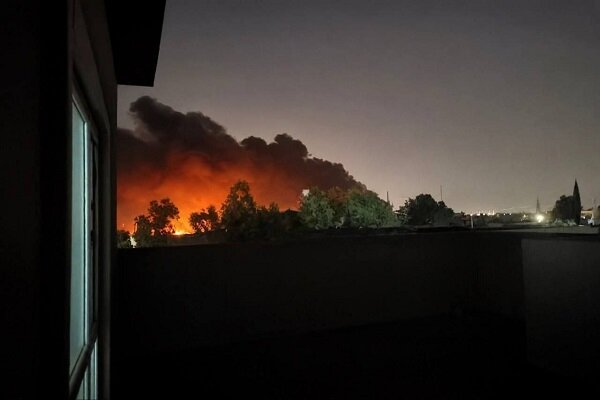
According to the International Desk of Webangah News Agency, Joint US-Saudi military operations against Iraq are being described as the most perilous wave of military tension against the country in recent months. These strikes targeted centers and bases affiliated with the Popular Mobilization Forces (PMF) across several provinces, resulting in numerous casualties and injuries.
This offensive has opened a new phase of confrontation between the United States and Iraqi resistance factions, with Saudi Arabia joining on the pretext of responding to attacks on its oil facilities, claiming to have been attacked from Iraqi territory. However, this Saudi assertion is refuted by the Ansar Allah movement in Yemen, which has claimed responsibility for those attacks and framed them as a response to the Saudi-American blockade of Yemen.
Challenges to the Iraqi Government’s “Balancing Policy”
Lebanon’s Al-Akhbar newspaper reported that the recent attack, for the first time in months of disagreement over the “weapons file,” has united Iraqis—including the government, political groups, and currents—in a common stance. All factions, albeit with varying tones, have expressed consensus in condemning the Saudi-American aggression. This attack once again demonstrated that the “balancing policy,” pursued by the Baghdad government to keep the country out of regional conflicts, faces significant challenges. Iraq’s complex social fabric and the intense polarization among political forces with diverse orientations make achieving such a policy difficult.
Immediately following the aggression, the National Security Council convened an emergency session chaired by Prime Minister and Commander-in-Chief of the Armed Forces, Ali Al-Zaidi. The council condemned the “aggression against Iraq” and emphasized opposition to “any violation of national sovereignty.” It instructed the Ministry of Foreign Affairs to “take action to document this aggression according to international law.” Concurrently, the council prioritized developing a security plan to prevent the use of Iraqi territory for threatening neighboring countries, reinforcing the government’s exclusive control over weapons, and implementing the agreement to end the international coalition’s mission.
Attack on Iraq: A Setback for the State Monopoly on Weapons Project
The government’s stance did not appease the resistance groups, who declared that condemnation statements were insufficient. The “Islamic Resistance in Iraq” issued a strong statement, giving the Iraqi government until August 6 to prove its capability to respond to the aggression. The statement characterized the events as “a real test for the project of state monopoly on weapons” and stressed that “a response to American aggression is inevitable, and if field conditions permit, Saudi Arabia may also be targeted.” However, any action would be postponed until after the Arbaeen pilgrimage.
One of the resistance group commanders informed Al-Akhbar that “resistance forces are studying the execution of a response to these attacks within 72 hours.” He emphasized that Saudi Arabia’s aggression against Iraq “will not come without cost.” He believes that “this aggression has eliminated any discussion about the handover of weapons.”
This resistance commander elaborated: “Whoever spoke of weapons monopoly or disarmament has practically received their answer; the resistance’s weapons remain and will not be bargained over.” He also revealed that “resistance groups are reviewing response options with parties of the resistance axis, including the Ansar Allah movement in Yemen, within the framework of broader regional coordination.”
In a related development, Hamed Al-Kaabi, a commander of the Sayyid al-Shuhada Brigades, asserted that “the blood of the martyrs will not be wasted” and stated with conviction that the response would be “earth-shattering.” He clarified that the timing and method would be subject to precise military calculations and emphasized that “America will regret this attack.”
Redefining Rules of Engagement in Iraq
On the ground, Baghdad and several Iraqi provinces witnessed grand funeral ceremonies for the martyrs of the bombing, attended by hundreds of thousands. Participants chanted slogans against the United States, Saudi Arabia, and Israel, vowing revenge for the martyrs’ blood, reflecting widespread public anger over the aggression.
At the parliamentary level, a representative from the “Haqq” movement, affiliated with the Hezbollah Brigades, announced the collection of over 60 signatures to hold an extraordinary session of the Council of Representatives. The session aims to demand the expulsion of the Saudi ambassador and the cessation of economic ties with Riyadh. Emphasizing that the recent attack constitutes “direct aggression” and a violation of Iraqi sovereignty and international law, the representative urged the government to take actions beyond mere condemnation statements.
Mohammad Al-Fatlawi, a researcher on political and security issues, told Al-Akhbar that the aggression has moved beyond direct military dimensions to “redefining the rules of engagement within Iraq and forcing the government to clarify its positions regarding the resistance groups.” He believes that Washington and Riyadh seek to impose a new deterrence equation following the attacks on Saudi energy facilities.
Attack on Iraq Within a Wider Regional Conspiracy
The Khanaq web portal reported that these aggressions are not merely limited military operations in response to alleged Saudi claims of attacks on its oil facilities by Iraqi resistance. Instead, they represent a Saudi-American act aimed at “reshuffling equations” within Iraq, with inevitable repercussions for the region. The action targeted a formal Iraqi security institution that plays a key role in combating terrorist and Wahhabi formations like “ISIS,” intending to divert public attention from the ongoing Israeli-American aggressions in the region.
One objective of this attack is to open a new front of tension within Iraq, scattering regional focus and diverting attention from continuous American and Israeli aggressions towards an internal conflict that would drain Iraq’s capabilities and resurrect past sectarian and political divisions. The most dangerous aspect of this aggression is the attempt to push Iraq and other regional countries towards internal and sectarian strife by targeting a prominent official security institution deeply embedded in the Iraqi landscape.
The positions of various Iraqi groups indicate a shared understanding of the nature of this event. Most Iraqis believe that the attack on the PMF stems from a broader project to recreate chaos in Iraq, serving regional objectives beyond Iraq’s borders. This project aims to occupy Iraq with an internal crisis, thereby reducing political and media pressure on American and Israeli military operations in other arenas. This allows these parties to manage multiple conflicts simultaneously while regional forces are preoccupied with the consequences of Iraq’s crisis.
In light of these developments, the Iraqi scene appears to have entered a new phase where security considerations are intertwined with regional calculations. Consequently, Iraq’s stability is no longer merely an internal matter but a significant factor influencing broader regional dynamics.