
US-China Summit Yields No Major Economic Breakthroughs Amidst Lingering Tensions
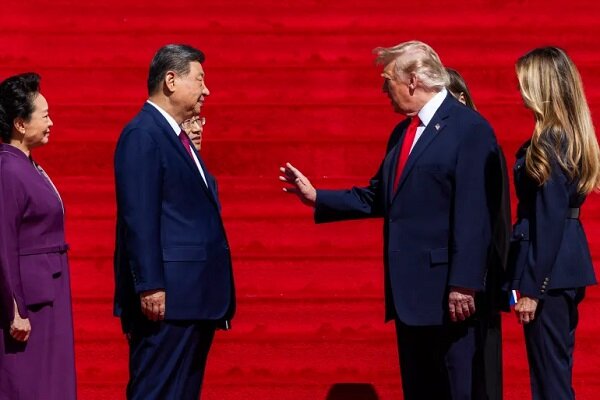
According to the International Desk of Webangah News Agency, U.S. President Donald Trump hosted Chinese President Xi Jinping for an elaborate ceremony during his official visit to the United States. However, the meeting between the leaders of the world’s two largest economies did not result in any new, impactful decisions, despite unresolved economic issues and disagreements between the two nations.
Bloomberg reported that anticipated agreements on reducing customs tariffs between the two countries or establishing a new communication channel for artificial intelligence have not yet been announced. Concurrently, Chinese stocks in the Hong Kong stock exchange saw a decline, indicating that economic markets did not experience substantial progress during the Trump-Xi summit.
Bloomberg also highlighted international disagreements between the two countries, noting that China continues to purchase crude oil from Iran despite U.S. sanctions. China also possesses spare parts for F-35 aircraft that Washington had sent to Hong Kong. Furthermore, evidence has emerged suggesting that Iran-backed Houthi forces in Yemen have utilized Chinese-made components to produce weapons. Competition between the two nations has intensified in the fields of artificial intelligence, rare earth metals, and tariffs.
Nevertheless, Trump lauded his “deep friendship” with the Chinese president and, in an unusual gesture, personally welcomed Xi upon his arrival at Andrews Air Force Base near Washington on Wednesday. He also presented Xi with a statue of an eagle, a symbol of the United States, and took him on a rare tour via presidential helicopter.
Xi, however, did not display significant emotion. He urged Trump to strengthen cooperation to ensure artificial intelligence remains “under human control,” a statement that contrasted with Trump’s earlier dismissal of AI as a potential threat to humanity. Xi stated that China welcomes American companies willing to invest and operate in his country, expressing hope that Chinese companies would receive fair treatment in the United States.
Xi also announced plans to invite 100,000 young Americans to China for educational exchange programs, an initiative signaling Beijing’s desire to improve relations with Washington.
Ryan Haas, a researcher at the Brookings Institution, told Agence France-Presse, “The display of ceremony was the main objective of this summit.” He added, “When the military displays and welcoming ceremonies are removed from the agenda, less than two hours of face-to-face meetings remain for both sides.”
Haas believes the purpose of these meetings was to demonstrate that the two presidents could effectively manage U.S.-China relations within a framework of reasonable competition.
During his meeting with Trump in the Oval Office of the White House, Xi urged caution regarding the independence of Taiwan, a self-governing island that China considers part of its territory.
According to a Chinese statement on the content of the discussions, Xi also emphasized the necessity of ending the war and reaching a negotiated solution with Tehran as soon as possible.
In a related development, U.S. Treasury Secretary Scott Sundheim announced that Beijing and Washington have agreed to extend the commercial ceasefire between the two countries for an additional two months. This ceasefire, which temporarily ended the trade war between China and the United States, was scheduled to expire next November. The trade war escalated after Trump significantly increased tariffs on Chinese goods to unprecedented levels.
Under the terms of this ceasefire, U.S. tariffs on Chinese goods were reduced, and in return, Beijing lifted export restrictions on rare earth metals. China controls a substantial portion of global exports of these materials, which are essential components for many critical U.S. industries, including technology, aviation, and defense.
Jared Mondshine, Director of Research at the Centre for American Studies at the University of Sydney, Australia, told Agence France-Presse that Trump is currently trying to stabilize relations to some extent, enabling the U.S. to fundamentally reduce its vulnerabilities to Beijing.
Trump has repeatedly urged China to purchase more goods from the United States to create a “more balanced” economic relationship. However, Xi’s visit did not lead to any commitments to purchase Boeing aircraft or American agricultural products. The United States has a significant trade deficit with China, meaning its imports of goods from China far exceed its exports to the country.
Data from the Office of the U.S. Trade Representative indicates that the value of U.S. goods exports to China reached $106 billion in 2025, while imports of Chinese goods into the United States amounted to $308.7 billion.


