BRICS Economic and Cultural Cooperation Fuels Global Influence Expansion
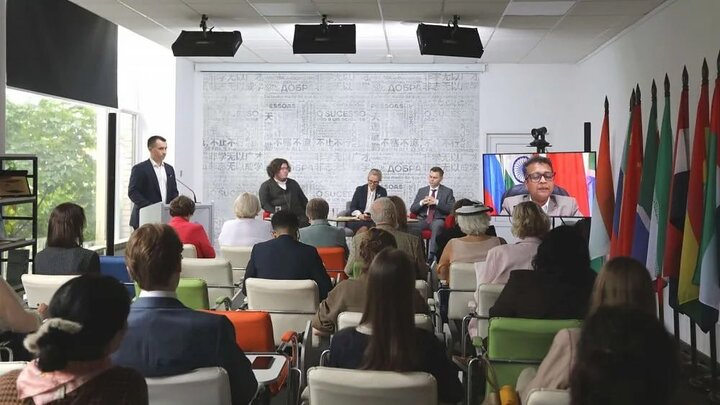
According to the International Desk of Webangah News Agency, a specialized session titled “BRICS: Twenty Years of Achievements, Outcomes, and Cooperation Prospects” was held at the BRICS Plus Cultural Media Center within the Rudomino State Library for Foreign Literature in Moscow. The event, part of a week-long celebration of BRICS’ 20th anniversary, convened representatives from international organizations, academic and cultural centers, economic actors, and public institutions of member countries.
Experts from India, China, Brazil, South Africa, and Russia presented their perspectives on BRICS’ accomplishments and future cooperation through in-person and video conference participation.
Samip Shastri, President of the BRICS Chamber of Commerce and Industry in India, characterized the bloc’s development as one of contemporary economics’ most prominent success stories. He noted that trade among member countries has surged thirteenfold over the past two decades. Shastri attributed this growth to the complementary nature of member economies, stating that the needs of one nation are met by the production of another, and learnings from one member are sought by others, thereby forming a self-sufficient economic ecosystem.
Shastri also emphasized the readiness of companies, particularly small and medium-sized enterprises, for direct cooperation, highlighting the immediate need for mechanisms to facilitate trade and investment linkages between member states.
Wang Weipeng from the BRICS Innovation Park in China shared experiences in industrial, educational, and technological cooperation between China and Russia, describing BRICS as a successful model of multilateral cooperation amid current global instability. He identified scientific and technological innovation, expanded cultural and educational exchanges, and deepened engagement with other nations as three primary areas for BRICS’ future development. Weipeng urged BRICS members to collaborate jointly in fields such as artificial intelligence, digital technologies, and smart healthcare.
Fabio Borges, Coordinator of the BRICS Observatory Project in Brazil, pointed to the establishment of the New Development Bank (NDB), founded at the 2014 Fortaleza Summit, as BRICS’ most significant tangible achievement. Borges stated that the NDB operates without imposing political conditions, unlike many traditional financial institutions, and prioritizes the needs of the Global South. He also mentioned the establishment of the BRICS Contingent Reserve Arrangement to support countries seeking to conduct trade in their national currencies.
Borges further elaborated on the expansion of cultural cooperation, noting that TV BRICS contributes to mutual understanding among nations by broadcasting films and documentaries from member countries. He added that film festivals and joint cultural programs play a crucial role in strengthening humanistic ties within BRICS.
He asserted that BRICS has become an influential force in the international system, capable of offering alternative pathways for economic and social development and fostering a more equitable global order.
Marina Zakharchenko, Director-General of the Rudomino State Library for Foreign Literature in Russia, spoke on the role of cultural diplomacy in advancing international cooperation, stressing that sustained relations between countries are impossible without understanding diverse cultures. She highlighted extensive collaborations among BRICS member country libraries in recent years, which have bolstered cultural interactions.
Kristina Muravyova, Executive Producer of TV BRICS, underscored the importance of cultural centers and libraries in preserving cultural heritage and generating new content. She stated that the outcomes and perspectives presented during the BRICS anniversary week would form the basis for media reports and analyses within member countries.
The events celebrating the 20th anniversary of BRICS are scheduled to continue until June 20, encompassing a series of cultural, educational, and diplomatic activities aimed at reviewing the bloc’s two-decade achievements in economic and humanistic spheres.