
Lebanon-Israel Security Annex Details Emerge, Highlighting Demilitarization Efforts
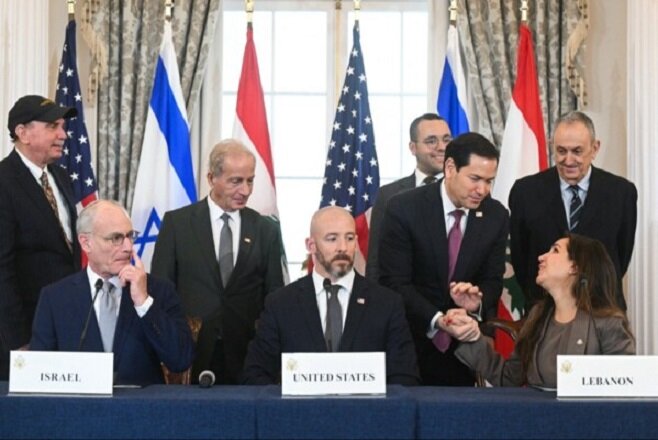
According to the International Desk of Webangah News Agency, Lebanese newspaper Al-Akhbar has reported obtaining the text of a security annex to the framework agreement between Lebanon and the Israeli regime through diplomatic channels. The newspaper indicated that the revealed document encompasses only the general framework, with specific clauses and executive titles yet to be disclosed. An informed source told Al-Akhbar that the enemy has presented detailed proposals for each article of the security annex, particularly concerning the role of the Lebanese army and its operational mechanisms.
The source added that the American side has also submitted additional proposals regarding the army, including ideas embedded within a broader framework that revive the previous plan to establish a special force for the disarmament of Hezbollah. According to the latest leaked version, the security annex includes the following provisions:
First: Determination of Pilot Zones
The parties commit to immediately designating and launching the first pilot zone in the southern part of the Litani River, within the framework of an agreed-upon military planning operation that follows a four-stage model: 1. Clearing the area and taking legal measures against all non-state armed individuals engaged in unauthorized activities, and destroying or disabling their associated infrastructure, weapons, and depots, as well as tunnels and command centers of non-state armed groups. 2. Verification of developments through a mutually agreed-upon third party, confirming the area is free from non-state armed groups and their military infrastructure. 3. Deployment of highly effective Lebanese armed forces to assume full operational control, preventing any resurgence of non-state armed group activities. 4. The Lebanese government will manage reconstruction efforts with the support of international aid and coordination through the political track.
Second: Implementation and Verification
The Lebanese army will manage the implementation of this model, with its success measured by the extent of achieving agreed-upon and verifiable disarmament and dissolution operations within the negotiation framework. Israel and Lebanon will form the “Lebanese Military Coordination Group for Security” (MCG4L), responsible for round-the-clock operations to manage de-confliction, verification, and comprehensive implementation oversight. This group will submit its reports to political authorities in Lebanon and Israel through indirect military channels, with the verification of activities proceeding in parallel with the clearing operations.
Third: Security Commitments
The Lebanese army commits to undertaking all necessary operational measures to guarantee the disarmament of Hezbollah and other non-state armed groups, and to end any military role or capability they possess within Lebanese territory.
Fourth: Gradual Redeployment
Until the completion of agreed-upon and verifiable disarmament and dissolution operations, Israel commits to a gradual reduction of its forces in Lebanese territory under specific conditions. This process will facilitate their final redeployment according to a defined plan and sequence, managed through the MCG4L and synchronized with the deployment of the Lebanese army.
Fifth: Desired Outcome
The Lebanese government, as part of broader efforts to disarm and dissolve all non-state armed groups based on the framework agreement, must restore its full sovereignty over all its territories and ensure Israel’s long-term security.
Sixth: Oversight and Dispute Resolution
The parties, with the presence of the United States, will conduct periodic reviews of the actions taken and may amend this annex by mutual agreement. Any disputes related to its interpretation or implementation will be resolved through tripartite discussions.


