
Makkah Defense Pact: A Strategic Shift Towards Collective Security in West Asia
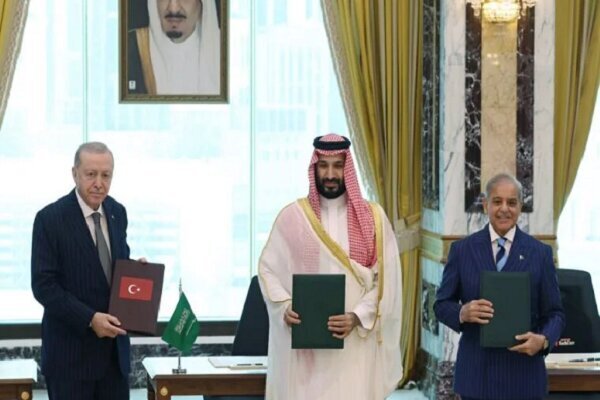
According to the International Desk of Webangah News Agency, the Makkah Joint Defense Agreement, signed on August 7, 2026, between the Kingdom of Saudi Arabia, the Islamic Republic of Pakistan, and the Republic of Turkey, should be examined within the context of accelerating security and geopolitical transformations in West Asia and in light of the historical political, economic, and defense relations between these three nations.
Saudi Arabia and Turkey, as two significant powers in the Muslim world and influential players in the Middle East, have experienced a dynamic yet continuous relationship over the past decades, evolving from political and economic cooperation to security and defense coordination. Islamabad has long maintained close ties with Saudi Arabia, with relations built on religious and social commonalities, as well as military, educational, and security cooperation. Likewise, Ankara and Islamabad’s connections are rooted in historical, cultural, and religious shared heritage, alongside defense and industrial collaboration, which have taken on broader strategic dimensions in recent years.
From this perspective, the Makkah Agreement should not be viewed as a mere temporary initiative or a limited reaction to a specific crisis. Instead, it is a product of accumulated relationships and bilateral and multilateral trust among the three countries. The significance of this agreement becomes clearer when considered in an environment where existing regional security arrangements face ambiguity and increasing pressure, and key West Asian actors are redefining their relationships with extra-regional powers and each other.
An Agreement Aimed at Restoring Deterrence
In this climate, Riyadh, Islamabad, and Ankara are striving to leverage their complementary capabilities to establish a framework for long-term defense cooperation. This framework is based on enhancing deterrence, coordination, integration, collaboration in defense industries, and the sharing of security responsibilities. Saudi Arabia’s economic and political standing, Turkey’s military and industrial prowess, and Pakistan’s defense experience and geopolitical positioning lend this agreement the capacity for strategic synergy.
Furthermore, officials from the three countries have emphasized that the Makkah Pact is not offensive in nature, does not target any specific country, and does not close channels for dialogue and diplomacy. Faisal bin Farhan, Saudi Arabia’s Minister of Foreign Affairs, described the agreement as a testament to the depth of the fraternal and strategic relations between the three nations, stressing its aim to support a more secure regional environment for the benefit of their peoples. Saudi Defense Minister Khalid bin Salman stated that the agreement creates a framework for long-term defense cooperation, boosting deterrence, coordination, and integration. Recep Tayyip Erdoğan, highlighting the strengthening of security and defense cooperation and the development of defense industries, reiterated that the pact targets no country and welcomes the participation of nations committed to regional stability. The Director of Communications for the Turkish Presidency affirmed that the Makkah Agreement does not target any country but will contribute to strengthening collective security and deterrence.
A Turn Towards Indigenous Security
The defense nature of this pact, based on its text and official statements, is founded on the principle of “collective defense” and the doctrine of “collective deterrence.” Published details of the agreement specify that the cooperation is defense-focused, does not target any particular country, and aims to strengthen commitments to maintaining regional and global peace, stability, and prosperity through shared responsibility and a common understanding of security. It is also emphasized that any armed attack against one of the three countries will be considered an attack against all of them. Pakistan’s Ministry of Foreign Affairs announced that the agreement’s objective is to bolster collective deterrence against any act of aggression and to expand defense cooperation among the three nations. This mechanism goes beyond a mere political alliance, resting on a foundation of mutual defense commitments.
Accordingly, Pakistan’s Defense Minister, Khawaja Muhammad Asif, described the agreement not as an exclusive club but as a cornerstone for the accession of other Islamic countries, urging Muslim nations to set aside their differences and stand together against common threats on a unified platform. Hakan Fidan, referencing the possibility of expanding this framework, stated Ankara’s view that the initiative should not be limited to the three countries but should encompass all nations under its umbrella if necessary.
Nevertheless, a careful examination of the technical and structural details of this agreement reveals that the absence of offensive mechanisms and the necessary logistical infrastructure for direct military intervention underscores its defensive and political approach. The lack of a standing, integrated command structure, fundamental differences in armament standards and defense networks among the three armies, and the requirement for national parliamentary approval for any military action effectively limit the formation of a swift, joint offensive force. Moreover, the divergence in the security and strategic priorities of each actor suggests that this document is more of a flexible political, psychological, and propaganda framework designed to enhance deterrence and provide political backing at the current juncture, rather than a committed war machine poised for new conflicts.
The text of the agreement itself states that the pact is not an offensive military front, an attempt at containment, or a plan for an attack, but rather a step towards creating a terror-free region aimed at ensuring regional stability. It also clarifies that the agreement does not signify the termination of any existing alliances or understandings; rather, it enhances regional security by complementing existing alliance relations. Consequently, Turkey’s NATO membership and regional partnerships are not seen as mutually exclusive but as complementary structures that facilitate the sharing of security burdens.
Conclusion
Therefore, at a time when the regional order is undergoing profound and rapid transformations, such as the Ramadan War, and traditional security structures in West Asia are facing increasing challenges, the emergence of the Makkah Defense Pact can be seen as a strategic response to these uncertainties. In an era where regional actors can no longer solely rely on external security guarantees, the move towards self-reliance and collective deterrence has become a logical choice for maintaining national and regional stability. This pact, extending beyond a classic military alliance, is indicative of an effort to shape a new, ownership-driven security architecture in the region. In this paradigm, regional powers are endeavoring to take greater responsibility for their own security. Although technical limitations exist, such as the absence of integrated command or differences in member states’ military structures, the primary significance of this agreement lies in its political paradigm shift. This orientation is not aimed at initiating conflict but at creating a deterrent barrier against common threats and power vacuums. In the current fluid and competitive environment, such initiatives are expected, as the more the regional order undergoes changes, the greater the tendency for actors to form security blocs, strengthen defense cooperation, and enhance their political and military weight. From this perspective, the Makkah Pact should be seen as a reflection of this trend, where defense cooperation, deterrence, and efforts to solidify positions within the new regional order are intertwined.


