
Iran Draws Parallels Between Saddam Hussein and Donald Trump’s Perceived Miscalculations
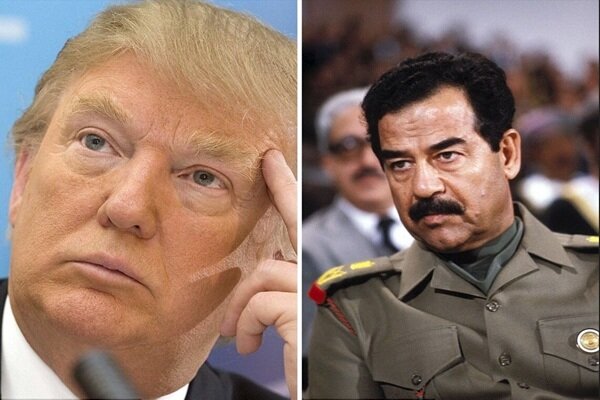
According to the International Desk of Webangah News Agency, the 46th anniversary of the Iraqi invasion of Iran under Saddam Hussein’s rule has prompted comparisons between the former dictator and current U.S. President Donald Trump. On the initial days of the Iran-Iraq War, Saddam Hussein, standing on occupied Iranian territory along the southwestern border, optimistically promised reporters an upcoming interview in Tehran.
This overconfidence stemmed from Iran’s recent tumultuous revolution, which had fundamentally altered the nation’s structures and left many institutions nascent. Senior military commanders had either fled or were apprehended and tried. The newly established Islamic Revolutionary Guard Corps (IRGC) comprised many personnel lacking military experience, leading Saddam to underestimate their ability to counter a full-scale foreign invasion. He believed he was facing a weakened Iran, susceptible to a rapid and extensive military assault for a swift and decisive victory.
This illusory ambition culminated in an eight-year war, during which Saddam failed to achieve any of his initial war objectives. The narrative suggests that Donald Trump, currently engaged in conflict with Iran, exhibits undeniable similarities to Saddam. Trump reportedly believed Iran was in a fragile state, expecting a swift and extensive aerial assault to conclude the conflict, mirroring Saddam’s initial widespread air attacks on dozens of military and civilian targets within Iran.
A further point of comparison between Trump and Saddam is their alleged involvement in war crimes. Saddam Hussein repeatedly committed war crimes during the conflict, including the use of Western-supplied chemical weapons and aerial attacks on Iranian cities and civilians. Trump is also accused of war crimes through attacks on schools, universities, hospitals, and other civilian infrastructure in the current conflict, citing the attack on a school in Minab on the first day of the war, which reportedly killed over 120 students.
Another shared characteristic lies in their relationships with certain southern neighbors of Iran. During the eight-year war, some Arab states bordering the Persian Gulf functioned as a substantial financial source supporting Saddam’s war machine and aiding his criminal acts. In the current conflict, these nations are alleged to have actively colluded with Trump and his alleged crimes by providing territory to the U.S. military and other forms of support to those invading Iranian territory. The text asserts that just as siding with Saddam in that war led to regret for these countries, they are now backing a losing horse and will not be immune to the consequences of this mistake.
The shared trait between these two allegedly delusional and criminal figures is their miscalculation of the Iranian people. Saddam Hussein had anticipated that the Arab-speaking population of Khuzestan province would welcome the invaders with open arms. However, they were among the first to staunchly resist the invasion, demonstrating enduring and historic defiance. Trump, similarly, reportedly expected widespread public unrest following heavy aerial bombardments, which would complete his plan to overthrow the Islamic Republic of Iran. He is quoted multiple times expressing his expectations of such an uprising and his frustration at the lack of public revolt.
The fate of the Iraqi dictator serves as a cautionary tale. Iraqi sources claim that as he was being led to his execution and the noose was placed around his neck, he was uttering profanities and blaming Iran for his humiliating end. Trump, the text concludes, will live under the shadow of Iranian retaliation for the rest of his life and can curse to himself to alleviate his fear and desperation. The world, it suggests, is not equipped to settle scores with these two great criminals of history, and they will find suitable companions in hell.


