
26 Years of Violence: The Ongoing Impact of Al-Aqsa Mosque Incidents on Palestinians
According to the International Desk of Webangah News Agency, the year 2026 marks 26 years since the initial incursion into Al-Aqsa Mosque by Ariel Sharon, then opposition leader and future Prime Minister of the Israeli regime. This event, occurring on September 28, 2000, shattered a period of relative calm in the West Bank and ignited a cycle of violence and bloodshed in both the West Bank and Gaza Strip that continues to the present day.
Sharon’s heavily guarded entry into Al-Aqsa Mosque 26 years ago triggered clashes that resulted in the martyrdom of seven Palestinians and injuries to 250 inside the mosque, alongside thirteen Israeli soldiers wounded. This incident served as the catalyst for an intifada that spread throughout the West Bank, Gaza Strip, and within occupied territories.
Although the Al-Aqsa Intifada officially concluded in 2004, the violence and atrocities committed by the Israeli regime did not cease. Conflicts have persisted in various regions for diverse reasons, leading to a series of uprisings and wars that have claimed hundreds of thousands of lives and inflicted widespread injuries.
Intifadas and Popular Uprisings:
- Al-Aqsa Intifada (2000-2004): Palestinian and Israeli statistics indicate approximately 4,412 Palestinians were martyred, with around 48,300 injured and 12,000 detained. This period saw raids into the West Bank, the siege of the Ramallah headquarters of the late Palestinian President Yasser Arafat, and the assassinations of prominent Palestinian leaders including Sheikh Ahmed Yassin, his successor Abdel Aziz al-Rantisi, Ismail Abu Shanab, Salah Shehadeh, Abu Ali Mustafa, and others.
- Knife Intifada (2015): The latter half of 2015 witnessed increased incidents in Jerusalem due to frequent incursions by settlers and the Israeli army into Al-Aqsa Mosque’s courtyards. Attacks on mosque defenders and those in spiritual retreat became recurrent. Tensions escalated across occupied Palestine following the arson attack on the Dawabsheh family in the village of Duma, north of the West Bank. Clashes broadened with further incursions into Al-Aqsa Mosque in September and October of that year. The Knife Intifada emerged, commencing with Muhannad Halabi’s operation on October 3, 2015, a stabbing attack in Jerusalem’s Old City that resulted in the death of two settlers and injuries to several others. That same year, 150 Palestinians were martyred in the West Bank, the majority in the last quarter of 2015.
- Prisoners’ Uprising (2017): The “Prisoners’ Uprising” began on April 28, 2017, in solidarity with the “Empty Stomachs” hunger strike, initiated by approximately 1,500 prisoners in Israeli jails protesting their detention conditions. Strikes and protests continued for several days across the occupied Palestinian territories.
- Al-Aqsa Uprising (2017): This uprising, from July 16 to July 25, 2017, was a widespread and passionate popular movement. It intensified with continuous sit-ins at Al-Aqsa’s entrances, protesting the installation of electronic gates for checking worshippers by occupying authorities. The uprising concluded with the occupying authorities retracting their decision. During this period, 15 Palestinians were martyred and hundreds injured.
Wars:
- Operation Cast Lead (2008-2009): The Israeli regime launched a war against the Gaza Strip on December 27, 2008, which it termed “Operation Cast Lead.” Palestinian resistance in Gaza responded with an operation named “Battle of the Furqan.” The brutal Israeli offensive lasted 23 days, leaving over 1,430 Palestinian martyrs, including more than 400 children, 240 women, and 134 police officers. Over 5,400 people were injured, and more than 10,000 homes in Gaza were completely or partially destroyed.
- Operation Pillar of Defense (2012): The Israeli regime’s aggression in 2012 was named “Pillar of Defense,” and Palestinian resistance countered with the “Stones of Sijil” battle. This war commenced on November 14, 2012, and lasted eight days. Approximately 180 Palestinians were martyred, including 42 children and 11 women, with about 1,300 injured.
- Operation Protective Edge (2014): On July 7, 2014, the Israeli regime initiated an operation named “Protective Edge,” to which the resistance responded with the “Undeclared Law” battle. This conflict lasted 51 days, during which the occupying army conducted over 60,000 attacks on the Gaza Strip. The war resulted in the martyrdom of 2,322 people and injuries to 11,000. The Israeli regime committed atrocities against 144 families, with at least three members martyred from each family.
- Battle of Dawn’s Cry (2019): On the morning of November 12, 2019, Gaza residents awoke to the sound of a missile strike from an Israeli drone. The missile targeted Baha Abu al-Ata, commander of the northern region for Islamic Jihad’s Al-Quds Brigades in Gaza, in his residential apartment in the Shujaiya neighborhood, east of Gaza, leading to his martyrdom along with his wife. Occupying forces carried out several attacks, resulting in the martyrdom of 34 Palestinians and injuries to over 100, including members of Saraya Al-Quds and numerous civilians.
- Operation Sword of Jerusalem (2021): The “Sword of Jerusalem” battle, termed “Guardian of the Walls” by the Israeli regime, began after settlers seized the homes of Jerusalem residents in the Sheikh Jarrah neighborhood. The conflict was ignited by incursions of Israeli forces into Al-Aqsa Mosque. This battle left approximately 250 Palestinian martyrs and over 5,000 injured. The Israeli regime also bombed several residential towers in Gaza and claimed to have destroyed about 100 kilometers of tunnels in Gaza.
- Battle of Unity of the Fields (2022): On August 5, 2022, the Israeli regime assassinated Taysir al-Jabari, commander of the northern region for Saraya Al-Quds in Gaza. The Israeli drone targeted al-Jabari in a residential apartment in “Palestine Tower” in the “Al-Rimal” neighborhood. This attack triggered a series of confrontations between Gaza’s resistance and the Israeli regime. The Gaza Ministry of Health reported that the number of martyrs in this war reached 24, including six children, while 203 people sustained injuries in various forms since the commencement of Israeli attacks on Gaza.
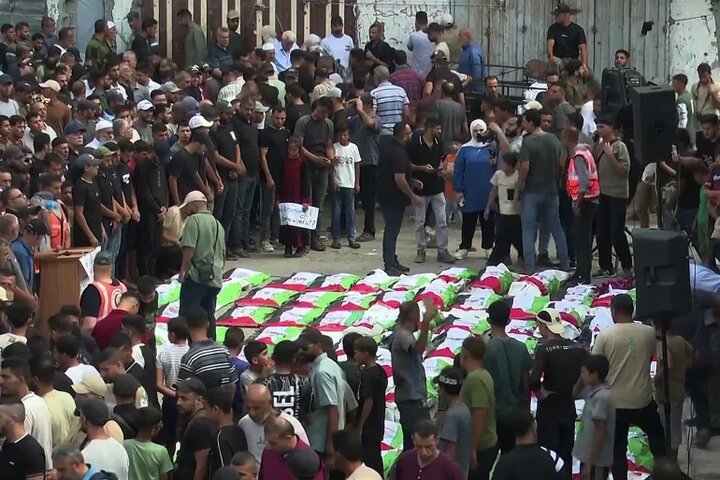
- Operation Al-Aqsa Flood (2023): In the early morning of October 7, 2023, Palestinian resistance launched an unprecedented attack on settlements surrounding Gaza, naming it “Operation Al-Aqsa Flood.” On the same day, the Israeli regime commenced its aggression on the Gaza Strip, dubbed “Iron Swords,” which has devolved into a genocide. As of September 22, 2026, this has resulted in the martyrdom of 73,914 Palestinians and the injury of approximately 175,000 others.
Total Palestinian Martyrs in the New Millennium:
Data from “Shahed Watch,” an entity specializing in documenting human rights violations by the Israeli regime from 2000 to 2026, indicates that the total number of Palestinian martyrs has reached approximately 85,597. Of these, 3,934 were in the West Bank and 81,574 in the Gaza Strip. Information regarding the demographic composition of the martyrs reveals that 24,378 were children and 13,905 were women.


