
Breakthrough in 3D Printing: Novel Zinc-Based Battery Components Developed
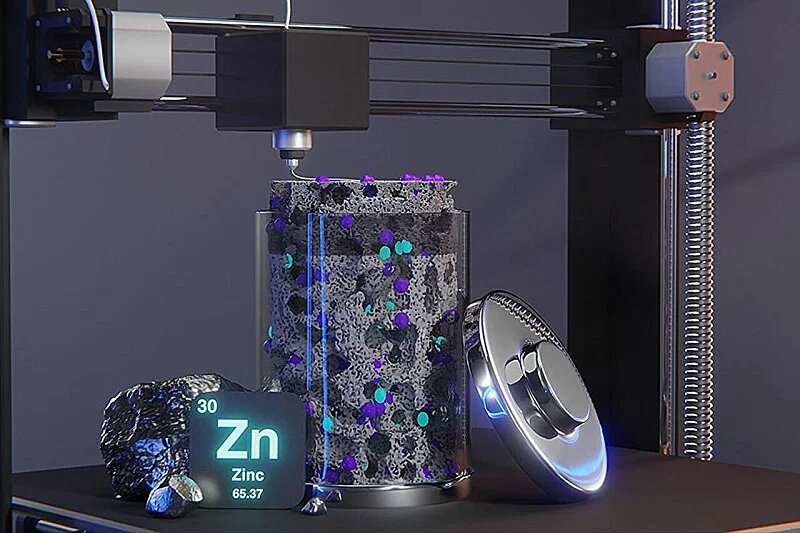
According to the Economic Desk of Webangah News Agency, a significant advancement has been made in the field of battery technology through the application of 3D printing. Scientists have developed a method to fabricate crucial elements for zinc-based batteries using sophisticated 3D printing techniques. This innovation focuses on the precise layering and incorporation of materials, including zinc compounds, to enhance battery performance and longevity.
The process involves a custom 3D printer that meticulously deposits different materials, creating complex structures with optimized internal architecture. This allows for greater control over the electrochemical processes within the battery, leading to improved energy density and charge-discharge cycles. The visual representation of the process highlights the integration of zinc, indicated by its elemental symbol ‘Zn’ and atomic weight, within a structured matrix, suggesting a novel approach to electrode design.
Zinc-based batteries are gaining traction as a more environmentally friendly and cost-effective alternative to traditional lithium-ion batteries. Their potential applications span from grid-scale energy storage to portable electronic devices. The ability to 3D print battery components offers a versatile platform for rapid prototyping and customization, allowing for the development of batteries tailored to specific energy requirements.
This development could significantly impact the renewable energy sector by providing more robust and affordable storage solutions. The ability to precisely engineer battery components at a microscopic level through 3D printing represents a leap forward in battery manufacturing, promising a future where energy storage is both more efficient and more accessible.


