
New York Mayor’s Stance on Netanyahu Warrant Ignites Political Debate
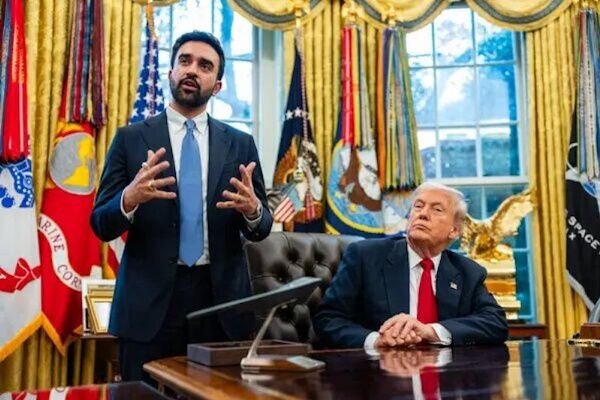
According to the International Desk of Webangah News Agency, recent remarks by New York City Mayor Eric Adams concerning the potential arrest of Israeli Prime Minister Benjamin Netanyahu have opened a case that extends beyond mere political disagreement. This situation stems from an arrest warrant issued by the International Criminal Court (ICC) in December 2024, in connection with allegations of war crimes in Gaza against Netanyahu and former Israeli Defense Minister Yoav Gallant.
Mayor Adams, who had previously spoken about efforts to enforce the warrant, announced after legal reviews that the New York City Mayor’s Office lacks the authority to do so, stating that such matters fall under the jurisdiction of the U.S. federal government. Concurrently, former President Donald Trump asserted that Netanyahu would not be arrested on American soil, transforming the case into one of the latest arenas for political confrontation in the United States.
The central question now is not only “What does American law say?” but also, “What does this confrontation reveal about the relationship between law, politics, and public opinion in the U.S. regarding the Gaza war and the Israeli regime’s case?”
U.S. Law on International Criminal Court Warrants
Under the U.S. legal system, the enforcement of international criminal laws and decisions regarding foreign obligations are handled by the federal government. Local officials, including the Mayor of New York City, do not possess independent authority to execute arrest warrants issued by the ICC.
Consequently, legal assessments by the New York City government confirmed that the Mayor’s Office cannot enforce an arrest warrant for Benjamin Netanyahu, and this responsibility, if a legal basis exists, rests with federal agencies.
Experts suggest that this limitation is more a reflection of the U.S. Constitution’s structure than solely due to Netanyahu’s status. Foreign policy, the implementation of international commitments, and cooperation with foreign tribunals are considered federal government prerogatives, and states or local governments cannot act independently in these domains.
Furthermore, the United States is not a member of the ICC and does not recognize the court’s jurisdiction. Therefore, an ICC warrant is not directly enforceable on U.S. territory.
The legal basis for this restriction can be found in Section 7423 of Title 22 of the U.S. Code, part of the “American Servicemembers’ Protection Act” enacted in 2002. Subsection (b) of this section prohibits state and local courts and authorities from cooperating with ICC requests, while subsection (d) prohibits the extradition of individuals from U.S. territory to the ICC. Subsection (e) of the same section forbids federal, state, and local entities from providing assistance to the ICC. Thus, the New York Police Department cannot arrest Netanyahu and transfer him to the ICC solely based on a warrant issued in The Hague.
This is not the first instance of an American mayor speaking out about enforcing an ICC warrant against Netanyahu. In November 2024, Dearborn Mayor Abdullah Hammoud announced that Netanyahu or Yoav Gallant would be arrested if they entered the city limits and called on other U.S. cities to adopt a similar stance. However, this position was not put to the test as Netanyahu did not visit Dearborn, and no arrests occurred. Therefore, Mayor Adams’ case is not the first of its kind but is among the few instances where a city official, following an official legal review, explicitly acknowledged a lack of authority to execute such a warrant.
Nevertheless, Mayor Adams’ statement revealed a significant reality: a distinction exists between legal authority and political stances, even within the United States. While U.S. law restricts the New York Mayor’s ability to execute an arrest warrant, this does not prevent the articulation of political demands for accountability from officials accused of war crimes and crimes against humanity.
A Confrontation Exposing America’s Political Divide
Experts believe that the Netanyahu case is not merely a legal dispute but has become a symbol of the political schism in America. On one side, Mayor Adams, citing the allegations from the ICC, called for the Israeli Prime Minister’s accountability, emphasizing that New York should not host individuals facing accusations of war crimes and crimes against humanity. On the other side, Donald Trump, in clear support of Netanyahu, rejected any action against him and underscored Washington’s continued support for the Israeli regime.
This confrontation reflects a deeper division in the American political landscape. Over recent months and years, the war in Gaza has become a contentious issue between Republicans and segments of the Democratic Party. Unconditional support for the Israeli regime has faced increasing criticism from progressive factions, academics, and human rights activists. In this context, Mayor Adams’ position, rather than being a purely personal opinion, represents a reflection of political and social demands within the U.S.
This shift in the political climate is also evident in public opinion. Recent Gallup polls indicate that American empathy for Palestinians has reached its highest level in over two decades, and among Democratic voters, it has, for the first time, surpassed empathy for the Israeli regime. This trend suggests that the Gaza war has altered a segment of American society’s perception of Tel Aviv’s policies.
Therefore, Trump’s sharp reaction to Mayor Adams’ stance can be interpreted as an effort to preserve the traditional discourse of support for the Israeli regime—a discourse now facing greater political and social challenges within the U.S. Conversely, Mayor Adams’ statements indicate that the case of Gaza war crimes is no longer solely a foreign policy issue for the United States but has become a central point of political competition and differing viewpoints within the country.
Political Message of Confrontation: Beyond Arrest Potential
Although the Mayor of New York legally lacks the authority to arrest Netanyahu, the significance of Mayor Adams’ stance should not be measured solely by legal criteria. In politics, an official statement, even without leading to practical action, can have consequences beyond an executive decision, influencing public opinion and the political atmosphere.
Mayor Adams’ remarks demonstrated that unconditional support for the Israeli regime no longer enjoys the same consensus within certain parts of the U.S. political establishment. The fact that a prominent American city official openly speaks of holding the Israeli Prime Minister accountable indicates that Washington’s official narrative regarding the Gaza war faces serious challenges domestically.
In contrast, Donald Trump’s firm support for Netanyahu highlighted that a significant segment of the American conservative movement continues to prioritize the security and interests of the Israeli regime over human rights considerations and allegations raised in international bodies. Consequently, this case was not limited to a dispute over the execution of a judicial order but evolved into a clash of two perspectives on the role of international law, governmental accountability, and the approach to the Gaza war.
Ultimately, even if the ICC’s arrest warrant is never enforced on U.S. soil, this case carries a clear message: the Gaza war and the allegations against Israeli officials are no longer confined to the Middle East but have become part of the political and legal disputes at the heart of America.
Therefore, the confrontation between Mayor Adams and Donald Trump should be viewed not as a conflict over legal authority but as an indicator of the gradual shift in the political climate and the increasing pressure from public opinion for accountability from those responsible for war crimes.


