
Yemen’s Strategic Position in Bab al-Mandab Challenges Global Economic Calculations
According to the International Desk of Webangah News Agency, recent declarations by Abdul-Malik al-Houthi, the leader of Yemen‘s Ansar Allah movement, regarding the group’s readiness for “any level of escalation in the region” serve as a deterrent message to the United States, the Israeli regime, and regional actors attempting to shift the balance of power in West Asia through military and political pressure.
Developments over the past two years demonstrate that Yemen is no longer a marginal player in regional equations. A country long embroiled in civil war and foreign aggression has emerged as a significant deterrent component within the axis of resistance, capable of impacting the global economy, international trade, and the security calculations of major powers beyond its own borders.
Greater Israel: A Plan to Reshape the Region
The Ansar Allah leader spoke of a project he described as “Greater Israel,” an endeavor aimed at altering the map of the Middle East. Following the Gaza war, many observers believe the Israeli regime and its Western backers are seeking to establish new security arrangements in the region. These arrangements primarily aim to restrict independent actors and eliminate resistance capabilities from future West Asian equations.
In this context, Yemen views itself not merely as a defender of its national interests but as part of a regional front extending from Gaza to Lebanon, Iraq, and other areas. It is from this perspective that Abdul-Malik al-Houthi emphasizes ongoing coordination with the axis of resistance, warning that any widespread war against this front will be met with a reciprocal response.
The Geopolitical Significance of Bab al-Mandab
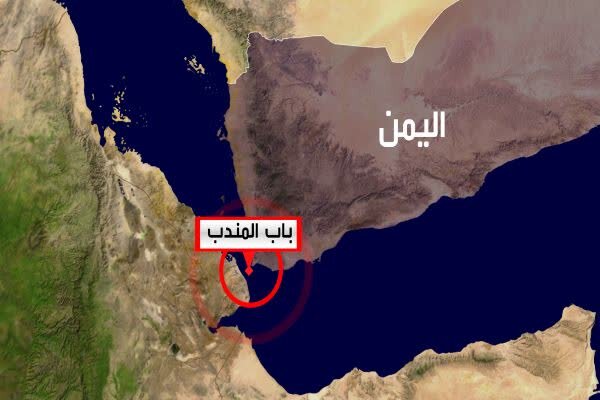
What lends greater weight to these warnings is not solely Yemen’s missile and drone capabilities, but its unique geopolitical position. The Bab al-Mandab strait is considered one of the most sensitive global energy and trade bottlenecks. This crucial maritime passage connects the Red Sea to the Gulf of Aden and the Indian Ocean. At its narrowest point, the strait measures approximately 30 kilometers in width, situated between Yemen on the Arabian Peninsula and Djibouti and Eritrea on the Horn of Africa. The importance of Bab al-Mandab is such that many experts rank it alongside the Strait of Hormuz and the Suez Canal as one of the three main arteries of global trade.
International estimates indicate that over six million barrels of oil and petroleum products transit this route daily. Furthermore, approximately 12 percent of global maritime trade and nearly 30 percent of the world’s container traffic are directly or indirectly dependent on the security of this waterway. Tens of thousands of commercial vessels, oil tankers, and military craft pass through Bab al-Mandab annually.
Any disruption in this passage could force ships to reroute around the continent of Africa via the Cape of Good Hope, a journey that adds between six to ten thousand kilometers to sea voyages and significantly increases global transportation costs. Consequently, the control and security of Bab al-Mandab are not merely regional issues but vital matters for international economy and security.
The importance of this strait is such that even Western media and research centers have repeatedly cautioned about Yemen’s decisive role in global maritime security. The daily transit of millions of barrels of oil and a vast volume of world trade through Bab al-Mandab means that any insecurity in the region immediately impacts global energy markets, maritime shipping costs, and international supply chains.
Yemen: A Power Beyond Missiles and Drones
For this reason, contrary to popular perception, Yemen’s power is not limited to its missile and drone arsenal. The country’s most significant strategic advantage lies in its ability to influence one of the world’s most critical economic arteries. This is the factor that has compelled many international shipping companies in recent months to alter their routes and incur increased transportation costs.
Indeed, if Gaza has become a symbol of popular resistance, Yemen has emerged as a symbol of the ability to transform geography into strategic power. A nation that was under siege for years is now capable of impacting crucial global security equations.
From the U.S. perspective, the situation is more complex than in the past. Washington has been striving to manage multiple crises simultaneously in recent years, from the war in Ukraine and competition with China in East Asia to supporting the Israeli regime in West Asia. In such a scenario, the opening of a new, broad front in the region could impose heavy costs on the United States.
Abdul-Malik al-Houthi’s warning about Washington’s attempts to draw the axis of resistance into a comprehensive confrontation can be analyzed within this framework. Experience has shown that whenever the U.S. and its allies have sought to increase military pressure, the resistance front has endeavored to counterbalance threats and raise the decision-making costs for the opposing side.
From this viewpoint, the Ansar Allah leader’s statements can be considered part of a deterrence strategy aimed at preventing miscalculations in Washington and Tel Aviv. In security parlance, deterrence is effective when the opposing side concludes that the cost of military action outweighs potential benefits. Yemen is currently endeavoring to convey this message.
A Warning to Regional Countries
Another significant point is Abdul-Malik al-Houthi’s explicit warning to regional countries against entering a war on behalf of the Israeli regime. This part of his speech indicates that Ansar Allah leaders believe certain regional players might enter the arena as part of American plans to contain the resistance. However, past experience has shown that many regional governments are also aware of the consequences of any widespread war and are disinclined to become part of a larger conflict.
The reality is that the West Asian region stands at a critical juncture. On one hand, the Israeli regime seeks to manage its security crises through military pressure and by altering regional balances. On the other hand, the axis of resistance aims to prevent the realization of such objectives by preserving and strengthening its deterrence capabilities.
In this context, Yemen’s role has become more significant than ever. A country once perceived merely as a humanitarian and security issue has now transformed into a decisive player in the region’s geopolitical equations. This development not only signifies a shift in the balance of power in West Asia but also marks the emergence of a new reality: one where regional security can no longer be analyzed without considering the role of non-state actors and resistance movements.
Conclusion
Ultimately, the core message of Abdul-Malik al-Houthi’s remarks is clear: any attempt to expand the war and impose the desired order of the United States and the Israeli regime will face a widespread reaction, with Yemen being one of its most critical focal points. A country that is now at the heart of West Asia’s security and strategic equations, not on the margins, and which can play a decisive role in shaping the outcome of any new confrontation.
Therefore, perhaps the most crucial aspect of current developments is that Yemen is no longer simply a war front but has become a primary component of regional deterrence. This component can complicate any calculations for initiating a new war with unpredictable and significant costs.


