
US-Europe Political Divorce Intensifies Trump’s Isolation and America’s Declining Hegemony
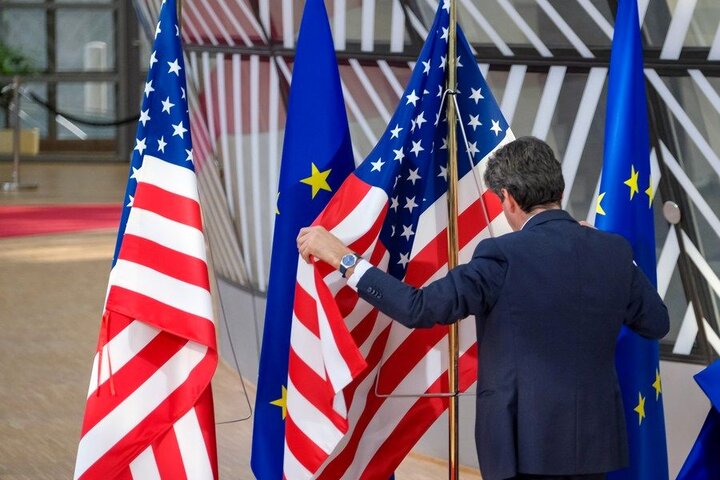
According to the International Desk of Webangah News Agency, tensions between the United States and Europe, which began with Denmark, Spain, and Italy, have reached a peak with a verbal altercation between U.S. President Donald Trump and German Chancellor Friedrich Merz. Following this tension, Merz sharpened his tone towards the Americans, stating that they had been humiliated by Iran. In response, Trump reacted with agitated remarks and decisions, including tariff increases and a plan to withdraw 5,000 U.S. military personnel from Germany.
This figure, while modest compared to the U.S. military presence in Germany exceeding 36,000 personnel as of last December, undoubtedly sent a significant message from Trump that Germany and all of Europe might face similar scenarios. Al Jazeera, in an article referencing these disagreements, notes that the political and media conflict between Trump and Merz is not merely a temporary disagreement between two Western leaders but rather a key indicator of the widening chasm in the historical relationship between the United States and Europe.
The article adds that since the end of World War II, the U.S. strategy was predicated on preventing the emergence of a dominant power in Europe and linking the continent’s security and interests with America through the North Atlantic Treaty Organization (NATO) and Western economic institutions. Thus, America’s presence in Europe was not solely for ‘supporting allies’ but served as a tool to guarantee U.S. global influence and prevent any strategic vacuum from being filled by Russia or China. Trump, however, in both his first and current terms, has demonstrated a different perspective on this equation.
He believes that his country bears an enormous financial and military burden, and Europe is exploiting America economically and militarily. The latest U.S. strategy has indicated that American policy is shifting its focus from Europe to other regions such as China and South America. While talk of a complete U.S. withdrawal from the alliance with Europe is still exaggerated, it appears Trump is inclined to ‘rebuild the relationship with Europe.’ However, dismantling the strategic structure Washington has built over approximately eight decades is not straightforward. Furthermore, constitutionally, an action like withdrawing from NATO cannot be solely decided by the President; it requires congressional legislation or a two-thirds majority vote in the Senate.
Potential U.S. Gains from Estrangement from Europe: If Washington moves toward reducing its European commitments, the immediate gain might be a partial reduction of the military and financial burden. Trump’s supporters argue that America spends billions of dollars annually to maintain its overseas military presence, funds that could instead be directed domestically. Moreover, reduced commitments to Europe could grant Washington greater capacity to concentrate on Asia, where China is considered the most serious strategic challenge for the coming decades. There are also commercial interests associated with using security as a bargaining chip by Washington to obtain economic advantages from European nations. From this perspective, a partial retreat from Europe does not signify ‘complete isolation’ but rather a redistribution of resources towards the Indian and Pacific Oceans.
Some American conservatives also contend that pressuring Europe might push them to accept their own defense responsibilities rather than relying almost perpetually on American power. U.S. Damages in Political Divorce from Europe: Al Jazeera points out that ‘the U.S. losses in separating from Europe could outweigh its benefits,’ asserting that a U.S. withdrawal from its alliance with Europe is not without significant strategic risks. Post-World War II American power was not solely based on economy and weaponry but on an extensive network of alliances that positioned Washington at the center of the Western world politically, militarily, and economically. Consequently, Europe is not just an ordinary ally or America’s largest economic and political partner; it represents a significant volume of diplomatic, technological, and industrial approaches.
The European Union, in its initial reaction to Washington’s decision to withdraw some of its troops from Germany, emphasized that the presence of American forces in Europe also benefits Washington. The iPaper website writes in this regard that American bases in Europe hold significant logistical importance for supporting U.S. military operations in regions like the Middle East. Therefore, withdrawing a large number of troops from Europe would undermine U.S. strategic interests.
This English website quotes Dr. Wynn Reece, a retired Professor of Political Science and International Relations at the University of Nottingham, emphasizing that any U.S. action in the Middle East, for instance, would necessitate transferring assets from Europe. Thus, the withdrawal of these assets would mean ‘cutting off America’s own hand.’ The website also quotes Noel Hage-Mikhael, Director of the Defence and Security Research Centre in London, stressing that a strong, cohesive, resilient, and democratic Europe is ultimately in America’s interest.
Linus Kujala, a European affairs specialist, wrote in The New York Times in a similar vein: Americans may later regret the weakening of one of their most important strategic investments in Europe; military presence there not only protects Europeans but also provides Washington with global influence, logistical depth, and the ability to manage crises from the Middle East to Ukraine. As Al Jazeera notes, the damages to the U.S. from severing ties with Europe are not limited to the military aspect; they could entail immense economic and commercial losses, especially since the European Union is America’s largest trading partner and the largest source of foreign direct investment in its economy.
Consequently, the economic and commercial losses from losing its largest trading partner for Trump include: loss of strategic and military influence; current U.S. military bases in Europe ensure control over shipping lanes in the Atlantic Ocean and the Mediterranean, which are vital arteries of global trade. A deadly geopolitical vacuum; if America withdraws from Europe, powers like China might increase their influence in these regions. Weakening of international standing and soft power; the U.S. sidelining of a European ally will cause concern among other allies, who will foresee a similar fate for themselves and seek alternatives. Temporary Crisis or the Dawn of a New Era: While it cannot yet be definitively stated that the U.S. is heading towards a complete severing of ties with Europe, it is clear that the relationship is undergoing a phase of profound redefinition. The post-World War II global order is rapidly changing, and America no longer views traditional alliances in the same way as Cold War generations did.
Complete strategic distancing from Europe, though potentially providing America with short-term financial gains, military capabilities, and political maneuvering space, would in the long run lead to a loss of influence, ally loyalty, economic leverage, and geopolitical control. Ultimately, Washington faces the concern that the earthquake initiated by the verbal clash between Trump and Merz, which opened the door for some unspoken sentiments to be aired, could eventually lead to the collapse of the global security architecture that has endured for 80 years, heralding more severe storms in an already tumultuous world.


