Trump and Netanyahu: Tactical Differences Mask Strategic Accord on Iran
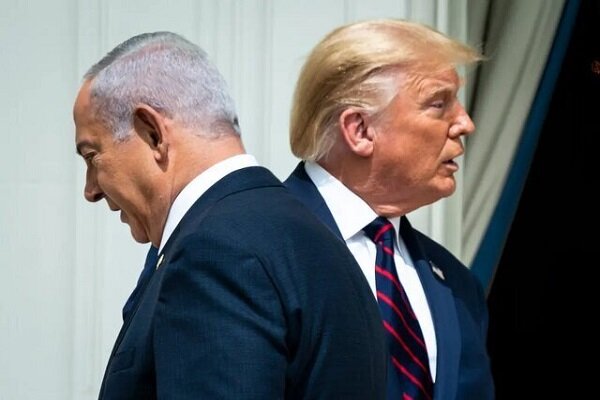
According to the International Desk of Webangah News Agency, tensions between U.S. President Donald Trump and Israeli Prime Minister Benjamin Netanyahu are not merely personal political frictions but are rooted in a structural reality where Israel serves as a crucial security proxy and executive arm for Washington’s regional balance of power strategy. However, this proxy status does not necessitate complete alignment in objectives, timelines, or methods.
The divergences between Netanyahu and Trump largely reflect differing views on exploiting crises, the extent of pressure on Iran, and the desired level of regional instability. Following the Ramadan War, Israel appeared to pause escalation, not necessarily due to a strategic shift, but as a result of immediate battlefield conditions and U.S. crisis management preferences. It later became evident that direct negotiation might not fully achieve Washington’s objectives, thus exposing operational differences.
Israel sought to increase the cost of de-escalation by keeping surrounding fronts active and preventing a low-tension equilibrium. This strategy included increased pressure on Hezbollah, aiming to force Iran into a choice between reaction or enduring attrition. Concurrently, limited but significant U.S. movements near southern Iran indicated that Washington had not abandoned the option of hard pressure. The core distinction lies in the U.S. calibrating pressure against containment and negotiation possibilities, while Israel views it in terms of perpetuating crises and preventing stabilization.
Furthermore, the political survival of both Trump and Netanyahu currently stands in opposition, with one favoring agreement and the other advocating for continued conflict.
The tactical disagreements between Trump and Netanyahu can be analyzed on three interconnected levels: the definition of Israel’s role in U.S. regional strategy, the management of crises and the use of military tools, and the political survival imperatives of both leaders. These factors have created a situation where, despite the enduring alliance, operational and political coordination faces challenges.
On the first level, the U.S. views Israel as a security asset for maintaining regional balance and countering geopolitical rivals, but the utilization of this asset is a point of contention. Trump, even while endorsing pressure on Iran, prefers it to be applied in a manner that allows for containment, bargaining, and leverage at the negotiation table. In this view, tension is desirable only if it translates into a bargaining chip, not if it escalates into unmanageable, high-cost conflict. Netanyahu, conversely, sees Israel not merely as a balancing tool but as an actor that must destabilize Iran’s security environment by continuously generating crises, thereby preventing political processes that could ease structural pressure on Tehran. What Washington deems manageable pressure, Israel often considers insufficient and requiring significant escalation.
The second level highlights differing perspectives on the function of war and crisis. For Trump, military threats are primarily instruments to compel withdrawal or agreement, rather than ends in themselves. He prefers using displays of force, limited actions, and combined pressure to shape adversary behavior without engaging in protracted warfare. Netanyahu, however, particularly when the continuation of a crisis environment supports his government’s survival logic, perceives crisis not just as a pressure tool but as a favorable political-security milieu that suspends domestic threats and maintains ruling coalition cohesion. Consequently, whenever diplomatic avenues or crisis containment arrangements lean towards relative stability, Israel attempts to disrupt the equilibrium through activating peripheral fronts, conducting limited but provocative strikes, or expanding insecurity. This dynamic intensifies the gap between Trump’s deal-centric approach and Netanyahu’s crisis-centric outlook.
Finally, the issue of survival emerges as the most significant factor driving divergence. Netanyahu’s political survival is increasingly tied to maintaining a security atmosphere, delaying a return to internal conflicts, and preserving his image as a leader in a state of emergency. For him, crisis is not merely a foreign policy tool but an integral component of domestic power reproduction. Trump, on the other hand, assesses regional dynamics primarily through a cost-benefit lens for U.S. domestic politics. He aims to demonstrate the ability to maintain pressure and elicit concessions without getting entangled in costly wars. Aligning fully with Netanyahu’s preferred model could lead Trump into an expensive arena with no clear domestic gains. Therefore, the existing differences are not rooted in opposition to the fundamental antagonism towards Iran but in divergent methods of exploiting this antagonism: one seeks containment and deals through pressure, while the other views sustained crisis as a security and political necessity.
Despite these differences, it is crucial to recognize that the disagreements between the U.S. and Israel are largely tactical rather than fundamental. Washington and Tel Aviv share significant common interests. Currently, a major tactical divergence concerns the approach to war with Iran, with the U.S. President viewing a prolonged, attritional conflict with the Islamic Republic as contrary to his personal and Washington’s interests. Conversely, Israel perceives the end of conflict as the end of its aspirations to overthrow the current political system in the Islamic Republic.