Lebanon-Israel Deal Under Scrutiny: A Washington-Planted Time Bomb
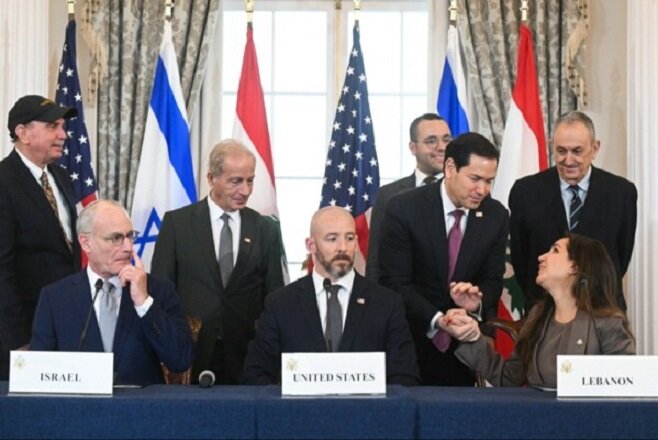
According to the International Desk of Webangah News Agency, a deeply contentious political reality lies beneath the diplomatic smiles and camera flashes that marked the signing of the “Framework Agreement” in the American capital. While ostensibly presented as a lifeline for a seemingly embattled Lebanon, a closer examination of its clauses and provisions, free from media hype, exposes a document drafted with American-Zionist ink, aiming to steer Lebanon down a predetermined path fraught with political and security pitfalls.
The agreement’s first clause ostensibly guarantees Lebanon’s sovereignty and the withdrawal of the Israeli army from Lebanese territory. However, this premise suffers from a critical structural flaw: Clause 2 explicitly links this withdrawal to the “confirmation of the disarmament of armed groups” and the dismantling of their infrastructure. This “impossible condition” demands that the Lebanese army achieve what the Israeli military machine itself has been unable to accomplish. Given the apparent impossibility of Hezbollah voluntarily disarming, this clause provides Tel Aviv with a golden, legitimate pretext to remain on Lebanese soil.
The true malevolence of the Israeli regime toward Lebanon becomes starkly evident as Prime Minister Benjamin Netanyahu, while the ink on the agreement was still fresh, violated Clause 5. He declared that Israel would remain in the “security zone” in southern Lebanon and would not allow refugees to return. This statement directly contradicts the document’s assertion in Clause 5 that Tel Aviv “has no territorial ambitions in Lebanon.” Netanyahu is not negotiating a withdrawal; he seeks to solidify an occupied border strip reminiscent of the pre-2000 era, but now desires to legitimize this through American backing and the signature of a Western-leaning Lebanese government.
A further danger emerges from Clause 3, which establishes “2 experimental zones.” The Lebanese army is tasked with asserting absolute control in these areas, overlooking the hidden intent behind this clause concerning troop deployment. It positions the Lebanese army as a de facto border guard for Israel, creating a direct confrontation with the support base of Hezbollah, a significant political and popular entity within Lebanon. This clause, coupled with the aspect of Hezbollah’s disarmament, effectively lays the groundwork for an internationally sanctioned civil war. More astonishing are the remarks by U.S. Secretary of State Marco Rubio, who pledged $30 million to the Lebanese army. This meager sum, a political insult and mockery to Lebanon and its military, is insufficient to equip even a single battalion. It appears Washington is seeking a proxy war fought at the lowest possible cost, as if demanding a mercenary army to conduct a devastating proxy conflict.
In an effort to embellish the agreement, the United States and the Israeli regime offer hollow promises in Clause 10 regarding “mobilizing significant aid for reconstruction” and “economic improvement” in Lebanon. This proposal, however, stems from an overly emotional optimism, entirely lacking any binding international financial mechanisms, rendering it mere “bad checks” and “ink on paper.” Conversely, Clause 7 grants Israel the right to “self-defense,” legally and internationally legitimizing any future pre-emptive strike, incursion, or aggression into Lebanon.
The report concludes by highlighting a deep division within Lebanon regarding this document. The government, represented by President Joseph Aoun and his supporters, views the agreement as an unavoidable, pragmatic passage to halt systematic destruction, opting to sacrifice Hezbollah’s weaponry—a decades-long support for Lebanon—to preserve its own structure. In stark contrast, the environment supporting Hezbollah and its allies vehemently rejects this accord, branding it a document of surrender that would dismantle Lebanon’s deterrence equation and hand it over to its enemies. They consider the implementation of this agreement a high-risk gamble for Lebanon’s integrity.
Al-Nashra emphasizes in its conclusion that the tripartite framework agreement cannot be considered a sustainable peace plan. Instead, it is a ticking time bomb in Lebanon, granting Israel permission to continue its occupation, securing a media victory for the U.S. government, but trapping Lebanon in a dilemma between internal conflict and permanent occupation.