Global Acknowledgment of Iranian Strength: Martyr Leader’s Funeral Dominates International Media
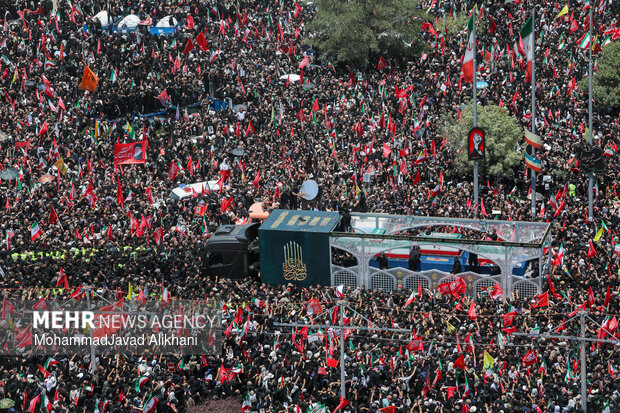
According to the International Desk of Webangah News Agency, the funeral ceremonies for the martyred leader of the Islamic Revolution in Tehran saw global public attention once again turn to Iran. What unfolded on the streets of Tehran was more than just a mourning ritual; it transformed into one of the most pivotal political and media events in international history. From the early hours of dawn, dozens of reputable global television networks, news agencies, and newspapers provided live, moment-by-moment coverage of the ceremony, closely following the developments in Tehran. This coverage progressively moved beyond simply describing a funeral procession to analyzing its political, security, and geopolitical implications.
Notably, many media outlets that had previously emphasized scenarios of instability and the weakening of the Islamic Republic post-war were compelled to report a different reality. This reality, characterized by the massive public turnout, the orderly conduct of the ceremony, the continued functioning of governance structures, and the participation of foreign delegations, presented a distinct image of Iran after the war. Consequently, the funeral of the martyred leader became not only a religious and national occasion but also an arena for competing narratives and a redefinition of Iran’s image in global media.
International media, transitioning from reporting a ceremony to acknowledging Iran’s national unity, turned Tehran into a major global news hub with deployed correspondents and live broadcasts from the early hours of the event.
Reuters, in an unusual analysis, stated that the funeral procession surpassed a national farewell, sending a clear message to the United States and the Zionist regime that their efforts to break the Islamic Republic of Iran had failed. The agency emphasized that Iran, post-war, had not weakened but instead demonstrated its resilience, unity, and readiness to play a role in the new regional order.
BBC Arabic, placing the funeral news at the top of its agenda, described the event as “historic” and reported on the multi-kilometer procession through the streets of Tehran.
Agence France-Presse (AFP) also viewed the extensive public participation as a sign of Iran’s resilience following attacks by the United States and the Zionist regime, reporting that the number of attendees could match or even surpass the funeral of the founder of the Islamic Republic.
Associated Press, ABC News, Euronews, and Turkey’s TRT extensively broadcast images of the vast crowds, the emotional atmosphere of the ceremony, and the widespread participation of various segments of society.
On the regional media front, Al Jazeera, Al-Manar, Al-Masirah, Al-Ahed, Shehab Palestine, and Iraqi and Lebanese networks, through live coverage, identified the massive public turnout as the most significant feature of the event.
Russian media, including RIA Novosti and TASS, reported that the streets of Tehran were filled with crowds from dawn, who had come out to bid farewell to the martyred leader.
Even media outlets from the Zionist regime, such as The Times of Israel, The Jerusalem Post, and Haaretz, could not overlook the scale of public participation, reporting on the crowded streets of Tehran.
The failure of the instability narrative, and the messages received by foreign media, showed a common thread across most published reports: a focus on a fundamental point – the continuation of Iran’s internal cohesion. In recent months, some Western analyses were based on the assumption that the removal of the Revolution’s leader could lead to political instability and fissures within the power structure. However, the images emerging from Tehran presented a different narrative to the global public.
Reuters’ report on “Iran’s resilience and unity,” AFP’s description of the “resilience of the Islamic Republic,” BBC Arabic’s portrayal of a “historic” ceremony, and even the admission by Israeli media of the extensive public presence all indicated that the narrative of weakening had collapsed. This perception was not limited to the media. Glenn Greenwald, an American journalist and Pulitzer Prize winner, posted images of the ceremony, writing that imagining such a crowd attending a leader’s funeral in the United States would be nearly impossible.
Furthermore, Max Blumenthal, an American author and journalist, described the funeral as one of the most enduring moments of anti-imperialist movements, stating that if the aim of assassinating the Revolution’s leader was to change Iran’s political system, the images from Tehran today show that this strategy has had the opposite effect.
These statements, alongside reports from Western media, suggest that the cognitive warfare against Iran is facing challenges from ground realities. The funeral of the martyred leader was an event transcending a national ritual. What distinguished the global media’s reflection from typical news coverage was their attention to the strategic implications of this ceremony. A significant portion of international media, in parallel with covering the event, addressed topics such as future Iran-U.S. negotiations, the security of the Strait of Hormuz, the balance of power in West Asia, the presence of foreign delegations, and the future of regional developments. This indicates that they did not view the ceremony as merely an internal affair.
In essence, the funeral of the martyred leader became a platform for evaluating the future of the Islamic Republic. It was a test whose outcome, according to many media outlets, was observed in the continuation of the political order, broad public participation, and the maintenance of social cohesion. Concurrently, the presence of numerous foreign delegations, the live coverage by dozens of international media outlets, and the multi-day continuation of the ceremonies in Iran and Iraq reinforced the message that this event had transcended Iran’s borders, becoming a regional and even international occurrence.
Conclusion: A review of reports from Western, Arab, Russian, and Asian media shows that despite differing approaches, nearly all emphasized several common components: the widespread public attendance, the order and security of the ceremony, the continuity of the Islamic Republic’s political structure, and the geopolitical significance of the event. These components, taken together, present a different image of Iran post-war, one that markedly diverges from narratives of collapse or weakening of the Islamic Republic in recent months. From a strategic communications perspective, the funeral of the martyred leader can be considered one of the most successful media events in recent years. Without the need for promotional messages, the presence of the people and the extensive global media coverage conveyed a message of stability, cohesion, and continuity to foreign audiences. Therefore, the importance of this ceremony is not limited to its religious or historical dimensions; it must be viewed as part of the narrative war in the international system, where the image of millions in the streets of Tehran challenged many previous calculations and narratives about Iran’s future, demonstrating that in power equations, social capital and national cohesion remain among the most crucial deterrent and authority components of the Islamic Republic of Iran.