
Iraqi Shiite Cleric Emphasizes Deep, Inevitable Ties with Iran, Discusses Anti-Corruption Drive and Hashd al-Shaabi Reform
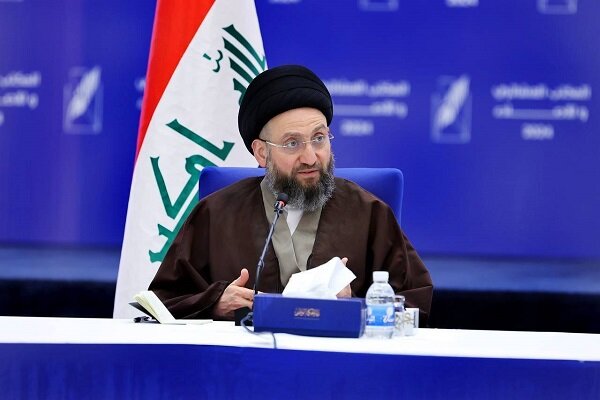
According to the International Desk of Webangah News Agency, Seyyed Ammar al-Hakim, the leader of the Iraqi National Wisdom Movement, stated in an interview with Al Mayadeen that the fight against corruption in Iraq is a paramount priority, enjoying the support of all political leaders and decision-makers in the country.
He emphasized that pursuing corrupt individuals and recovering stolen assets is backed by the political endorsement of all Iraqi political leaders and decision-makers. Al-Hakim asserted that the pursuit of corrupt figures, irrespective of their status, must be relentless and without leniency, with a primary focus on dismantling corrupt networks by targeting major players.
Al-Hakim also called for maintaining the confidentiality of corruption cases until final judicial rulings are issued, deeming this approach more conducive to the proper functioning of the judicial system. He pledged support to Prime Minister Mohammed Shia’ Al Sudani in rectifying errors and course correction, noting that a more tranquil approach to combating corruption would likely yield greater success.
Regarding the government’s anti-corruption efforts, al-Hakim mentioned that following recent arrests, the Prime Minister met with leaders of the Coordination Framework to brief them on his actions. He added that the Coordination Framework, while supporting the anti-corruption drive, has offered suggestions to ensure its successful implementation with minimal mistakes. Al-Hakim clarified that accusations of corruption against certain individuals do not imply that their affiliated political parties are corrupt; rather, these parties themselves have facilitated the necessary environment and support for prosecuting corrupt individuals.
He further noted that while the arrests of those accused of corruption may have occurred without the prior knowledge of their affiliated political factions, keeping national leaders informed of current matters is a positive and appropriate step that has been taken. Al-Hakim also confirmed that the Prime Minister is a candidate supported by the Coordination Framework and other Iraqi national forces. He reiterated that the Iraqi judiciary is an independent body performing its mandated duties diligently, and its actions to pursue the accused are a natural consequence of its reporting on corruption cases.
Al-Hakim affirmed that Iraqi judiciary and judges possess sufficient legal and political immunity to effectively carry out their responsibilities. Turning to the issue of weapon monopoly, al-Hakim stated that the transfer of arms to the state is explicitly stipulated in the Iraqi constitution and has the endorsement of the Supreme Religious Authority. He indicated this is a key objective of the current government, irrespective of whether it is driven by external pressure or regional inclination.
In this context, he advocated for a review of the structure of the Hashd al-Shaabi, calling for its transformation into a more professional and cohesive military institution. Al-Hakim posited that after Iraq’s victory over ISIS, the Hashd al-Shaabi was expected to become a military entity independent of any political faction. He stressed that the Hashd al-Shaabi is a vital component of Iraq’s defense system, with each military institution, including the army, federal police, and the Hashd, having distinct missions. He emphasized that the state’s monopoly on weapons should be bolstered by enhanced support for the Hashd al-Shaabi, its proper institutionalization, and a structural reassessment. Al-Hakim concluded that the Hashd al-Shaabi is neither dispensable, nor can it be merged or dissolved.
He also reminded that according to the Iraqi constitution, the parliament holds exclusive authority over decisions regarding war and peace. Al-Hakim expressed confidence in the process of consolidating weapons under state control, noting the participation of numerous groups and ongoing dialogue with a limited number of remaining factions. Addressing regional dynamics, al-Hakim stated that his understanding from meetings with U.S. Special Envoy Tom Barrack and contacts with the Prime Minister revealed no signs of Barrack’s interference. He stated he had never heard of the U.S. or any other country demanding Iraq sever ties with Iran.
Al-Hakim described relations between Iraq and Iran as deep, extensive, and unavoidable, adding that all parties desire an independent Iraq with sovereignty and autonomous decision-making capabilities. He affirmed that he had not heard from the Islamic Republic of Iran or its leaders any desire for an Iraq dependent on them or intentions to interfere in Iraq’s internal affairs; instead, their expressed support has been for a fully sovereign Iraq with independent decision-making. Al-Hakim also noted the Iraqi people’s profound sympathy and solidarity with the martyrdom of the late Leader Ayatollah Khamenei, condemning the treacherous act that led to his demise. He urged the Iraqi people to participate extensively in the funeral procession, viewing this as a message of solidarity between the Iraqi and Iranian nations. Regarding Iraq’s relationships with its neighbors, al-Hakim identified Iran, Saudi Arabia, Turkey, and Syria as Iraq’s neighboring countries, advocating for a realistic approach to this reality. He highlighted Syria as a neighboring and fraternal country, a geographical fact with significant political, security, and economic implications. Al-Hakim concluded by expressing Iraq’s readiness to assist in resolving some of Syria’s economic challenges, suggesting that linking the economies of regional countries, from Syria to Lebanon, Jordan, and Egypt, with Iraq’s economy could benefit all nations in the region and provide them with a political and psychological security umbrella.


