Ayatollah Khamenei’s Enduring Legacy in Defense and Security
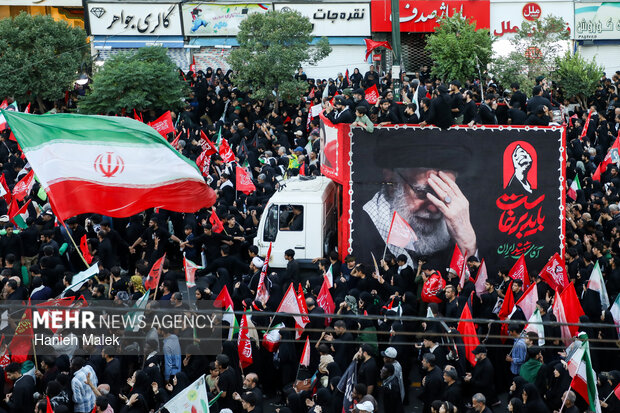
According to the International Desk of Webangah News Agency, the legacy of the martyred leader, Ayatollah Khamenei, in the defense and security sector is characterized by a comprehensive approach to building a cohesive national power structure. This vision integrated the battlefield, decision-making processes, defense organizations, scientific progress, social cohesion, and cultural identity as interconnected elements, rather than disparate components.
In this framework, national security was not merely a result of arms accumulation or political agreements. Instead, it was shaped by a synergy of popular will, effective organization, deterrence capabilities, technological self-sufficiency, and constant preparedness against both hard and soft threats. During critical junctures, this approach manifested in overcoming managerial bottlenecks, fostering coordination between official and popular forces, reinforcing asymmetric warfare tactics, and safeguarding strategic regions. On a regional scale, it led to linking the nation’s security with its surrounding environment and expanding transnational deterrence capacities.
Furthermore, this model extended into the cultural and social spheres, emphasizing that the erosion of identity, social despair, discrimination, and diminished public trust could pose dangers as significant as military threats. From this perspective, scientific progress and strategic technologies were not seen as unattainable goals but as integral components of maintaining independence and authority.
While discussions of Ayatollah Khamenei’s security legacy often focus on nuclear and missile capabilities or the axis of resistance, a broader perspective reveals a leadership model that anchored decision-making in resistance, progress as a tool for independence, and the populace as the cornerstone of national power’s longevity.
The Sacred Defense as a Mirror of National Defense Strategy
During the eight-year war, the martyred leader adopted a specific strategy for war management. In critical moments when political and bureaucratic deadlocks hindered vital operations, his direct and decisive intervention fostered synergy between the conventional army forces and the nascent popular and Revolutionary Guard forces. This networked coordination, alongside the establishment of the Headquarters for Irregular Warfare, indicated a shift towards asymmetric warfare to counter the enemy’s equipment superiority. Moreover, the management of logistics and the equitable and targeted distribution of strategic anti-armor weapons among various units demonstrated his precise understanding of support and logistics’ importance in sustaining defensive lines, which ultimately prevented the fall of crucial geopolitical areas such as Susa and Abadan.
Beyond tactical battlefield management, his security approach possessed a regional and transnational vision. Support and organization of resistance groups during that period marked the early signs of the “strategic depth” doctrine, linking national security to areas beyond geographical borders. Concurrently, in internal security and maintaining territorial integrity during the war’s final days, his charismatic influence and field presence served as a deterrent and mobilization tool. In situations where fronts faced troop shortages and surprise attacks, this direct involvement led to the rapid reinforcement of defensive lines by tens of thousands of volunteers, repelling multifaceted threats, and stabilizing borders, all while strategic discipline and adherence to overarching system frameworks, such as the resolution, were meticulously observed.
Maintaining National Independence in a Unipolar Era
Ayatollah Khamenei’s most significant strategic achievement for Iran was the establishment and consolidation of an independent national security strategy in the post-Cold War era. This policy was based on the understanding that the dominance of major powers in the Middle East was designed not for the security of nations but for exploitation, containment, and, if necessary, the division of independent states. Drawing on Iran’s historical experiences of occupation and famine, he insisted on the necessity of central authority, indigenous defense capabilities, popular support, and maintaining a network of regional allies, refusing to place Iran under a Western security umbrella. This approach, contrary to the views of some managers and elites who considered reducing power instruments a prerequisite for welfare and security, emphasized that welfare without independence and security without defense power are neither sustainable nor reliable.
Soft Power as a National Capability
In the latter half of the hard war, Ayatollah Khamenei’s strategies in the soft war domain were based on a smart defensive-offensive logic. This logic did not confine threat response to mere reactive measures but emphasized proactive action, initiative, and anticipating enemy formations. Soft war was conceptualized as a comprehensive and complex arena where religious identity, cultural capital, social hope, and national self-confidence were considered primary elements of power. From this perspective, neutralizing soft pressures required more than just security tools; it necessitated strategic discourse building, strengthening religious democracy, indigenizing strategic capabilities, and diversifying methods of confrontation. This strategy also posited that enemies sought to weaken internal cohesion through cultural erosion, obscuring insight, exploiting economic and social disparities, and influencing lifestyles. Therefore, an effective response entailed cultural organization, enhancing human capacity, reinforcing idealistic motivations, inspiring identity, and social mobilization.
Generally, Ayatollah Khamenei’s soft war strategy combined foresight, internal resilience, consolidation of revolutionary-Islamic identity, and activation of popular capacities. This aimed not only to make society more resilient against soft threats but also to shift the cultural and political balance in its favor. The outcome of this path has been the establishment of a leadership model whose efficacy is demonstrated in practice and during critical historical moments. This model showed that resistance, when combined with prudence, organization, situational awareness, and reliance on internal capacities, can both safeguard the country from external pressure and steer it towards progress.
The most prominent aspect of this record is its success in establishing a lasting connection between seemingly disparate elements: defense power and popular legitimacy, regional deterrence and internal security, faith and technology, and cultural identity and political strength. Ayatollah Khamenei’s positive performance was not limited to defending the country against threats but also extended to transforming Iran into a resilient actor with independent will and indigenous scientific and security capabilities. This approach enabled resistance to move from a passive stance to an active logic for building the future, a logic where neither submission to pressure nor reliance on external powers held meaning.
To summarize this legacy, he demonstrated that it is possible to stand firm, build, advance, and remain independent. This nexus between resistance and effectiveness has made the name and actions of the martyred leader prominent and enduring in the political and strategic memory of the Islamic Republic.