
Thailand Eyes BRICS Membership, Sees Bloc as Key to Free Trade and Investment
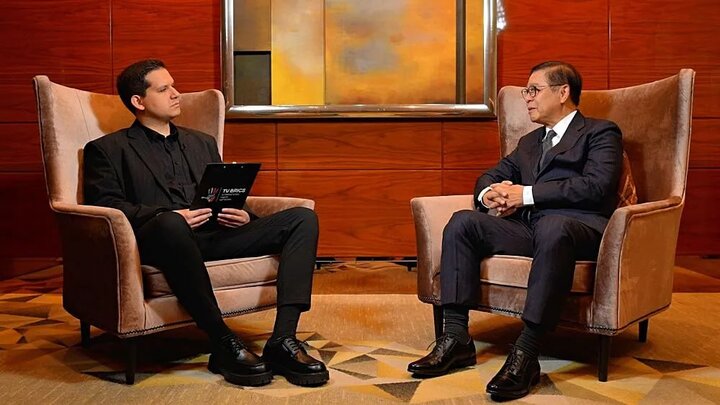
According to the International Desk of Webangah News Agency, Thailand‘s Deputy Prime Minister and Minister of Foreign Affairs, Sihasak Phuangketkeaw, highlighted the growing importance of BRICS for Bangkok in an exclusive interview with TV BRICS. The discussion covered potential cooperation with the bloc, ASEAN’s economic convergence, trade and investment dynamics, regional connectivity, and the trilateral India-Myanmar-Thailand highway project.
Thailand joined BRICS as a partner country in 2025 and anticipates full membership in 2026. Phuangketkeaw underscored that BRICS provides a platform for forging new relationships and strengthening ties with member and partner nations across various sectors, including science and technology. He also noted that BRICS effectively represents the voice of the Global South, a crucial platform for these nations to assert their perspectives amid current global shifts and the formation of a new world order.
Addressing the significance of maintaining a rules-based international order, the Thai Foreign Minister stated its vital importance for many developing nations. However, he stressed the necessity for this order to adapt to the significant changes in the international system since the post-World War II era. Phuangketkeaw observed that while the international order was heavily influenced by Western nations after World War II, the landscape has transformed with the rise of the Global South and the emergence of a multipolar world as a new reality.
Despite not yet being a full member, Thailand actively participates in numerous BRICS activities and cooperation areas, Phuangketkeaw confirmed. This engagement offers opportunities for interaction with new partners and the development of collaborations in fields such as trade, investment, and people-to-people connectivity. He also announced that the Thai Prime Minister will attend the BRICS summit in New Delhi on September 12-13, expressing hope for meetings with other participating leaders.
Regarding Thailand’s role in ASEAN, Phuangketkeaw discussed the country’s upcoming chairmanship of the organization in 2028. He reiterated ASEAN’s consistent role as a pillar of peace and stability in Southeast Asia and the broader Asia-Pacific region. The current priority for ASEAN nations, he explained, is to enhance economic cooperation and convergence, which can unlock greater trade and investment opportunities for regional partners. Phuangketkeaw described ASEAN as the world’s second most successful regional organization, noting its rapid economic growth and substantial potential for economic expansion through deeper integration. He also emphasized the fundamental importance of preserving ASEAN’s centrality and ensuring regional peace and stability through ASEAN-led structures, citing the ASEAN Regional Forum, the ASEAN Defence Ministers’ Meeting Plus, and the East Asia Summit as key platforms for dialogue on security, defense cooperation, and strategic issues.
On BRICS’ role in attracting foreign investment and boosting economic growth for Thailand and the region, Phuangketkeaw highlighted the bloc’s collective strength, comprising 11 members and 10 partner countries, forming a 21-nation group with significant potential for trade and investment growth. “I am confident that BRICS can play a very important role in maintaining the free flow of trade and investment,” he stated. He sees BRICS as a venue for countries to interact and explore economic opportunities, emphasizing the critical role of the private sector as the primary driving force, even with the government’s significant influence in trade, investment, and economic ventures.
Finally, Phuangketkeaw touched upon the trilateral India-Myanmar-Thailand highway project, recognizing transportation and infrastructure links as central to trade, investment, and economic development. The project, under discussion for nearly two decades, has faced delays due to Myanmar’s internal conditions. Phuangketkeaw expressed hope for an improvement in Myanmar’s situation, including progress in peace talks, to expedite the highway’s completion. He anticipates the completed highway will significantly boost trade, investment, and people-to-people connectivity, linking Southeast Asia with South Asia, particularly India. As India emerges as a major economic power in the region, the highway is expected to enhance trade not only between Thailand, Myanmar, and India but also foster broader economic ties across Southeast Asia, India, and South Asia.


