Iraqi Leader Emphasizes State Monopoly on Weapons, Calls for National Dialogue
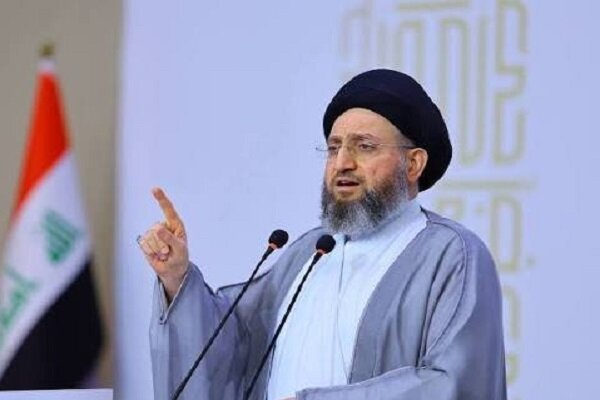
According to the International Desk of Webangah News Agency, Sidi Ammar al-Hakim, the leader of Iraq‘s National Wisdom Movement, declared that the state’s monopoly on weapons is not directed against any faction or group, nor does it diminish the sacrifices of those who defended Iraq. Instead, he described it as an essential requirement for solidifying the government’s structure and asserting its sovereignty.
Speaking at a central ceremony celebrating the birth anniversary of Prophet Muhammad (peace be upon him), organized by the Sunni Endowment Directorate, al-Hakim stated that the call for state control over weapons is not a political slogan against anyone, nor an attempt to disregard the valor of martyrs whose blood protected Iraq. He characterized it as a natural necessity for completing the edifice of governance and its authority.
The leader of the National Wisdom Movement further commented that armed groups are brothers and integral to Iraq’s victory over terrorism. He asserted that no one should engage with them through accusations or by overlooking their contributions. “We do not want the government to triumph over its children, nor do we want the nation’s children to triumph over the government. Rather, we want everyone to triumph through the government and in its path,” he added.
Al-Hakim called for the formation of a national Iraqi process based on dialogue, understanding, and gradual steps to honor the dignity of fighters and the sacrifices of martyrs. He underscored the importance of preserving the Popular Mobilization Forces (PMF) as an official institution established by law.
He emphasized that the issue of weapons monopoly, in terms of decision-making, discussion, timelines, mechanisms, and outcomes, is entirely an Iraqi matter. He cautioned against managing it with accusatory language, labeling it as treason, employing a win-lose mentality, or making hasty decisions, as such approaches could lead to internal confrontations with devastating consequences for Iraq and its people.
The head of the National Wisdom Movement elaborated that the monopoly on weapons should be a step towards completing the government’s structure, not a catalyst for new conflicts. He advocated for dialogue as a means to preserve social peace and honor sacrifices, serving as a bridge for all Iraqis to move towards a strong, secure, and unified nation.
Al-Hakim also affirmed that decisions regarding war and peace, the deployment of organized force, and the safeguarding of citizens’ security must exclusively reside with the government’s legitimate institutions, as a government that protects everyone bears the responsibility for the security of all.
He explained that Iraq’s internal fortification begins with a powerful government, efficient institutions, a unified security and sovereign decision, and an economy capable of generating opportunities and diversifying revenue streams. He identified combating corruption, preventing resource wastage, responsible support for social peace and tranquility, and adopting responsible political discourse as other prerequisites for national fortification. Such discourse, he noted, should help mitigate crises rather than become a source of them.
Al-Hakim stated that Iraq’s security and economic and political stability are not the responsibility of a single party but a shared national duty involving the government, political forces, institutions, society, and citizens alike.
He expressed his support for Prime Minister Ali al-Zaidi’s administration and its endeavors in economic and financial reform, anti-corruption efforts, and service provision. “The success of the government is the success of Iraq,” he remarked, adding that genuine support must be accompanied by oversight, accountability, and tangible achievements that citizens can experience in their daily lives.
Turning to the regional situation, al-Hakim observed that the region is currently in a highly sensitive and complex phase, where security and political challenges are intertwined with economic pressures, and developments are unfolding at an accelerating pace. This, he stated, demands greater responsibility and prudence from all.
He added that Iraq cannot isolate itself from surrounding developments but can protect itself from their repercussions. In the current volatile regional climate, al-Hakim stressed the increased need for an Iraq that is not a theater for conflicts but a stable country, a capable government, and a bridge for dialogue, understanding, and the protection of common interests.
Concluding his remarks, al-Hakim affirmed that Iraq will neither be a launching pad for aggression against its neighbors nor will it tolerate being a target of aggression by any party. He also rejected any dictation or pressure that undermines Iraq’s sovereignty or national decision-making, asserting that Iraq’s sovereignty and the unity of its national decision are non-negotiable under any circumstances or pretexts.