Yemeni Forces Liberate 5,400 Square Kilometers in Western Coast Operations
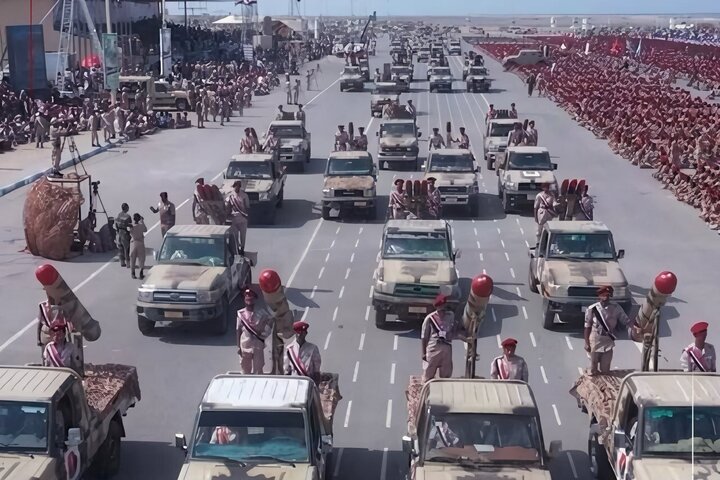
According to the International Desk of Webangah News Agency, Yemeni military commander and analyst Abed Al-Thawr announced that recent military operations by the Yemeni armed forces on the western coast have thwarted a comprehensive attack plan orchestrated by forces loyal to the Saudi enemy. He highlighted that the armed forces achieved a major battlefield success, liberating an area of about 5,400 square kilometers within seven days.
Al-Thawr explained to Al-Masirah that the operation’s outcomes extended beyond the western coast’s battlefield developments, with its effects reaching deep into Saudi Arabia through attacks targeting important Saudi military centers and bases. These bases were reportedly used to support mercenary forces in Marib and eastern regions.
He emphasized that these developments exposed the extent of coordination between Saudi-directed military operations and the movements of mercenaries on the battlefield.
The Yemeni analyst pointed to images released from the western coast operations, stating they demonstrated a high level of organization, tactical planning, and strategic capability by the Yemeni armed forces. He added that the use of ambushes and precise attacks indicated the forces’ ability to manage the battle according to specific military priorities.
The military expert elaborated that at the outset of the operation, the armed forces concentrated on the highlands and main routes connecting Mokha to inland areas. This move effectively separated the coastal regions from their main support centers and prevented any chaos during the advance, thereby providing the attacking forces with a battlefield advantage and enabling them to manage the operation in a phased and orderly manner.
He noted that the precision and scale of the attacks were crucial in determining the battle’s outcome. Concurrently, he pointed to the direct role of the Saudi enemy in attempting to prevent forces from withdrawing, stating that Saudi airstrikes targeted troops and military convoys attempting to flee or retreat in the initial hours after the fall of Mokha, Dhubab, and coastal areas.
The military commander also referenced footage depicting the evacuation and rescue of enemy wounded, stating that the Yemeni armed forces’ efforts to provide aid and transfer the injured to medical facilities demonstrated adherence to humanitarian values in dealing with prisoners and the wounded, even amidst combat.
He added that the heroic members of the armed forces, in collaboration with military medical services, civilian medical services, and the Ministry of Health, directly participated in the rescue and transfer of opposing forces’ wounded, marking a prominent humanitarian aspect of the operation.
Abed Al-Thawr noted that Saudi-aligned mercenaries had believed their substantial deployment of forces and weaponry in Mokha, Dhubab, and the western coastal areas would enable a large-scale offensive towards Hodeidah and the eastern and northern regions. However, battlefield developments unfolded contrary to their expectations, neutralizing this plan.
The military affairs expert concluded by emphasizing that controlling 5,400 square kilometers in seven days is a significant achievement, a territory roughly ten times the size of Bahrain. He also highlighted the capture of strategic positions, including four airstrips in Zagr, Dhubab, Mokha, and Mayyun, stating that the operation’s results have altered the military deployment map on the western coast and deprived the enemy of many support points they relied on for their offensives in other areas.